kids-scooters

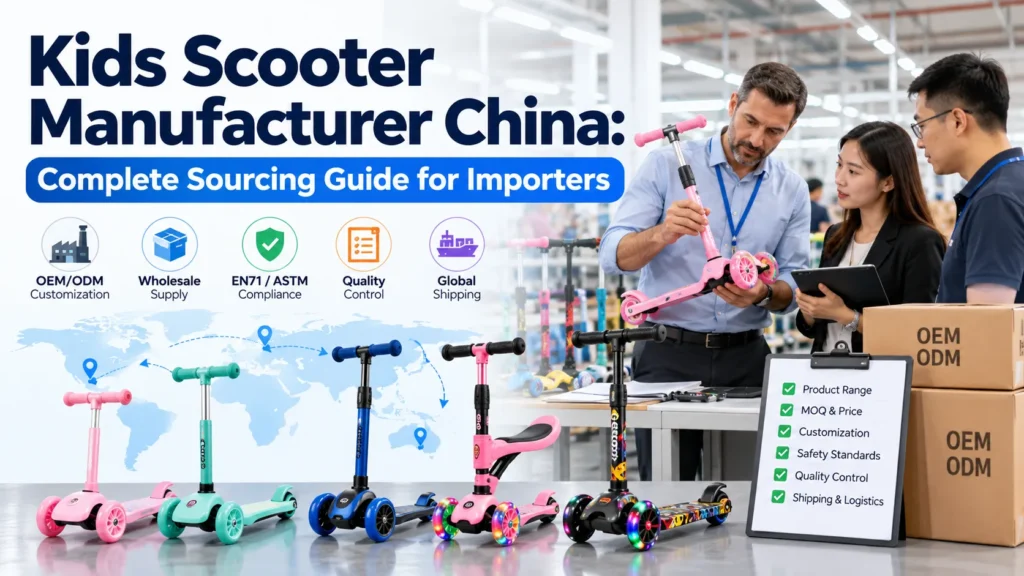
Kids Scooter Quality Control Checklist Before Shipment: A Guide for Importers

A kids scooter quality control checklist is one of the most important tools for importers, distributors and private-label brands purchasing children’s scooters from China. A scooter may look attractive in a product catalog and perform well during sample evaluation, but mass production can introduce problems that are not visible in the original sample. Common issues include loose handlebars, inconsistent wheel rotation, defective brakes, damaged folding mechanisms, incorrect LED functions, mismatched colors, misplaced logos and packaging errors. These problems can create additional costs, shipment delays, customer complaints and potential safety risks. For importers purchasing hundreds or thousands of scooters, identifying defects before shipment is generally more practical than dealing with nonconforming goods after delivery. This guide explains how to organize a professional kids scooter pre-shipment inspection, what components to examine, how AQL sampling works and what buyers should do when defects are discovered. Guangzhou Pingdi Technology Co., Ltd. supports international importers, distributors, wholesalers and private-label brands through children’s mobility product sourcing, OEM/ODM coordination, supplier communication, production follow-up, quality inspection and export support. 1. Why Quality Control Matters When Importing Kids Scooters Children’s scooters contain multiple components that must work together. Depending on the model, these may include: A defect in one component can affect product performance, customer satisfaction or safety. For example, a poorly secured handlebar may create a functional or safety concern even when the scooter’s appearance is acceptable. Similarly, a scooter with incorrect retail packaging may be difficult to distribute despite meeting the approved mechanical specifications. For B2B importers, quality control should address three objectives: Product Conformity Does the finished product match the approved sample and technical specification? Functional Performance Do the relevant components operate according to the agreed requirements? Shipment Readiness Are the quantities, labels, packaging and shipping marks correct? A professional inspection plan should be established before mass production, not created on the day of shipment. 2. What Is a Kids Scooter Pre-Shipment Inspection? A pre-shipment inspection, commonly called PSI, is an inspection of goods near the end of production and before dispatch. Its purpose is to verify that the finished products conform to the buyer’s agreed requirements. Many inspection providers conduct PSI when production is substantially complete and the goods are sufficiently packed for representative sampling. A commonly used operational threshold is at least 80% completion, although the exact inspection timing and packing status should be agreed with the inspection company. QIMA A typical inspection may cover: The inspector compares selected production units against the approved specification, reference sample and inspection checklist. The result is documented in an inspection report. However, PSI is not a guarantee that every unit is defect-free, and routine factory inspection does not replace mandatory laboratory testing. 3. Prepare the Approved Product Specification Before inspection begins, the buyer should provide a complete specification package. This is particularly important for OEM and private-label kids scooter orders. A useful inspection reference package includes: Without an agreed reference, inspectors may have difficulty determining whether a difference is acceptable. For example, a slightly different handlebar color may be a cosmetic defect, a contractual deviation or an approved variation. The answer depends on the buyer’s agreed specification. At PINGDI, specification coordination is an important part of managing OEM and wholesale sourcing projects. 4. Kids Scooter Frame and Structural Inspection The frame and deck form the main structure of a scooter. During inspection, relevant checks may include: Frame Assembly Verify that the product is assembled according to the approved specification. Visible Damage Check for cracks, deformation, damage and other visible defects. Fasteners Inspect accessible screws, bolts and fastening points. Surface Finishing Check for scratches, coating defects, uneven finishing and visible manufacturing problems. Deck Condition Examine the deck for damage, deformation and workmanship inconsistencies. Product Dimensions Compare relevant dimensions with the approved specification. Component Alignment Check that assembled components are correctly positioned. Where structural strength or durability testing is required, it should follow the applicable test method and approved acceptance criteria. A visual inspection alone cannot establish structural compliance. 5. Handlebar and Steering System Inspection The handlebar and steering system are important functional areas. Inspection should be adapted to the selected scooter design. Handlebar Installation Check whether the handlebar is installed correctly and securely. Height Adjustment For adjustable models, verify the available adjustment positions and operation. Locking Mechanism Check that the adjustment lock operates according to the approved design. Steering Movement Evaluate steering movement and look for abnormal resistance, looseness or interference. Handle Grips Inspect grip installation, appearance and security. Alignment Verify that the handlebar and steering components are correctly aligned. For scooters using lean-to-steer mechanisms, the inspection procedure should reflect that specific steering design. A scooter with conventional handlebar steering should not be inspected using an inappropriate lean-to-steer checklist. 6. Kids Scooter Wheel and Bearing Inspection Wheel quality can affect the riding experience and product durability. Common inspection points include: Wheel Installation Verify that the wheels are installed correctly. Wheel Rotation Check for abnormal resistance, rubbing or inconsistent movement. Wheel Appearance Inspect visible defects, damage and material inconsistencies. Axles and Fasteners Check accessible wheel attachment points. Wheel Specifications Compare the wheel configuration and dimensions against the approved specification. Bearing Performance Where applicable, evaluate rotation and abnormal noise according to the inspection plan. LED Wheel Function For scooters with illuminated wheels, check whether the agreed lighting function operates correctly. Wheel materials, sizes and bearing specifications should be confirmed from the product specification rather than inferred from photographs. 7. Kids Scooter Brake Inspection Brake performance is an important inspection area for scooters equipped with braking systems. Many children’s kick scooters use a rear foot brake. Some models may incorporate different braking mechanisms. A practical brake inspection can include: The inspection method should reflect the actual brake design. Where a relevant safety standard requires a defined braking performance test, the applicable procedure and acceptance criteria should be used. An inspector pressing the rear brake by hand is not equivalent to completing a formal laboratory braking test. 8. Folding Mechanism and Adjustable Component Inspection Foldable kids scooters contain additional mechanical components.

Kids Scooter Quality Control Checklist Before Shipment: A Guide for Importers Read More »
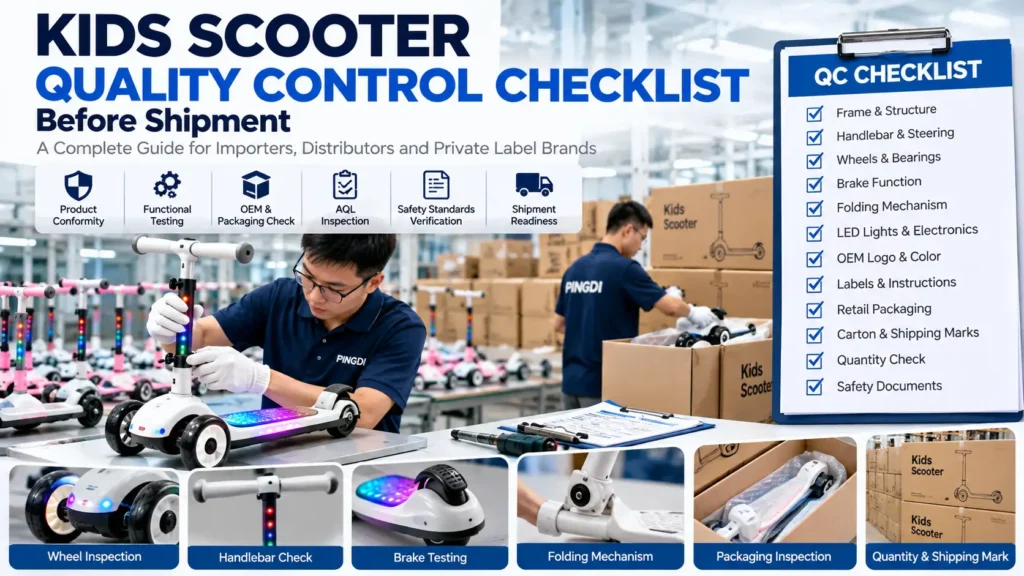
How to Import Kids Scooters from China: A Complete Guide for Importers (2026)

Importing kids scooters from China can be a practical way for distributors, wholesalers and private-label brands to expand their children’s mobility product ranges. However, a successful import project involves much more than finding a supplier and comparing FOB prices. Buyers need to select suitable scooter models, verify manufacturing capabilities, understand minimum order quantities, confirm safety requirements, approve samples, manage production quality and arrange international shipping. A low factory quotation does not necessarily mean a lower total import cost. Incorrect product specifications, inconsistent quality, unsuitable packaging or incomplete compliance documentation can create unexpected expenses. For companies planning to import kids scooters from China, a structured sourcing process helps reduce these risks. This guide explains the complete import process, from supplier selection and OEM customization to quality inspection, freight arrangements and customs clearance. Guangzhou Pingdi Technology Co., Ltd. supports international importers, distributors, wholesalers and private-label brands through product sourcing, OEM/ODM project coordination, supplier communication, quality inspection and export support. 1. Understand the Kids Scooter Market Before Importing The first step is to determine which scooter categories fit your target customers. Children’s scooters are available in different designs, sizes, configurations and price segments. 3 Wheel Kids Scooters Three-wheel scooters are commonly selected for younger children’s product ranges. Depending on the model, features may include adjustable handlebars, wide decks, light-up wheels and different steering mechanisms. For importers developing a toddler mobility collection, 3 wheel kids scooter wholesale products can be an important category. Kids Scooters with Seats Some models combine a standing scooter platform with a seat. Depending on the design, the seat may be removable, adjustable or integrated into the structure. These models can provide product differentiation compared with basic standing scooters. Multifunction Kids Scooters Multifunction scooters may include parent push handles, seats, guardrails, baskets or convertible configurations. Importers should confirm the exact functional modes before marketing a product as 3-in-1, 4-in-1 or 5-in-1. Foldable 2 Wheel Kids Scooters Two-wheel kick scooters may be suitable for older children, depending on the product’s intended age range and specifications. Buyers should compare folding mechanisms, wheel structures, handlebar adjustment systems and braking configurations. Scooter Luggage Scooter suitcases combine children’s luggage with a scooter structure. This category can be relevant to distributors selling children’s travel accessories and mobility products. Before requesting quotations, buyers should identify their preferred product categories, target retail prices and destination-market requirements. 2. How to Find a Kids Scooter Supplier in China Finding a supplier is relatively easy. Identifying a reliable sourcing partner requires more evaluation. Common supplier discovery channels include: Useful search phrases include: Kids scooter manufacturer China Kids scooter supplier China Wholesale kids scooters from China OEM kids scooter manufacturer Private label kids scooter supplier However, buyers should not assume that every company describing itself as a manufacturer owns its production facilities. Some suppliers operate their own factories, while others are trading companies or supply-chain management businesses. Both models can support international purchasing when responsibilities and capabilities are transparent. Manufacturer vs Trading Company A direct manufacturer may provide closer access to its production facilities and technical team. A professional trading or sourcing company may help buyers compare multiple manufacturing resources, coordinate different product categories and consolidate shipments. The best option depends on the buyer’s requirements. For example, a distributor sourcing three different scooter structures may need production resources with different specializations. PINGDI operates as a China-based sourcing and OEM/ODM project management partner, coordinating suitable manufacturing resources according to product specifications, quantity and customization requirements. 3. Verify Your Kids Scooter Supplier Before placing a bulk order, importers should complete a supplier verification process. Important checks include: Business Registration Confirm the supplier’s legal company name and business registration information. Manufacturing Relationship Ask whether the supplier owns the factory or works with production partners. Product Experience Evaluate whether the supplier has experience with the required scooter category. Technical Specifications Request detailed specifications rather than relying only on product photographs. Quality Management Ask how production quality and product consistency are controlled. Testing Documentation Review available reports and determine whether they apply to the exact product configuration. Production Capacity For larger projects, confirm whether the selected production resources can meet the required order quantity and delivery schedule. Export Experience Evaluate the supplier’s ability to coordinate packaging, documentation and international shipping. A reliable sourcing partner should explain its business model and provide appropriate evidence rather than making unsupported manufacturing claims. 4. Request Accurate Kids Scooter Wholesale Quotations When importing kids scooters, a quotation should include more than a unit price. Importers should provide a complete RFQ, or Request for Quotation. A professional RFQ should include: Buyers should request confirmation of: For OEM projects, tooling or development charges should be identified separately where applicable. This makes it easier to compare quotations from different suppliers. 5. What Is the MOQ for Wholesale Kids Scooters? MOQ means Minimum Order Quantity. There is no universal MOQ for kids scooters imported from China. Minimum quantities vary according to the product, supplier and customization requirements. Standard Models Existing models using standard colors and packaging may offer more flexible order quantities. Custom Logo Orders Logo printing or labeling can introduce additional setup requirements. Custom Colors Special colors may require separate material preparation or production batches. Private Label Packaging Printed retail boxes, manuals and labels may have their own minimum quantities. ODM Development New tooling or structural development usually requires a separate commercial assessment. For new importers, beginning with an established scooter platform may reduce development complexity. PINGDI can help buyers evaluate different sourcing options based on expected order quantity, product requirements and customization needs. 6. Understand Kids Scooter Wholesale Prices The factory cost of a kids scooter depends on several factors. Product Structure Basic three-wheel scooters, foldable two-wheel scooters and multifunction scooters have different component requirements. Materials Frame construction, plastic components, wheels, grips and other materials influence cost. Functions LED wheels, folding mechanisms, adjustable handlebars, seats and other features may affect the final quotation. OEM Customization Custom colors, logos, packaging and new tooling can increase development or production costs. Order Quantity Larger production volumes

How to Import Kids Scooters from China: A Complete Guide for Importers (2026) Read More »

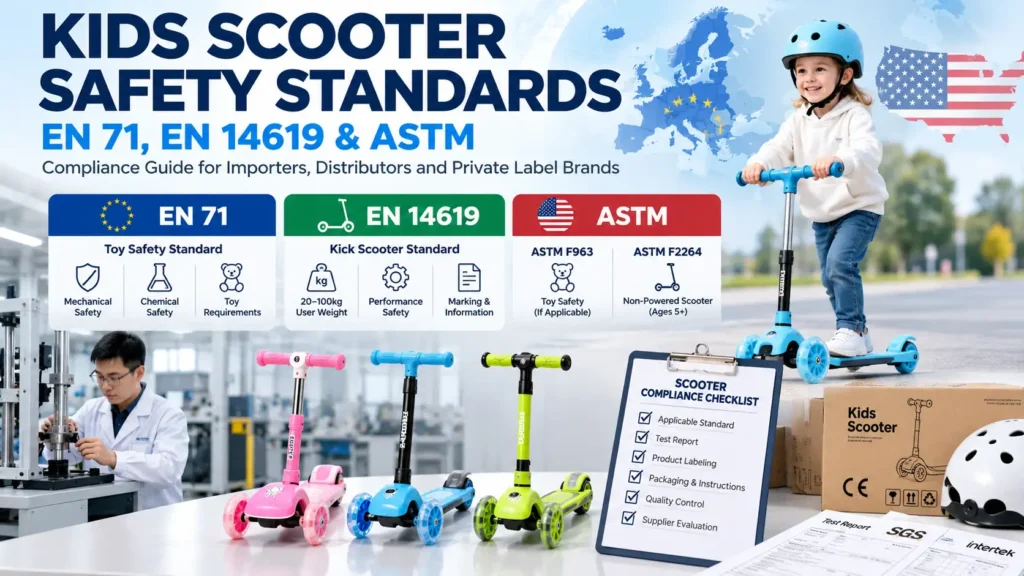
Kids Scooter Safety Standards: EN 71, EN 14619 & ASTM

For importers and private-label brands, understanding kids scooter safety standards is essential before selecting a manufacturer, approving samples or placing a bulk order. One of the most common sourcing mistakes is assuming that every children’s scooter must comply with the same safety standards. In reality, the applicable requirements depend on the scooter’s intended use, product design, age grading, user weight, destination market and regulatory classification. A three-wheel toddler scooter intended as a toy may be evaluated differently from a larger two-wheel kick scooter designed as sporting equipment. For buyers importing kids scooters from China, the main standards frequently discussed include EN 71, EN 14619, ASTM F963 and ASTM F2264. However, these standards are not interchangeable. This guide explains the differences, what importers should verify and how to reduce compliance risks when sourcing OEM and wholesale kids scooters. Guangzhou Pingdi Technology Co., Ltd. supports international importers, distributors and private-label brands through children’s mobility product sourcing, OEM/ODM coordination, supplier communication, quality inspection and export support. 1. Why Kids Scooter Safety Standards Matter for Importers Children’s scooters contain multiple structural and moving components. Depending on the model, these may include: Each component can introduce potential mechanical, stability, durability or misuse-related hazards. For importers, product safety affects more than consumer protection. It can influence customs documentation, product liability, retailer acceptance, insurance requirements, marketplace listings and potential recalls. A product that passes a supplier’s internal inspection is not necessarily compliant with the applicable destination-market requirements. Likewise, a certificate from another scooter model does not automatically demonstrate compliance for a new design. Professional buyers should establish the applicable regulatory requirements before approving mass production. 2. EN 71: Safety Requirements for Toy Scooters in Europe EN 71 is a series of European toy safety standards. For children’s scooters classified as toys, EN 71-1 is particularly relevant because it addresses mechanical and physical properties. Depending on the product and applicable requirements, the assessment may involve: Other parts of the EN 71 series may also be relevant, depending on the product’s materials and characteristics. For example, chemical-related requirements must be assessed according to the applicable legislation and standards. Importers should not assume that an EN 71-1 test report alone establishes complete EU compliance. Are All Kids Scooters Considered Toys? No. A scooter’s classification depends on its intended use, design, marketing and other relevant characteristics. A scooter intended for young children as a plaything may fall within toy legislation. A larger kick scooter intended as sports equipment may require a different regulatory assessment. Importers should document the intended use and classification before selecting the testing program. What About CE Marking? For a scooter classified as a toy and covered by applicable EU toy legislation, CE marking forms part of the conformity process. However, CE marking is not a universal quality certificate. It represents the manufacturer’s declaration that the product complies with applicable EU requirements. Importers should verify the supporting conformity assessment, technical documentation, declaration of conformity and required labeling. A supplier simply stating “CE approved” is not sufficient evidence. 3. EN 14619: Safety Standard for Kick Scooters EN 14619:2019 addresses safety requirements and test methods for certain non-powered kick scooters. Its scope includes scooters propelled by muscular activity and intended for users with a body mass greater than 20kg and less than 100kg. The standard distinguishes between relevant categories of scooters. Importantly, scooters intended for users below 20kg are outside its scope and are treated as toys within the standard’s classification framework. For the 20–50kg range, a distinction must also be made between sports-equipment scooters and toy scooters. This distinction is important for buyers sourcing products for older children. What Does EN 14619 Cover? The standard addresses safety requirements, testing, marking and information supplied by the manufacturer. Depending on the applicable product configuration, assessment areas can include structural performance, steering, braking, mechanical integrity and product information. The exact tests should be determined using the relevant standard and approved product specification. EN 71 vs EN 14619 The main difference is product classification and intended use. EN 71-1 is relevant to products classified as toys. EN 14619 addresses the defined category of kick scooters used as sports equipment. The presence of two wheels or three wheels alone does not establish which standard applies. Importers must evaluate the complete product. 4. ASTM F963: US Toy Safety Requirements ASTM F963 is a comprehensive toy safety standard incorporated into mandatory US toy safety requirements through 16 CFR Part 1250. The current incorporated version is ASTM F963-23. For products classified as children’s toys within its scope, applicable requirements must be identified and evaluated. These can involve mechanical hazards, material-related requirements, labeling and other relevant safety provisions. However, a critical distinction applies to scooters. The US Consumer Product Safety Commission excludes non-powered scooters as defined in ASTM F2264 from the scope of ASTM F963. Therefore, importers should not automatically request an ASTM F963 report for every non-powered scooter. When Might ASTM F963 Be Relevant? ASTM F963 may be relevant where a product is properly classified as a toy and falls within the standard’s scope. The determination should consider the product’s actual design, intended use and applicable definitions. For multifunction products, such as scooter-and-ride-on combinations, buyers should obtain a product-specific classification assessment rather than relying on the supplier’s marketing name. 5. ASTM F2264: Non-Powered Scooter Safety ASTM F2264 is a consumer safety specification for non-powered scooters. It addresses performance requirements, testing methods and labeling requirements intended to reduce scooter-related hazards. Its stated scope covers scooters intended for children aged five years and older. For importers selling non-powered kick scooters in the United States, ASTM F2264 is an important reference when evaluating product safety. However, buyers should distinguish between: Not every ASTM standard is automatically a mandatory federal regulation. The applicable legal obligations should be confirmed for the specific product. 6. EN 71 vs EN 14619 vs ASTM: Comparison for Importers Standard Market Main application EN 71-1 European Union Mechanical and physical requirements for toys, including applicable toy scooters EN 14619:2019 Europe Defined category of non-powered kick scooters

Kids Scooter Safety Standards: EN 71, EN 14619 & ASTM Read More »

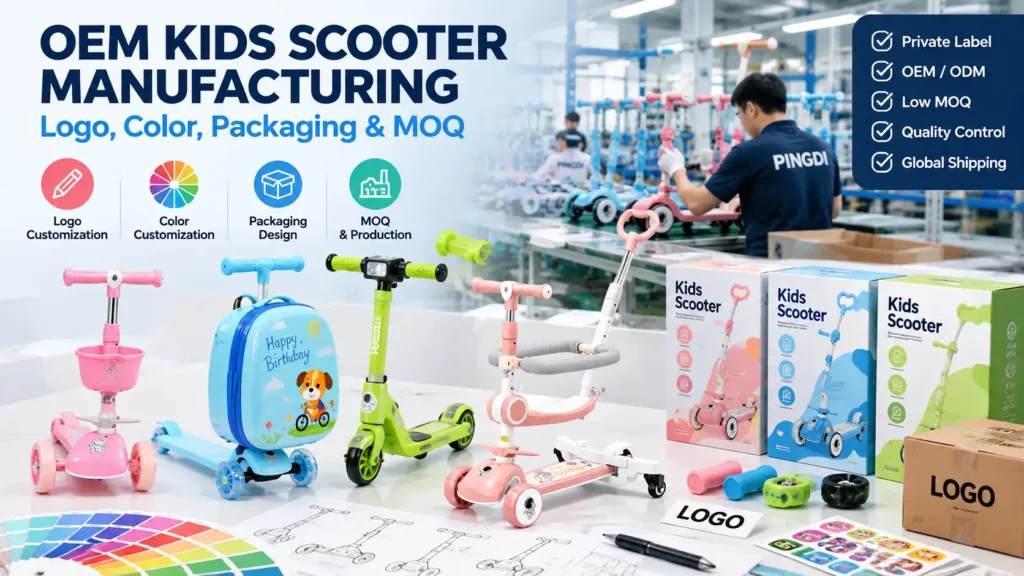
OEM Kids Scooter Manufacturing: Logo, Color, Packaging & MOQ

OEM kids scooter manufacturing is not simply about adding a logo to an existing scooter. For importers, distributors and private-label brands, a successful OEM project requires coordination between product specifications, colors, branding, packaging, minimum order quantities, sampling, quality control and market-specific requirements. A scooter that looks attractive in a supplier catalog may still create problems during mass production if the buyer has not confirmed the technical specifications or customization details. Common issues include inconsistent colors, incorrect logo placement, packaging artwork errors, unexpected MOQ increases, component substitutions and shipment delays. For businesses sourcing OEM kids scooters from China, understanding the complete customization process is essential. This guide explains how professional buyers can develop a private-label kids scooter range, evaluate customization options and reduce sourcing risks. Guangzhou Pingdi Technology Co., Ltd. supports international importers, wholesalers, distributors and children’s mobility brands through product sourcing, OEM/ODM project coordination, supplier management, quality inspection and export support. 1. What Is OEM Kids Scooter Manufacturing? OEM stands for Original Equipment Manufacturer. In the children’s scooter industry, OEM commonly refers to producing or customizing scooters according to a buyer’s agreed product specifications and branding requirements. An OEM project may involve an existing scooter design with customized colors, logos and packaging. More advanced projects may require component modifications, structural changes or new tooling. For importers, there are three practical levels of customization. Level 1: Private Label Customization The buyer selects an existing scooter model and adds brand elements such as: This is often the most practical starting point for a new children’s scooter brand. Level 2: Product Appearance Customization The buyer requests additional changes, including: This approach helps brands create a more distinctive product range without necessarily developing a completely new structure. Level 3: ODM Product Development ODM projects may involve: These projects generally require more engineering coordination, development investment and testing. For first-time importers, beginning with an established product platform can reduce development complexity. 2. Choosing the Right Kids Scooter for OEM Customization Before discussing colors or logos, buyers should select the correct scooter category. Different products serve different customer groups and retail channels. 3 Wheel Kids Scooters Three-wheel scooters are commonly selected for toddler and younger children’s product ranges. Available configurations may include adjustable handlebars, wide decks, LED wheels and different steering mechanisms. For importers targeting this segment, 3 wheel kids scooter OEM projects may focus on coordinated colors, graphics, branding and packaging. Kids Scooters with Seats Scooters with seats provide additional product configurations compared with standard standing scooters. Depending on the model, they may include removable seats, baskets or other accessories. Multifunction Kids Scooters Some models combine a scooter platform with a seat, parent push handle, guardrail or other components. Buyers should verify the actual number of functional modes before marketing a product as 3-in-1, 4-in-1 or 5-in-1. Foldable 2 Wheel Kids Scooters Two-wheel scooters may be positioned toward older children, depending on the model’s intended age group and specifications. Customization may involve frame colors, deck graphics, handle grips and retail packaging. At PINGDI, we help buyers evaluate suitable product platforms based on their target market, product positioning, required specifications and expected order quantity. 3. Custom Logo Options for OEM Kids Scooters One of the most common questions from importers is: Can I put my own brand logo on a kids scooter? For suitable models and production quantities, private-label logo customization can be coordinated. However, the appropriate logo application method depends on the product surface, material, design and production requirements. Logo Printing Printed logos can be suitable for selected plastic or metal surfaces. Buyers should confirm the printing position, dimensions, colors and durability requirements. Logo Stickers and Labels Customized stickers or labels may be used on appropriate product areas. The adhesive, surface preparation and expected durability should be evaluated. Deck Graphics The scooter deck provides a useful branding area on many models. Custom graphics can include brand names, patterns or product-specific designs. Molded or Embossed Logos For selected projects, logos may be integrated into molded components. This can require tooling modifications or new molds. It is generally more suitable for projects where the expected order volume justifies the additional development cost. What Should Buyers Confirm? Before approving logo production, importers should confirm: PINGDI can coordinate these details with suitable production partners and help ensure the approved branding requirements are communicated before bulk production. 4. Custom Colors: How to Maintain Consistency Color customization is another important part of private label kids scooter manufacturing. For children’s mobility brands, coordinated colors can help create a recognizable product collection. However, color customization involves more than choosing a color from a photograph. Different scooter components may use different materials and manufacturing processes. For example, a scooter may include: The same requested color may appear different across these materials. Pantone Color Matching For projects requiring a specific brand color, buyers should provide a Pantone reference when applicable. A Pantone reference can improve communication, but it does not automatically guarantee identical appearance across different materials. Physical color samples may still be necessary. Color Approval Process A practical approval process includes: Step 1: Select the product model. Step 2: Provide color references. Step 3: Confirm which components require customization. Step 4: Review available production options. Step 5: Approve physical samples or agreed color standards. Step 6: Confirm color requirements before mass production. For repeat orders, keeping an approved reference sample can help maintain consistency. At PINGDI, color coordination forms part of the OEM project management process when included in the agreed scope. 5. Private Label Packaging for Kids Scooters Packaging is frequently underestimated during OEM product development. For distributors and brands, packaging affects product presentation, transportation efficiency, labeling and overall landed cost. Common packaging options include: Standard Export Carton A practical option for wholesale distribution where elaborate retail presentation is unnecessary. Custom Color Box A branded retail box may include product photographs, logos, product features and market-specific information. E-Commerce Packaging Buyers selling through online channels may require packaging designed for parcel distribution and handling. Private Label Packaging A complete private-label packaging project may

OEM Kids Scooter Manufacturing: Logo, Color, Packaging & MOQ Read More »

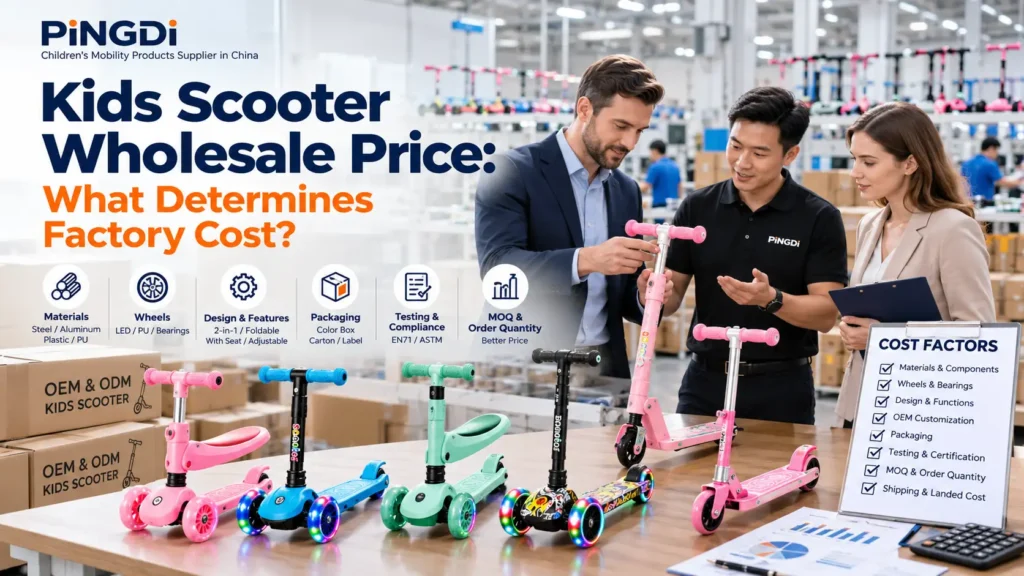
Kids Scooter Wholesale Price: What Determines Factory Cost?

For importers, distributors and private-label brands, comparing kids scooter wholesale prices can be surprisingly difficult. Two scooters may look almost identical in supplier catalogs. Both may have three wheels, an adjustable handlebar and LED wheels. One supplier may quote USD 7.50, another USD 10.50, while another may quote USD 14 or more. Why? The answer is rarely just factory margin. The real kids scooter factory cost depends on product structure, materials, wheel specifications, bearings, plastic quality, folding mechanisms, OEM requirements, packaging, testing, order quantity and many other variables. Current B2B listings illustrate how wide this range can be. Recent supplier listings include basic or promotional kids scooter configurations below USD 10, while larger, multifunctional or more highly specified models can move well above USD 14 per unit. MOQ also varies significantly between models and suppliers. For professional buyers, therefore, asking: “What is your cheapest kids scooter?” is usually the wrong question. A better question is: “What product specification can meet our target market, quality standard and landed-cost requirement?” This guide explains the major factors determining kids scooter wholesale price in China, and how importers can compare supplier quotations more accurately. 1. Product Type Is the First Major Cost Factor Not every kids scooter should be compared on the same price basis. The market includes many different configurations: Each structure requires different components, molds, assembly processes and packaging. For example, a basic 2 wheel kids scooter wholesale model may use a relatively simple frame, two wheels and a basic folding mechanism. A 3 wheel kids scooter with seat may require additional plastic components, a seat structure, locking components and larger packaging. A multifunctional 3 in 1 toddler scooter may add a parent handle, removable seat, guard structure or additional adjustment mechanisms. Therefore, buyers should never compare quotations based only on the word “scooter.” Always compare the complete product specification. 2. Frame and Structural Materials Affect Factory Cost Materials are one of the biggest contributors to the final kids scooter factory price. Depending on the product, a scooter may combine: Even when two products use the same general material description, their actual construction may differ. For example, simply writing “aluminum tube” does not tell the buyer everything needed to compare two quotations. Tube dimensions, wall thickness, processing method, surface treatment and overall structural design can all affect material consumption and production cost. The same principle applies to plastic components. A cheaper quotation may sometimes be achieved by reducing material usage or changing component specifications rather than through higher production efficiency. For importers, the correct comparison should therefore be: Specification A vs Specification A not: Photo A vs Photo A. 3. Wheels Can Create a Significant Price Difference Wheels are another important variable in children’s scooter wholesale cost. A buyer should confirm: Light-up wheels have become especially common in children’s scooter ranges. Recent supplier listings frequently combine terms such as PU flashing wheels, LED wheels, adjustable, foldable and custom logo, showing how these features have become important differentiators in wholesale product configurations. Alibaba But not every LED wheel has the same cost. Wheel size, PU quality, lighting structure and internal components can change the quotation. This is why an importer comparing two LED kids scooter wholesale quotations should request detailed wheel specifications rather than relying only on product photos. 4. Bearings and Moving Components Matter Bearings are small components, but they affect riding performance and long-term product consistency. A quotation can change according to the selected bearing specification and overall wheel assembly. Importers should also consider other moving or locking components, including: A more complicated scooter generally requires more parts and more assembly operations. It may also create additional QC checkpoints. Therefore, a multifunctional scooter should not be expected to have exactly the same factory cost as a basic model. 5. LED Lights, Music and Additional Functions Increase Cost Today’s kids scooter market includes much more than traditional kick scooters. Products may include: Current wholesale listings demonstrate this difference clearly: simple flashing-wheel scooters can sit at the lower end of supplier pricing, while models combining light, music, Bluetooth, seats or multifunctional structures generally move into higher price brackets. 中国制造网 Importers should decide which functions actually add value in their target market. Adding every available feature does not necessarily produce a better-selling product. Sometimes a simpler scooter with better wheels, stronger packaging and more consistent QC is commercially more attractive than a heavily featured model. 6. MOQ Has a Direct Impact on Kids Scooter Wholesale Price Kids scooter MOQ and unit price are closely related. Why? A production order includes costs that are not perfectly proportional to quantity. Examples include: These costs have to be distributed across the order quantity. For example: If a fixed preparation cost is USD 300 and the buyer orders 100 units, that represents: USD 3.00 per unit If the same cost is distributed across 1,000 units: USD 0.30 per unit The exact factory calculation will differ by supplier and product, but the principle explains why a 100-piece quotation cannot always be compared directly with a 1,000-piece quotation. Current market listings also show substantial MOQ variation: some configurations are offered from 50–100 units, while other products quote MOQ levels of 300, 500 or 1,000 pieces. 中国制造网 7. OEM Customization Changes the Cost Structure Many buyers searching for an OEM kids scooter manufacturer want more than a standard product. Typical OEM requirements include: Some changes cost very little. Others can change the economics of the project substantially. For example, adding a simple logo to an existing product is very different from developing a new plastic component requiring a new mold. This distinction is important when comparing OEM vs ODM kids scooters. Using an existing platform with customized colors, graphics and packaging generally requires less development investment than creating an entirely new structure. Recent industry sourcing guidance also highlights tooling as a potentially major cost in deeper OEM development, making the level of customization an important commercial decision rather than simply a design preference. 阿里巴巴卖家中心 8. Packaging Can Change the Final

Kids Scooter Wholesale Price: What Determines Factory Cost? Read More »

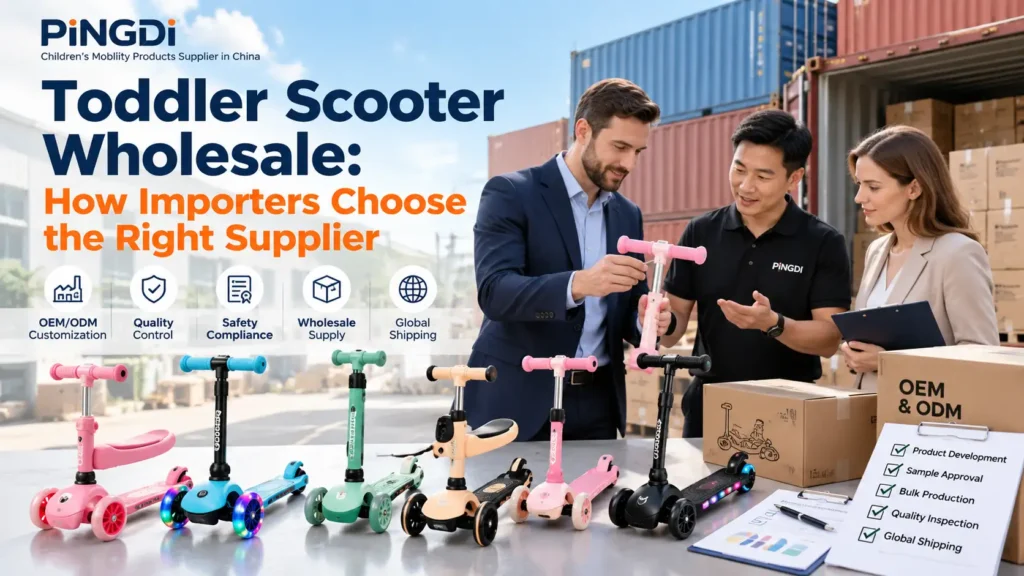
Toddler Scooter Wholesale: How Importers Choose the Right Supplier

Choosing a toddler scooter supplier is not simply a matter of comparing FOB prices. For importers, distributors and private-label brands, two toddler scooters that look almost identical in a supplier’s catalog can perform very differently after they reach the market. The differences may be hidden in the wheel material, steering mechanism, deck structure, plastic quality, handlebar locking system, seat connection, bearings, packaging, production consistency and quality-control process. These details directly influence product safety, customer complaints, return rates and the long-term reputation of your brand. For this reason, professional buyers sourcing toddler scooters wholesale should evaluate the complete supply program—not only the unit price. This guide explains how importers can evaluate a toddler scooter manufacturer or supplier in China, compare OEM options, control product quality and reduce sourcing risks before placing a bulk order. 1. Start With the Product, Not the Supplier’s Price One of the most common sourcing mistakes is sending several suppliers a photo and asking: “What is your best price?” The quotations may look comparable, but the products may not actually have the same specifications. A typical 3 wheel toddler scooter may differ in: Even relatively small specification differences can affect manufacturing cost. Before comparing quotations, importers should therefore create a basic product specification sheet. For example: Specification Requirement Product 3 Wheel Toddler Scooter Configuration Sit / Stand or Stand Only Steering Lean-to-Steer Handlebar Adjustable Wheels PU / LED optional Seat Optional Color Custom Logo OEM Packaging Retail Color Box Market EU / USA / UK / Other Order Type Wholesale / Private Label Once every supplier is quoting against the same specification, price comparisons become much more meaningful. 2. Choose the Right Toddler Scooter Configuration “Toddler scooter wholesale” is not one single product category. Importers can now choose from several configurations depending on their retail channel and target age group. Standard 3-Wheel Toddler Scooter This is one of the most common configurations. Two front wheels and one rear wheel create a relatively stable platform for younger users. For wholesalers looking for an entry-level SKU, this can offer a straightforward balance between product cost, packaging size and retail positioning. Kids Scooter With Seat A kids scooter with seat adds another usage configuration and can create a more differentiated retail proposition. When evaluating this type, buyers should pay additional attention to the seat attachment, adjustment mechanism and structural stability. 2-in-1 and 3-in-1 Toddler Scooters Convertible models are increasingly common in children’s mobility ranges. Depending on the design, one product may support several configurations such as sitting, standing or parent-assisted use. The sourcing challenge is that additional components also create additional quality-control points. LED Kids Scooters LED wheels and deck lighting can improve visual differentiation, particularly for online retail and gift-oriented channels. But importers should evaluate whether lighting components, batteries where applicable, wiring, wheel construction and packaging introduce additional compliance or durability considerations. PINGDI currently coordinates multiple scooter configurations including standard 3-wheel models, seat models, LED models and convertible designs for B2B sourcing projects. 3. Do Not Choose a Supplier Only by MOQ Toddler scooter MOQ is naturally one of the first questions asked by importers. However, the lowest MOQ is not automatically the best offer. MOQ depends on factors such as: For example, purchasing an existing model in an existing color may require significantly less production coordination than developing a private-label product with a custom Pantone color, printed logo and customized retail box. Importers should therefore ask suppliers to separate: Standard Product MOQ from: OEM / Private Label MOQ This makes it easier to decide whether to test a product first or move directly into a customized program. 4. Compare the Real Wholesale Cost When buyers search for kids scooters wholesale from China, FOB unit price often becomes the headline number. But the cheapest quotation may not produce the lowest landed cost. Consider: Product Cost + Packaging + Testing + Inspection + Inland Logistics + Export Costs + Freight + Import Charges + Defect/Return Risk Suppose Supplier A is slightly cheaper than Supplier B. If Supplier A uses weaker cartons and the shipment experiences higher packaging damage, the apparent saving can disappear quickly. The same applies to poor wheel performance, loose handlebars, inconsistent colors or missing accessories. Professional importers therefore evaluate total sourcing cost, not simply factory quotation. 5. Evaluate the Supplier’s OEM Capability For brands and distributors, OEM toddler scooter capability can become more important than the initial price. Common customization requirements include: Custom Colors Frame, deck, wheels, handles, seats and other plastic components may be coordinated in different color combinations. Always confirm colors through approved references or samples rather than relying only on computer images. Custom Logo Depending on the product structure, branding options may include: Private-Label Packaging Packaging is particularly important for distributors and retail brands. A professional private label kids scooter project may involve: Product Configuration Depending on the model, importers may also evaluate alternative wheels, seats, handlebars, lighting features and accessories. The key is to freeze the specification before mass production. 6. Check Product Quality Before You Discuss Mass Production A sample that looks attractive in photographs is not enough. For a 3 wheel kids scooter wholesale program, buyers should inspect the product systematically. Important areas include: Steering The steering system should operate consistently and correspond to the intended product design. Check excessive movement, interference and assembly consistency. Handlebar and Locking System Check adjustment positions, locking mechanisms and component fit. Wheels and Bearings Rotate every wheel and check for abnormal resistance, excessive movement or inconsistent assembly. Deck Inspect dimensions, surface condition, anti-slip features and structural consistency. Brake Where fitted, inspect position, operation and assembly. Seat and Conversion Mechanisms For toddler scooters with seats, check the attachment system and every intended configuration. Edges, Openings and Accessible Components These need to be evaluated according to the intended user, product design and applicable safety requirements. This is why product selection and quality control should begin before the purchase order—not after production has already finished. 7. Confirm Safety Requirements for the Destination Market Children’s mobility products require

Toddler Scooter Wholesale: How Importers Choose the Right Supplier Read More »

Children’s Scooters Manufacturer China: 12 Things Importers Should Check Before Ordering

Finding a children’s scooters manufacturer in China is relatively easy. Finding the right supply partner for a long-term wholesale or private-label program is much more difficult. Two children’s scooters may look almost identical in supplier photos while having very different frame materials, plastic quality, wheels, bearings, steering systems, packaging and quality-control standards. For importers and distributors, these differences affect more than the purchase price. They can influence product consistency, customer complaints, compliance risk, container utilization and the total landed cost of an order. This is why professional buyers should not select a kids scooter supplier in China based only on FOB price. Before placing your next order, evaluate these 12 areas. 1. Does the Supplier Understand Your Type of Children’s Scooter? “Children’s scooter” covers several different product structures. Common products include: A supplier that performs well with a basic metal kick scooter is not automatically the best supplier for a multifunctional toddler scooter with a seat, LED wheels and molded plastic components. This distinction matters because different models involve different manufacturing processes and upstream suppliers. For example, a three-wheel plastic scooter may involve injection-molded components, PU wheels, bearings, metal steering tubes, printing, packaging and assembly. Before requesting prices, define exactly which product platform you need. For current models, buyers can explore our kids scooter wholesale collection and compare suitable configurations before preparing an RFQ. 2. Manufacturer, Trading Company or Sourcing Partner? International buyers frequently search Google for terms such as: But the word “manufacturer” should not be the only supplier-selection criterion. A direct factory can be an excellent choice when its production specialization matches the buyer’s exact product. A sourcing and project-management company can be useful when a buyer needs multiple scooter designs, mixed categories or coordination among different manufacturing resources. The important question is transparency. Buyers should understand: Guangzhou Pingdi Technology Co., Ltd. operates as a China-based sourcing and OEM/ODM project management partner rather than presenting itself as the owner of every manufacturing facility. We coordinate suitable manufacturing resources according to product specifications, order quantity, target market and customization requirements. For professional importers, a transparent supply structure is more useful than simply seeing the word “factory” on a website. 3. Compare Specifications Before Comparing Prices One of the most common sourcing mistakes is comparing quotations before confirming that the products are actually equivalent. Suppose Supplier A quotes $8.50 and Supplier B quotes $9.20. The $8.50 scooter is not necessarily cheaper if it uses different: Ask each supplier to provide a comparable specification sheet. For a 3 wheel kids scooter, for example, the RFQ should ideally define the wheel configuration, handlebar adjustment, deck size, steering system, seat requirements, folding structure and packaging. Only after specifications are aligned does a price comparison become meaningful. 4. What Is the MOQ? There is no universal kids scooter MOQ. Current B2B marketplace listings show that minimum quantities vary considerably by supplier, model and customization level. 阿里巴巴 MOQ may depend on: Therefore, instead of asking only: What is your MOQ? ask: What is the MOQ for the standard model, custom logo, custom color and full private-label packaging? This provides much more useful purchasing information. 5. What Determines Children’s Scooter Wholesale Price? Buyers searching for children’s scooters wholesale should calculate total landed cost rather than focusing exclusively on unit price. Important cost variables include: Frame and structure — Material selection, dimensions and construction affect cost. Wheels and bearings — Wheel diameter, PU quality, lighting and bearing specifications can change both cost and performance. Plastic components — Material selection, molding quality and component thickness matter. Functions — Seats, folding mechanisms, LED wheels, music and other functions increase component complexity. Packaging — Brown cartons, color boxes and customized retail packaging have different costs. Order quantity — Component purchasing and production efficiency may change at different volumes. Testing requirements — Destination-market requirements can add testing and documentation costs. A quotation should therefore be evaluated against an agreed specification, not simply against a competitor’s headline price. 6. What OEM Options Are Available? A serious OEM kids scooter program goes beyond printing a logo. Depending on the selected product and manufacturing conditions, customization can include: More extensive ODM projects may involve component or structural changes. Before development begins, create an approved specification sheet that identifies every customized element. This document becomes one of the most important references during sampling, mass production and inspection. 7. Does the Supplier Understand Safety Requirements? This is particularly important for children’s products. The applicable requirements depend on the product design, age grading and destination market. Importers should establish the target market before approving mass production. For example, buyers may need to evaluate applicable requirements associated with EN 71 or ASTM F963, depending on the product and market. Do not rely simply on: “EN71 available.” Ask: Compliance documentation needs to correspond to the product being imported. 8. Order a Sample Before Mass Production For most new supplier relationships, a sample is a relatively inexpensive risk-control step. Evaluate: Do not evaluate only how the scooter looks. Operate the product. Fold it repeatedly if it is foldable. Adjust the handlebar. Check wheel movement. Inspect connections and fasteners. For an OEM order, retain an approved reference sample wherever practical. 9. How Does the Supplier Control Mass-Production Quality? A good sample does not guarantee a good shipment. The bigger question is: Can the supplier reproduce the approved specification consistently across hundreds or thousands of units? A kids scooter quality control plan can include checks for: OEM orders should also be compared against the approved specification and reference sample. 10. Check Packaging Before Confirming the Order Packaging is frequently underestimated in scooter sourcing. It affects both: product protection and landed cost. Ask for: A scooter that costs $0.30 less at the factory can ultimately be more expensive if inefficient packaging significantly reduces container loading quantity. For e-commerce customers, packaging durability can become even more important. 11. Can the Supplier Handle Multiple Models? Distributors often do not want 2,000 identical scooters. They may want: This creates a different sourcing challenge. The buyer

Children’s Scooters Manufacturer China: 12 Things Importers Should Check Before Ordering Read More »

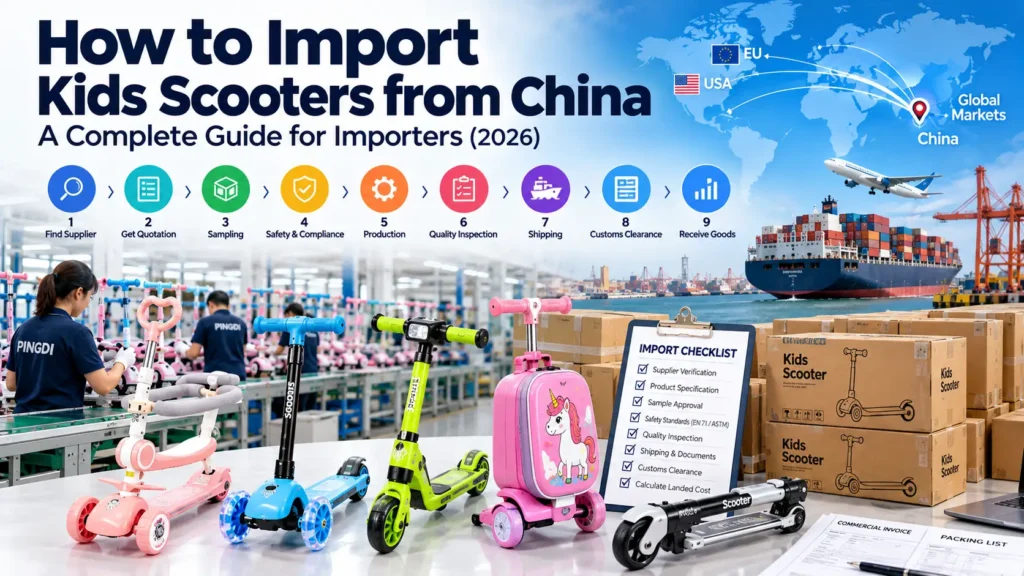
Kids Scooter Manufacturer China: Complete Sourcing Guide for Importers

Choosing a kids scooter manufacturer in China is not simply a matter of finding the lowest quotation. For importers, distributors, wholesalers and private-label brands, the real challenge is finding a supply partner that can match the right scooter model, control product quality, manage customization, coordinate testing and deliver consistent products across repeat orders. A supplier offering a price that is $0.50 lower per unit can quickly become more expensive if the shipment has unstable steering systems, inconsistent colors, weak packaging, incorrect labeling or compliance problems. This guide explains the key factors buyers should evaluate when sourcing kids scooters from China, including product types, MOQ, wholesale pricing, OEM/ODM options, safety requirements, supplier verification, quality control and shipping. If you are currently comparing a kids scooter supplier in China, use the following points as a practical sourcing checklist. 1. What Types of Kids Scooters Can You Source from China? China has a broad supply base for children’s scooters, ranging from basic entry-level models to multifunctional private-label products. Common categories include: 3-Wheel Kids Scooters Importers sourcing this category can read our 3-wheel kids scooter wholesale guide for more information about MOQ, pricing, OEM options and safety requirements. Three-wheel scooters are one of the most common choices for younger children because the two-front-wheel or two-rear-wheel structure can provide greater stability. Typical options include: View our wholesale kids scooter models for current product options, including 3-wheel, sit-and-ride and foldable scooters. Buyers searching for a 3 wheel kids scooter manufacturer in China should compare more than appearance. Steering structure, wheel quality, deck strength, handlebar locking and material consistency can vary considerably between models. Sit-and-Ride Scooters These models combine riding and scooting functions. They are especially common in the toddler segment and may be marketed as: 2-in-1, 3-in-1 or multifunction kids scooters. Importers should carefully confirm age recommendations, seat structure, load requirements and applicable safety testing before selecting a model. Foldable Kids Scooters Foldable designs can reduce storage space and improve retail convenience. However, the folding mechanism becomes an important QC point. Importers can also review the EU’s Safety Gate database to understand the types of safety issues and product recalls reported in the European market. Buyers should inspect: Private-Label Scooters Brands and distributors can also develop customized scooter programs with selected colors, logos, packaging and product configurations. This is where the capabilities of the supplier become particularly important. 2. Manufacturer, Trading Company or Supply-Chain Partner? One of the most common questions from overseas buyers is: Should I work directly with a scooter factory? There is no single answer. A direct manufacturer may offer strong production control for its own product range. However, a sourcing or project-management company can sometimes provide greater flexibility when a buyer needs multiple scooter models, mixed products or different manufacturing processes. For example, a private-label scooter project may involve: Therefore, importers should evaluate the actual supply-chain management capability, rather than relying only on whether the supplier describes itself as a factory. Guangzhou Pingdi Technology Co., Ltd. operates as a China-based children’s mobility product sourcing and OEM/ODM project management partner. Instead of presenting ourselves as the direct manufacturer of every product, we coordinate suitable manufacturing resources according to the buyer’s product, target price, market and customization requirements. For professional buyers, transparency about the supply structure is important. 3. What Is the MOQ for Wholesale Kids Scooters? MOQ is one of the first questions importers ask when sourcing wholesale kids scooters from China. There is no universal MOQ. Current marketplace listings illustrate just how widely order minimums can vary—from tens of units on some offers to hundreds on others—depending on model, supplier and customization. 中国制造网 The MOQ normally depends on: For an existing model with standard colors and packaging, the MOQ can usually be more flexible. For an OEM project requiring a custom Pantone color, logo, printed carton and instruction manual, the MOQ may increase because upstream component and packaging suppliers also have minimum production quantities. Importers should therefore ask for MOQ by customization level, not simply: What is your MOQ? A better RFQ asks: What is the MOQ for the standard model, custom color, custom logo and fully customized retail packaging? That produces a much more useful answer. 4. What Determines Kids Scooter Wholesale Price? Searching only for the lowest kids scooter wholesale price is one of the easiest ways to create quality problems. Two scooters that look nearly identical in photographs can have very different costs. Important price factors include: Frame Material The amount and grade of steel or aluminum affects both cost and structural performance. Plastic Components Different plastics, wall thicknesses and molding quality can significantly change durability. PU Wheels Wheel diameter, hardness, bearings, lighting systems and PU quality all influence cost. Steering System A basic steering structure and a better-controlled lean-to-steer system should not be treated as identical products. Packaging Brown cartons, color boxes, mail-order packaging and customized retail packaging have different costs. Testing Requirements Products intended for different markets may require different testing and documentation. Order Quantity Higher quantities may improve component purchasing and production efficiency. Therefore, when comparing quotations from different kids scooter manufacturers in China, make sure the specification is genuinely comparable. A cheaper quotation based on different materials or packaging is not a true price comparison. 5. OEM Kids Scooter: What Can Importers Customize? Learn more about our OEM and ODM product development services for private-label children’s mobility projects. A professional OEM kids scooter project can involve much more than adding a logo. Typical customization includes: Product color Buyers can specify existing colors or Pantone references. Logo Common positions include the deck, steering tube, handlebar area and packaging. Wheels Wheel colors and LED options can be selected on suitable models. Packaging Options may include: Product configuration Depending on the model and tooling, buyers may select different seats, handles, wheels or accessories. For deeper ODM development, structural modifications or new tooling may also be possible. Before beginning an OEM project, the buyer should provide a clear specification sheet. This reduces repeated revisions and quotation errors. 6.

Kids Scooter Manufacturer China: Complete Sourcing Guide for Importers Read More »

Scroll to Top