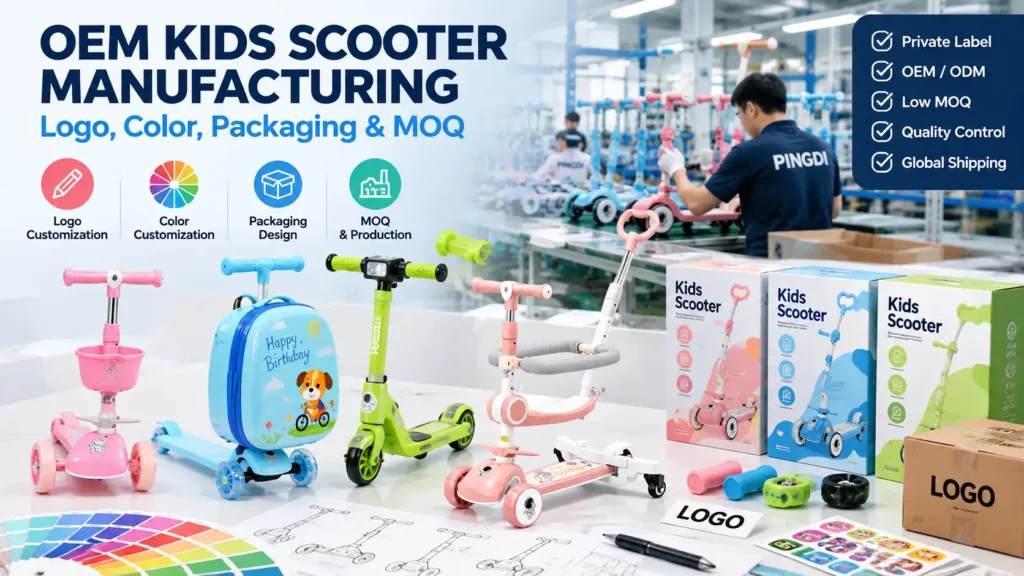
OEM kids scooter manufacturing is not simply about adding a logo to an existing scooter. For importers, distributors and private-label brands, a successful OEM project requires coordination between product specifications, colors, branding, packaging, minimum order quantities, sampling, quality control and market-specific requirements.
A scooter that looks attractive in a supplier catalog may still create problems during mass production if the buyer has not confirmed the technical specifications or customization details.
Common issues include inconsistent colors, incorrect logo placement, packaging artwork errors, unexpected MOQ increases, component substitutions and shipment delays.
For businesses sourcing OEM kids scooters from China, understanding the complete customization process is essential.
This guide explains how professional buyers can develop a private-label kids scooter range, evaluate customization options and reduce sourcing risks.
Guangzhou Pingdi Technology Co., Ltd. supports international importers, wholesalers, distributors and children’s mobility brands through product sourcing, OEM/ODM project coordination, supplier management, quality inspection and export support.
1. What Is OEM Kids Scooter Manufacturing?
OEM stands for Original Equipment Manufacturer.
In the children’s scooter industry, OEM commonly refers to producing or customizing scooters according to a buyer’s agreed product specifications and branding requirements.
An OEM project may involve an existing scooter design with customized colors, logos and packaging. More advanced projects may require component modifications, structural changes or new tooling.
For importers, there are three practical levels of customization.
Level 1: Private Label Customization
The buyer selects an existing scooter model and adds brand elements such as:
- Custom logo
- Product labels
- Branded packaging
- Instruction manuals
- Barcode labels
This is often the most practical starting point for a new children’s scooter brand.
Level 2: Product Appearance Customization
The buyer requests additional changes, including:
- Custom frame colors
- Custom handle grips
- Wheel color combinations
- Deck graphics
- Decorative components
- Coordinated packaging
This approach helps brands create a more distinctive product range without necessarily developing a completely new structure.
Level 3: ODM Product Development
ODM projects may involve:
- New scooter structures
- Modified folding mechanisms
- Custom components
- New molds
- Different steering systems
- Exclusive product designs
These projects generally require more engineering coordination, development investment and testing.
For first-time importers, beginning with an established product platform can reduce development complexity.
2. Choosing the Right Kids Scooter for OEM Customization
Before discussing colors or logos, buyers should select the correct scooter category.
Different products serve different customer groups and retail channels.
3 Wheel Kids Scooters
Three-wheel scooters are commonly selected for toddler and younger children’s product ranges.
Available configurations may include adjustable handlebars, wide decks, LED wheels and different steering mechanisms.
For importers targeting this segment, 3 wheel kids scooter OEM projects may focus on coordinated colors, graphics, branding and packaging.
Kids Scooters with Seats
Scooters with seats provide additional product configurations compared with standard standing scooters.
Depending on the model, they may include removable seats, baskets or other accessories.
Some models combine a scooter platform with a seat, parent push handle, guardrail or other components.
Buyers should verify the actual number of functional modes before marketing a product as 3-in-1, 4-in-1 or 5-in-1.
Foldable 2 Wheel Kids Scooters
Two-wheel scooters may be positioned toward older children, depending on the model’s intended age group and specifications.
Customization may involve frame colors, deck graphics, handle grips and retail packaging.
At PINGDI, we help buyers evaluate suitable product platforms based on their target market, product positioning, required specifications and expected order quantity.
3. Custom Logo Options for OEM Kids Scooters
One of the most common questions from importers is:
Can I put my own brand logo on a kids scooter?
For suitable models and production quantities, private-label logo customization can be coordinated.
However, the appropriate logo application method depends on the product surface, material, design and production requirements.
Logo Printing
Printed logos can be suitable for selected plastic or metal surfaces.
Buyers should confirm the printing position, dimensions, colors and durability requirements.
Logo Stickers and Labels
Customized stickers or labels may be used on appropriate product areas.
The adhesive, surface preparation and expected durability should be evaluated.
Deck Graphics
The scooter deck provides a useful branding area on many models.
Custom graphics can include brand names, patterns or product-specific designs.
Molded or Embossed Logos
For selected projects, logos may be integrated into molded components.
This can require tooling modifications or new molds.
It is generally more suitable for projects where the expected order volume justifies the additional development cost.
What Should Buyers Confirm?
Before approving logo production, importers should confirm:
- Logo artwork format
- Logo dimensions
- Application method
- Exact placement
- Color requirements
- Surface finish
- Durability expectations
- Sample approval
PINGDI can coordinate these details with suitable production partners and help ensure the approved branding requirements are communicated before bulk production.
4. Custom Colors: How to Maintain Consistency
Color customization is another important part of private label kids scooter manufacturing.
For children’s mobility brands, coordinated colors can help create a recognizable product collection.
However, color customization involves more than choosing a color from a photograph.
Different scooter components may use different materials and manufacturing processes.
For example, a scooter may include:
- Metal tubes
- Injection-molded plastic parts
- Handle grips
- Wheels
- Deck components
- Decorative accessories
The same requested color may appear different across these materials.
Pantone Color Matching
For projects requiring a specific brand color, buyers should provide a Pantone reference when applicable.
A Pantone reference can improve communication, but it does not automatically guarantee identical appearance across different materials.
Physical color samples may still be necessary.
Color Approval Process
A practical approval process includes:
Step 1: Select the product model.
Step 2: Provide color references.
Step 3: Confirm which components require customization.
Step 4: Review available production options.
Step 5: Approve physical samples or agreed color standards.
Step 6: Confirm color requirements before mass production.
For repeat orders, keeping an approved reference sample can help maintain consistency.
At PINGDI, color coordination forms part of the OEM project management process when included in the agreed scope.
5. Private Label Packaging for Kids Scooters
Packaging is frequently underestimated during OEM product development.
For distributors and brands, packaging affects product presentation, transportation efficiency, labeling and overall landed cost.
Common packaging options include:
Standard Export Carton
A practical option for wholesale distribution where elaborate retail presentation is unnecessary.
Custom Color Box
A branded retail box may include product photographs, logos, product features and market-specific information.
E-Commerce Packaging
Buyers selling through online channels may require packaging designed for parcel distribution and handling.
Private Label Packaging
A complete private-label packaging project may involve:
- Brand logo
- Product images
- Model number
- Product specifications
- Barcode
- Warning labels
- Instruction manual
- Country-specific information
- Master carton marks
Packaging Artwork Approval
Before mass printing, buyers should review the final artwork carefully.
Important checks include product model, language, barcode, logo position, warning statements and dimensions.
A packaging error can affect an entire shipment even when the scooters themselves meet the approved specifications.
PINGDI can coordinate packaging requirements, artwork communication and production follow-up according to the agreed project scope.
6. What Is the MOQ for OEM Kids Scooters?
Kids scooter MOQ is one of the most important commercial questions for importers.
MOQ means Minimum Order Quantity.
There is no universal MOQ for every kids scooter model.
The minimum quantity depends on several factors.
Standard Product MOQ
Existing products with standard colors and packaging may offer more flexible order quantities.
Custom Logo MOQ
Logo customization may introduce minimum requirements for printing, labels or component processing.
Custom Color MOQ
Custom colors may require separate material preparation or production batches.
Custom Packaging MOQ
Packaging suppliers may have their own minimum quantities for printed color boxes or other materials.
New Tooling MOQ
Projects involving new molds or structural development generally require a different commercial evaluation.
How Buyers Should Ask About MOQ
Instead of asking only:
“What is your MOQ?”
A more useful request is:
“Please provide MOQ and pricing for the standard model, custom logo, custom color and fully customized retail packaging.”
This allows suppliers to present different customization options rather than quoting one minimum quantity without explanation.
For buyers testing a new market, an existing product platform with limited customization may be more practical than a fully customized design.
PINGDI evaluates MOQ according to the selected product, manufacturing resources, customization requirements and expected order volume.
7. How OEM Customization Affects Kids Scooter Factory Cost
The final OEM kids scooter price depends on the complete product specification.
Customization can affect cost through several channels.
Materials
Different materials, component specifications and surface treatments can change production costs.
Logo Application
Printing, labels and molded branding have different preparation and processing requirements.
Custom Colors
Special color production may involve additional material preparation or smaller production batches.
Packaging
Printed retail boxes, manuals, labels and protective materials affect packaging cost.
Tooling
New molds or modified components may require development investment.
Testing
Applicable testing and documentation requirements should be evaluated according to the exact product and destination market.
Order Quantity
Production volume can affect purchasing efficiency and the allocation of setup costs.
For importers, the lowest unit price is not always the most economical option.
A better comparison considers product specifications, quality requirements, packaging, testing, freight and total landed cost.
8. OEM Kids Scooter Sampling Process
Sample approval is one of the most important stages of an OEM project.
Importers should not approve mass production based only on catalog images.
A structured sampling process can include the following stages.
Product Selection
Choose the scooter model and confirm the required configuration.
Technical Specification
Review dimensions, components, functions and available materials.
Branding Requirements
Confirm logos, graphics, colors and labels.
Packaging Requirements
Review the packaging format and artwork.
Sample Preparation
Coordinate the sample according to the agreed requirements.
Sample Evaluation
Check product appearance, function, branding and packaging.
Final Approval
Confirm the approved specification and reference sample before bulk production.
For more complex ODM projects, additional development and testing stages may be necessary.
PINGDI can coordinate sampling and approval communication between buyers and selected manufacturing partners.
9. Quality Control for OEM Kids Scooter Orders
Quality control becomes particularly important when multiple components and customization requirements are involved.
A product may look correct during sample approval but develop inconsistencies during mass production.
Common risks include:
- Incorrect product colors
- Misplaced logos
- Printing defects
- Wheel inconsistencies
- Handlebar adjustment problems
- Loose fasteners
- Folding mechanism issues
- Packaging errors
- Incorrect carton marks
A practical inspection process should cover both product function and customization requirements.
Incoming Component Checks
Where agreed, relevant components can be checked against approved specifications.
Production Inspection
Selected production-stage checks can help identify assembly or appearance issues before final packing.
Pre-Shipment Inspection
Final inspection may include product appearance, functional checks, labeling, packaging and quantity verification.
Approved Reference Samples
Maintaining approved samples helps establish a consistent reference for production and repeat orders.
PINGDI can coordinate inspection requirements and production follow-up as part of an agreed OEM sourcing project.
10. Safety and Compliance for International Markets
Children’s scooters are regulated differently depending on their design, intended use, age grading and destination market.
Importers should not assume that every scooter follows the same testing requirements.
For example, product classification may affect whether toy-related or other scooter requirements apply.
Important considerations can include:
- Product classification
- Intended age group
- Structural requirements
- Stability
- Steering and braking functions
- Mechanical hazards
- Material-related requirements
- Warning labels
- Instruction manuals
- Applicable testing
- Required documentation
For the European Union, buyers should determine whether the product falls within applicable toy requirements or another relevant regulatory category.
For the United States, the applicable requirements should also be confirmed according to the exact scooter type and intended use.
A certificate or test report for one scooter model should not automatically be treated as valid for a different product configuration.
PINGDI can coordinate documentation review and third-party testing discussions with relevant production partners and laboratories.
Final compliance responsibilities and required evidence should be established for each project.
11. OEM vs ODM: Which Is Better for Importers?
OEM and ODM serve different business objectives.
OEM Customization
Usually involves selecting an established product platform and customizing agreed branding or specifications.
It may offer a more practical route for buyers who want to launch a private-label scooter collection.
ODM Development
May involve developing new designs, structural modifications, exclusive components or new tooling.
It can create greater differentiation but usually requires more development coordination.
For a new brand testing market demand, OEM customization may be a sensible starting point.
For an established distributor with predictable sales volume, ODM development may become more attractive.
The correct choice depends on budget, product strategy, expected order quantity, target market and development timeline.
12. Why Work with PINGDI for OEM Kids Scooter Projects?
Guangzhou Pingdi Technology Co., Ltd. is a China-based children’s mobility product sourcing and OEM/ODM project management partner.
We primarily serve international importers, distributors, wholesalers and private-label brands.
Our role is to coordinate suitable manufacturing resources and support buyers throughout the sourcing process.
Rather than claiming to own every production facility, we focus on matching project requirements with appropriate supply-chain capabilities.
Product Sourcing
We help buyers evaluate scooter models according to target specifications, product positioning and commercial requirements.
Supplier Coordination
Different scooter structures and customization requirements may involve different manufacturing capabilities.
We coordinate suitable production resources according to project needs.
OEM/ODM Project Management
We support communication relating to logos, colors, graphics, packaging and selected product configurations.
Sample Coordination
We help buyers communicate sample requirements and confirm approval details before production.
Production Follow-Up
We coordinate production progress and communicate project requirements with relevant suppliers.
Quality Inspection
Inspection requirements can be coordinated according to the agreed project scope.
Export Support
We can support packaging coordination, shipment preparation and export-related communication.
Multi-Category Sourcing
In addition to kids scooters, our sourcing range includes balance bikes, kids bicycles, baby strollers and electric ride-on cars.
This can be useful for importers purchasing several children’s mobility product categories from China.
13. Common OEM Kids Scooter Mistakes Importers Should Avoid
Several avoidable mistakes can increase sourcing costs and project risks.
Mistake 1: Confirming Price Before Specifications
A quotation is difficult to compare when materials, components and packaging are unclear.
Mistake 2: Assuming Every Logo Method Has the Same MOQ
Printing, labels and molded branding can have different commercial requirements.
Mistake 3: Approving Colors from Screenshots Only
Screen colors may not accurately represent finished products.
Mistake 4: Ignoring Packaging Development
Incorrect packaging can delay shipment or create market compliance issues.
Mistake 5: Skipping Sample Approval
Mass production should follow an agreed specification and approval process.
Mistake 6: Assuming All Scooters Have the Same Compliance Requirements
Testing and documentation should match the exact product and destination market.
Mistake 7: Choosing Suppliers Only by Unit Price
A low quotation may exclude important customization, inspection or packaging requirements.
A structured OEM sourcing process helps buyers identify these risks earlier.
14. How to Request an OEM Kids Scooter Quotation
A professional RFQ should contain enough information for the supplier to evaluate the project accurately.
Buyers should provide:
- Destination country
- Target scooter category
- Reference product or specifications
- Estimated order quantity
- Required colors
- Logo artwork
- Packaging requirements
- Testing and compliance requirements
- Target price range, if available
- Expected delivery schedule
For projects involving new designs, buyers should also provide drawings, functional requirements or relevant design references.
The more complete the RFQ, the easier it becomes to compare suitable sourcing options.
15. Frequently Asked Questions About OEM Kids Scooters
Can I put my own logo on a kids scooter?
Yes. Suitable models can support private-label branding through methods such as printing, labels, deck graphics or other agreed applications. Availability depends on the product and order requirements.
Can I customize kids scooter colors?
Custom colors may be available depending on the model, components, MOQ and production feasibility. Physical samples or agreed color references are recommended.
What is the MOQ for OEM kids scooters?
MOQ varies by product, supplier, color, logo method, packaging and tooling requirements. Buyers should request separate MOQ information for different customization levels.
Can I customize the retail packaging?
Private-label packaging can be coordinated for suitable projects, including color boxes, manuals, labels, barcodes and shipping marks.
How long does OEM kids scooter manufacturing take?
The timeline depends on sample development, customization complexity, material availability, packaging approval, testing and production scheduling. A project-specific timeline should be confirmed before ordering.
Can I order a sample before mass production?
Sample availability depends on the selected product and customization requirements. Buyers should confirm sample cost, preparation time and approval procedures.
Can PINGDI help with quality inspection?
Yes. PINGDI can coordinate quality inspection requirements and pre-shipment inspection according to the agreed project scope.
Does PINGDI own the scooter factories?
PINGDI operates as a China-based sourcing and OEM/ODM project management partner. We coordinate suitable manufacturing resources rather than claiming ownership of every factory.
Conclusion: Build a Reliable Private Label Kids Scooter Supply Chain
Successful OEM kids scooter manufacturing requires more than an attractive design or a competitive quotation.
For importers and private-label brands, the key is to manage the complete project: product selection, logo application, color approval, packaging, MOQ, sampling, quality control and export coordination.
A structured approach can help reduce misunderstandings, improve production consistency and support long-term sourcing relationships.
PINGDI helps international B2B buyers source and develop OEM kids scooters in China through supplier coordination, customization management, quality inspection and export support.
If you are planning a private-label kids scooter collection, send us your target market, product requirements, estimated quantity, logo and packaging specifications.
Contact PINGDI to discuss your next OEM kids scooter sourcing project.