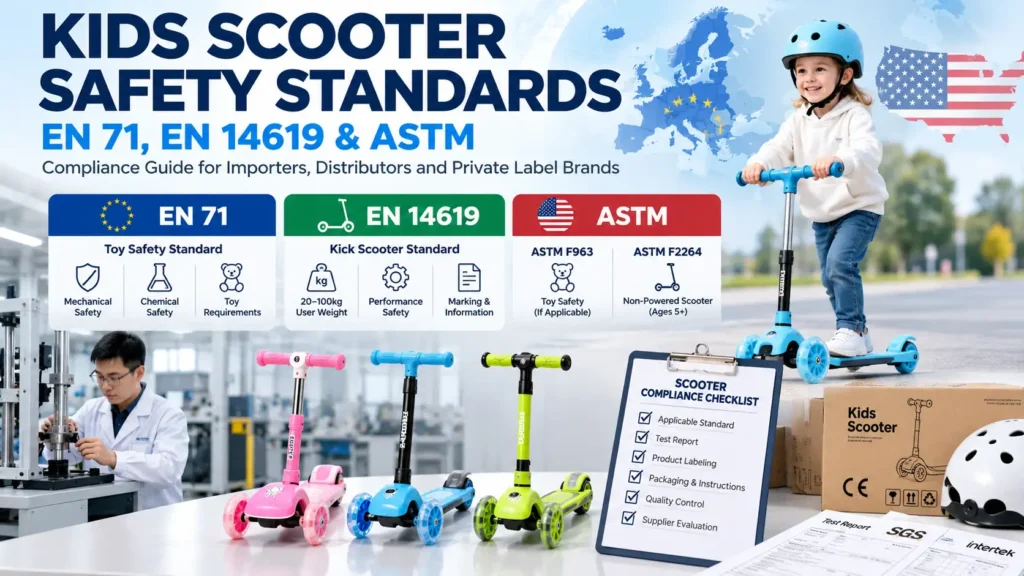
For importers and private-label brands, understanding kids scooter safety standards is essential before selecting a manufacturer, approving samples or placing a bulk order.
One of the most common sourcing mistakes is assuming that every children’s scooter must comply with the same safety standards.
In reality, the applicable requirements depend on the scooter’s intended use, product design, age grading, user weight, destination market and regulatory classification.
A three-wheel toddler scooter intended as a toy may be evaluated differently from a larger two-wheel kick scooter designed as sporting equipment.
For buyers importing kids scooters from China, the main standards frequently discussed include EN 71, EN 14619, ASTM F963 and ASTM F2264.
However, these standards are not interchangeable.
This guide explains the differences, what importers should verify and how to reduce compliance risks when sourcing OEM and wholesale kids scooters.
Guangzhou Pingdi Technology Co., Ltd. supports international importers, distributors and private-label brands through children’s mobility product sourcing, OEM/ODM coordination, supplier communication, quality inspection and export support.
1. Why Kids Scooter Safety Standards Matter for Importers
Children’s scooters contain multiple structural and moving components.
Depending on the model, these may include:
- Steering systems
- Handlebars and adjustment mechanisms
- Folding mechanisms
- Wheels and bearings
- Decks and frames
- Brakes
- Seats and removable accessories
- Parent push handles
Each component can introduce potential mechanical, stability, durability or misuse-related hazards.
For importers, product safety affects more than consumer protection.
It can influence customs documentation, product liability, retailer acceptance, insurance requirements, marketplace listings and potential recalls.
A product that passes a supplier’s internal inspection is not necessarily compliant with the applicable destination-market requirements.
Likewise, a certificate from another scooter model does not automatically demonstrate compliance for a new design.
Professional buyers should establish the applicable regulatory requirements before approving mass production.
2. EN 71: Safety Requirements for Toy Scooters in Europe
EN 71 is a series of European toy safety standards.
For children’s scooters classified as toys, EN 71-1 is particularly relevant because it addresses mechanical and physical properties.
Depending on the product and applicable requirements, the assessment may involve:
- Structural strength
- Mechanical hazards
- Stability-related requirements
- Steering components
- Accessible edges and projections
- Entrapment hazards
- Warnings and instructions
Other parts of the EN 71 series may also be relevant, depending on the product’s materials and characteristics.
For example, chemical-related requirements must be assessed according to the applicable legislation and standards.
Importers should not assume that an EN 71-1 test report alone establishes complete EU compliance.
Are All Kids Scooters Considered Toys?
No.
A scooter’s classification depends on its intended use, design, marketing and other relevant characteristics.
A scooter intended for young children as a plaything may fall within toy legislation.
A larger kick scooter intended as sports equipment may require a different regulatory assessment.
Importers should document the intended use and classification before selecting the testing program.
What About CE Marking?
For a scooter classified as a toy and covered by applicable EU toy legislation, CE marking forms part of the conformity process.
However, CE marking is not a universal quality certificate.
It represents the manufacturer’s declaration that the product complies with applicable EU requirements.
Importers should verify the supporting conformity assessment, technical documentation, declaration of conformity and required labeling.
A supplier simply stating “CE approved” is not sufficient evidence.
3. EN 14619: Safety Standard for Kick Scooters
EN 14619:2019 addresses safety requirements and test methods for certain non-powered kick scooters.
Its scope includes scooters propelled by muscular activity and intended for users with a body mass greater than 20kg and less than 100kg.
The standard distinguishes between relevant categories of scooters.
Importantly, scooters intended for users below 20kg are outside its scope and are treated as toys within the standard’s classification framework.
For the 20–50kg range, a distinction must also be made between sports-equipment scooters and toy scooters.
This distinction is important for buyers sourcing products for older children.
What Does EN 14619 Cover?
The standard addresses safety requirements, testing, marking and information supplied by the manufacturer.
Depending on the applicable product configuration, assessment areas can include structural performance, steering, braking, mechanical integrity and product information.
The exact tests should be determined using the relevant standard and approved product specification.
EN 71 vs EN 14619
The main difference is product classification and intended use.
EN 71-1 is relevant to products classified as toys.
EN 14619 addresses the defined category of kick scooters used as sports equipment.
The presence of two wheels or three wheels alone does not establish which standard applies.
Importers must evaluate the complete product.
4. ASTM F963: US Toy Safety Requirements
ASTM F963 is a comprehensive toy safety standard incorporated into mandatory US toy safety requirements through 16 CFR Part 1250.
The current incorporated version is ASTM F963-23.
For products classified as children’s toys within its scope, applicable requirements must be identified and evaluated.
These can involve mechanical hazards, material-related requirements, labeling and other relevant safety provisions.
However, a critical distinction applies to scooters.
The US Consumer Product Safety Commission excludes non-powered scooters as defined in ASTM F2264 from the scope of ASTM F963.
Therefore, importers should not automatically request an ASTM F963 report for every non-powered scooter.
When Might ASTM F963 Be Relevant?
ASTM F963 may be relevant where a product is properly classified as a toy and falls within the standard’s scope.
The determination should consider the product’s actual design, intended use and applicable definitions.
For multifunction products, such as scooter-and-ride-on combinations, buyers should obtain a product-specific classification assessment rather than relying on the supplier’s marketing name.
5. ASTM F2264: Non-Powered Scooter Safety
ASTM F2264 is a consumer safety specification for non-powered scooters.
It addresses performance requirements, testing methods and labeling requirements intended to reduce scooter-related hazards.
Its stated scope covers scooters intended for children aged five years and older.
For importers selling non-powered kick scooters in the United States, ASTM F2264 is an important reference when evaluating product safety.
However, buyers should distinguish between:
- A standard that applies to a product category
- A standard that is incorporated into mandatory federal requirements
- Other federal or state requirements that may apply
Not every ASTM standard is automatically a mandatory federal regulation.
The applicable legal obligations should be confirmed for the specific product.
6. EN 71 vs EN 14619 vs ASTM: Comparison for Importers
| Standard | Market | Main application |
|---|---|---|
| EN 71-1 | European Union | Mechanical and physical requirements for toys, including applicable toy scooters |
| EN 14619:2019 | Europe | Defined category of non-powered kick scooters used as sports equipment |
| ASTM F963-23 | United States | Toys within the standard’s scope; excludes non-powered scooters defined in ASTM F2264 |
| ASTM F2264-14(2019) | United States | Non-powered scooters intended for children aged 5+ |
This comparison is a starting point, not a complete compliance determination.
The correct testing and documentation requirements depend on the exact product and applicable laws.
For buyers sourcing several scooter categories, each model should be assessed separately.
7. Safety Requirements for 3 Wheel Toddler Scooters
Three-wheel toddler scooters are a major product category for children’s mobility importers.
Common product configurations include:
- Adjustable handlebars
- Wide decks
- Three-wheel structures
- Lean-to-steer mechanisms
- LED wheels
- Rear foot brakes
The applicable safety assessment depends on the scooter’s intended use, age grading and market.
For a toy scooter intended for the EU, relevant toy legislation and applicable EN 71 provisions should be evaluated.
For the United States, buyers should confirm whether the exact product falls within the non-powered scooter definition or another applicable product category.
Key Inspection Points
A practical product inspection may include:
- Handlebar attachment
- Steering movement
- Wheel installation
- Fastener security
- Deck integrity
- Brake operation
- Adjustment locks
- Accessible sharp edges
- Labels and instructions
Inspection alone does not replace required laboratory testing.
8. Safety Considerations for Scooters with Seats
Multifunction kids scooters may include seats, baskets, guardrails and parent push handles.
These additional components can introduce hazards that are not present in a basic standing scooter.
Importers should pay particular attention to:
Seat Connections
The seat attachment and support structure should be evaluated against the approved design and applicable requirements.
Guardrail Connections
Guardrails and removable accessories require appropriate assessment of attachment integrity and potential hazards.
Parent Push Handles
Handle connections, locking mechanisms and intended control functions should be reviewed.
Conversion Mechanisms
Products marketed as 3-in-1, 4-in-1 or 5-in-1 should be assessed in their intended configurations.
A test report covering only one configuration may not be sufficient to establish compliance for all advertised modes.
For OEM projects, PINGDI recommends confirming the complete functional specification before arranging testing.
9. What Documents Should Importers Request?
A professional kids scooter compliance review should begin with a clear documentation request.
Depending on the destination market and product classification, relevant documents may include:
- Product specification sheet
- Model identification
- Intended age range and use
- Material information
- Applicable test reports
- Laboratory identification
- Relevant declarations of conformity
- Product labels and warnings
- Instruction manuals
- Manufacturing and traceability information
For EU toys, importers should also verify the applicable conformity documentation and technical file requirements.
For US children’s products subject to applicable CPSC requirements, certification and testing obligations must be evaluated according to the specific regulations involved.
How to Review a Test Report
Importers should verify:
- Exact model number
- Product photographs
- Test standard and edition
- Test date
- Laboratory information
- Tested configuration
- Report conclusions
- Applicable limitations
A report is not automatically invalid because it is older, but buyers must verify that it remains applicable to the current product, materials, design and regulatory requirements.
10. Common Kids Scooter Compliance Mistakes
Mistake 1: Requesting EN 71 for Every Scooter
Not every scooter is classified as a toy.
The intended use and applicable regulatory category must be established first.
Mistake 2: Assuming EN 14619 Applies to Every Two-Wheel Scooter
Wheel count alone does not determine applicability.
The standard’s scope and product classification must be considered.
Mistake 3: Treating ASTM F963 as a Universal Scooter Requirement
CPSC guidance explicitly excludes non-powered scooters defined in ASTM F2264 from ASTM F963.
Mistake 4: Accepting Certificates Without Model Verification
A test report should be matched to the exact product.
Mistake 5: Changing Components After Testing
Material or structural changes may affect the relevance of existing test results.
Mistake 6: Ignoring Packaging and Warnings
Labels, warnings and instructions can form part of the applicable compliance requirements.
Mistake 7: Relying Only on Supplier Claims
Importers should review supporting documentation and obtain qualified compliance advice where necessary.
11. OEM Kids Scooter Manufacturing and Safety Compliance
OEM customization can affect more than product appearance.
Some changes may have limited safety implications, while others can affect the applicable testing or documentation requirements.
Examples include:
Custom Colors
Changing pigments or materials may require review of relevant chemical requirements.
Custom Wheels
Different wheel materials, dimensions or constructions may affect product performance.
Modified Handlebars
Changes to handlebar structure or locking mechanisms can affect mechanical safety.
New Seats or Accessories
Additional components may introduce new hazards or change product classification.
Custom Packaging
Packaging artwork must accurately reflect the product and include applicable information.
For importers developing private-label kids scooters, compliance should be considered during product development rather than only after production.
PINGDI can coordinate communication between buyers, manufacturing partners and third-party testing organizations to help establish the required project documentation.
12. How to Evaluate a Kids Scooter Manufacturer in China
When selecting a kids scooter manufacturer in China, buyers should evaluate more than product price and catalog appearance.
A supplier assessment should consider:
- Relevant product experience
- Production capabilities
- Quality management procedures
- Sample consistency
- Technical documentation
- Testing coordination
- Component traceability
- Packaging management
- Communication
- Production follow-up
For OEM projects, buyers should also determine whether the supplier can consistently reproduce the approved design.
Questions to Ask Before Ordering
A professional RFQ can include:
- What is the exact scooter model?
- What is its intended use?
- What age group is it designed for?
- Which safety standards have been evaluated?
- Are test reports available for this configuration?
- Can the supplier provide product specifications?
- How are component changes controlled?
- Can pre-shipment inspection be arranged?
- What OEM changes are available?
- How are compliance documents managed?
These questions help importers compare suppliers on more than FOB price.
13. Kids Scooter Quality Control Checklist
For wholesale kids scooter orders, a practical quality control process should be based on approved specifications.
Inspection areas may include:
Structural Components
Check frame assembly, fasteners, handlebar connections and visible defects.
Steering
Verify steering movement and relevant locking mechanisms.
Wheels
Inspect wheel installation, rotation and consistency.
Brakes
Check the intended braking mechanism according to the approved specification.
Folding Mechanisms
For foldable models, inspect operation and locking functions.
Seats and Accessories
For multifunction models, verify component installation and relevant adjustments.
Branding
Check logo placement, colors and printing.
Packaging
Confirm labels, manuals, carton marks and packing requirements.
Quantity
Verify the agreed inspection quantity and shipment information.
The inspection plan should be established before production.
For regulated safety characteristics, the required testing and conformity assessment must be handled separately from routine visual inspection.
14. How PINGDI Supports Kids Scooter Compliance Projects
Guangzhou Pingdi Technology Co., Ltd. operates as a China-based children’s mobility product sourcing and OEM/ODM project management partner.
We primarily work with importers, distributors, wholesalers and private-label brands.
Our role is to coordinate suitable manufacturing resources and help buyers manage sourcing requirements.
Product and Supplier Matching
We help buyers identify suitable scooter products and production partners according to target specifications and commercial requirements.
Specification Confirmation
We coordinate product details such as structure, colors, components, accessories and packaging.
Sample Coordination
We support communication and approval of samples before bulk production.
Testing Coordination
Where required, we can coordinate discussions with production partners and third-party laboratories regarding applicable testing and documentation.
Production Follow-Up
We help communicate approved requirements and follow production progress.
Quality Inspection
Inspection activities can be coordinated according to the agreed project scope.
Export Support
We support shipment preparation, packaging coordination and relevant export communication.
PINGDI does not represent itself as the owner of every production facility or as a certification body.
Our value lies in supply-chain coordination, OEM/ODM project management and helping international buyers manage purchasing requirements more effectively.
15. Frequently Asked Questions
Do all kids scooters need EN 71 certification?
No. The applicable requirements depend on whether the product is classified as a toy and on the destination market. EN 71-1 is relevant to toy scooters within its scope.
What is the difference between EN 71 and EN 14619?
EN 71 addresses toy safety, while EN 14619 covers a defined category of non-powered kick scooters used as sports equipment. Product classification determines which requirements should be assessed.
Is ASTM F963 required for kids scooters in the USA?
Not universally. CPSC excludes non-powered scooters as defined in ASTM F2264 from ASTM F963. Buyers must determine the applicable requirements for the exact product.
What is ASTM F2264?
ASTM F2264 is a consumer safety specification for non-powered scooters intended for children aged five years and older.
Do kids scooters need CE marking in Europe?
Scooters classified as toys under applicable EU toy legislation require conformity assessment and CE marking. Other scooter categories must be evaluated under their applicable legislation.
Can an OEM logo affect compliance?
Logo changes do not automatically require complete retesting, but changes to inks, materials, coatings or product construction may affect relevant compliance requirements.
Can PINGDI help coordinate testing?
PINGDI can coordinate communication with manufacturing partners and third-party laboratories according to the agreed project requirements.
Should every color variation be tested separately?
Not necessarily. The answer depends on the applicable requirements, material differences, test coverage and supporting technical documentation.
Conclusion: Choose Kids Scooter Suppliers Based on Safety and Supply-Chain Capability
Understanding kids scooter safety standards is an important part of professional sourcing.
EN 71, EN 14619, ASTM F963 and ASTM F2264 serve different purposes and should not be treated as interchangeable certifications.
For importers, the correct approach begins with product classification, followed by identification of applicable requirements, documentation review, sample approval, testing where required and production quality control.
Choosing a supplier based only on price can expose buyers to avoidable risks.
PINGDI supports international B2B buyers with kids scooter sourcing, OEM/ODM coordination, supplier communication, quality inspection and export support from China.
Planning to import or develop private-label kids scooters?
Send us your target market, scooter specifications, estimated quantity and compliance requirements.
Contact PINGDI to discuss your next kids scooter sourcing project.