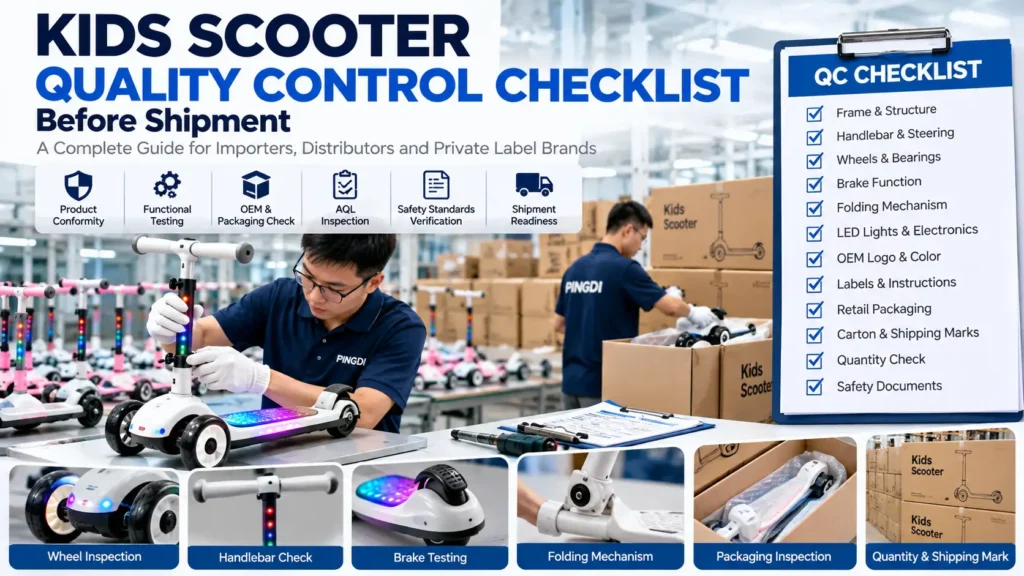
A kids scooter quality control checklist is one of the most important tools for importers, distributors and private-label brands purchasing children’s scooters from China.
A scooter may look attractive in a product catalog and perform well during sample evaluation, but mass production can introduce problems that are not visible in the original sample.
Common issues include loose handlebars, inconsistent wheel rotation, defective brakes, damaged folding mechanisms, incorrect LED functions, mismatched colors, misplaced logos and packaging errors.
These problems can create additional costs, shipment delays, customer complaints and potential safety risks.
For importers purchasing hundreds or thousands of scooters, identifying defects before shipment is generally more practical than dealing with nonconforming goods after delivery.
This guide explains how to organize a professional kids scooter pre-shipment inspection, what components to examine, how AQL sampling works and what buyers should do when defects are discovered.
Guangzhou Pingdi Technology Co., Ltd. supports international importers, distributors, wholesalers and private-label brands through children’s mobility product sourcing, OEM/ODM coordination, supplier communication, production follow-up, quality inspection and export support.
1. Why Quality Control Matters When Importing Kids Scooters
Children’s scooters contain multiple components that must work together.
Depending on the model, these may include:
- Frame and deck
- Handlebars
- Steering mechanisms
- Wheels and bearings
- Rear brakes
- Folding systems
- Adjustable components
- Seats and accessories
- LED lighting
- Packaging and labels
A defect in one component can affect product performance, customer satisfaction or safety.
For example, a poorly secured handlebar may create a functional or safety concern even when the scooter’s appearance is acceptable.
Similarly, a scooter with incorrect retail packaging may be difficult to distribute despite meeting the approved mechanical specifications.
For B2B importers, quality control should address three objectives:
Product Conformity
Does the finished product match the approved sample and technical specification?
Functional Performance
Do the relevant components operate according to the agreed requirements?
Shipment Readiness
Are the quantities, labels, packaging and shipping marks correct?
A professional inspection plan should be established before mass production, not created on the day of shipment.
2. What Is a Kids Scooter Pre-Shipment Inspection?
A pre-shipment inspection, commonly called PSI, is an inspection of goods near the end of production and before dispatch.
Its purpose is to verify that the finished products conform to the buyer’s agreed requirements.
Many inspection providers conduct PSI when production is substantially complete and the goods are sufficiently packed for representative sampling.
A commonly used operational threshold is at least 80% completion, although the exact inspection timing and packing status should be agreed with the inspection company. QIMA
A typical inspection may cover:
- Order quantity
- Product specifications
- Visual workmanship
- Functional checks
- Measurements
- OEM customization
- Labels and warnings
- Retail packaging
- Export cartons
- Shipping marks
The inspector compares selected production units against the approved specification, reference sample and inspection checklist.
The result is documented in an inspection report.
However, PSI is not a guarantee that every unit is defect-free, and routine factory inspection does not replace mandatory laboratory testing.
3. Prepare the Approved Product Specification
Before inspection begins, the buyer should provide a complete specification package.
This is particularly important for OEM and private-label kids scooter orders.
A useful inspection reference package includes:
- Purchase order
- Product model number
- Approved product specification
- Approved sample photographs
- Approved reference sample, where available
- Product dimensions
- Component specifications
- Color references
- Logo artwork
- Packaging artwork
- Inspection requirements
- Defect classification rules
Without an agreed reference, inspectors may have difficulty determining whether a difference is acceptable.
For example, a slightly different handlebar color may be a cosmetic defect, a contractual deviation or an approved variation.
The answer depends on the buyer’s agreed specification.
At PINGDI, specification coordination is an important part of managing OEM and wholesale sourcing projects.
4. Kids Scooter Frame and Structural Inspection
The frame and deck form the main structure of a scooter.
During inspection, relevant checks may include:
Frame Assembly
Verify that the product is assembled according to the approved specification.
Visible Damage
Check for cracks, deformation, damage and other visible defects.
Fasteners
Inspect accessible screws, bolts and fastening points.
Surface Finishing
Check for scratches, coating defects, uneven finishing and visible manufacturing problems.
Deck Condition
Examine the deck for damage, deformation and workmanship inconsistencies.
Product Dimensions
Compare relevant dimensions with the approved specification.
Component Alignment
Check that assembled components are correctly positioned.
Where structural strength or durability testing is required, it should follow the applicable test method and approved acceptance criteria.
A visual inspection alone cannot establish structural compliance.
5. Handlebar and Steering System Inspection
The handlebar and steering system are important functional areas.
Inspection should be adapted to the selected scooter design.
Handlebar Installation
Check whether the handlebar is installed correctly and securely.
Height Adjustment
For adjustable models, verify the available adjustment positions and operation.
Locking Mechanism
Check that the adjustment lock operates according to the approved design.
Steering Movement
Evaluate steering movement and look for abnormal resistance, looseness or interference.
Handle Grips
Inspect grip installation, appearance and security.
Alignment
Verify that the handlebar and steering components are correctly aligned.
For scooters using lean-to-steer mechanisms, the inspection procedure should reflect that specific steering design.
A scooter with conventional handlebar steering should not be inspected using an inappropriate lean-to-steer checklist.
6. Kids Scooter Wheel and Bearing Inspection
Wheel quality can affect the riding experience and product durability.
Common inspection points include:
Wheel Installation
Verify that the wheels are installed correctly.
Wheel Rotation
Check for abnormal resistance, rubbing or inconsistent movement.
Wheel Appearance
Inspect visible defects, damage and material inconsistencies.
Axles and Fasteners
Check accessible wheel attachment points.
Wheel Specifications
Compare the wheel configuration and dimensions against the approved specification.
Bearing Performance
Where applicable, evaluate rotation and abnormal noise according to the inspection plan.
LED Wheel Function
For scooters with illuminated wheels, check whether the agreed lighting function operates correctly.
Wheel materials, sizes and bearing specifications should be confirmed from the product specification rather than inferred from photographs.
7. Kids Scooter Brake Inspection
Brake performance is an important inspection area for scooters equipped with braking systems.
Many children’s kick scooters use a rear foot brake.
Some models may incorporate different braking mechanisms.
A practical brake inspection can include:
- Brake component installation
- Visible workmanship
- Brake operation
- Mechanical interference
- Abnormal movement
- Return function, where applicable
- Damage or deformation
The inspection method should reflect the actual brake design.
Where a relevant safety standard requires a defined braking performance test, the applicable procedure and acceptance criteria should be used.
An inspector pressing the rear brake by hand is not equivalent to completing a formal laboratory braking test.
8. Folding Mechanism and Adjustable Component Inspection
Foldable kids scooters contain additional mechanical components.
These may include hinges, locking systems, release buttons and adjustment mechanisms.
Inspection points can include:
Folding Operation
Verify that the mechanism operates according to the approved design.
Locking Function
Check that the scooter locks into the intended position.
Release Mechanism
Verify the agreed release operation.
Component Alignment
Inspect for abnormal movement or interference.
Accessible Hazards
Review visible pinch points, sharp edges and other potential concerns.
Repeated Operation
Where included in the inspection plan, perform an agreed number of functional cycles.
Durability and mechanical safety testing should be conducted according to the relevant requirements where applicable.
9. LED Kids Scooter Quality Inspection
LED scooters are an important product category for importers seeking visually differentiated children’s mobility products.
Depending on the model, lighting may be integrated into:
- Wheels
- Decks
- Handlebar stems
- Decorative components
LED scooters require additional inspection of the agreed lighting functions.
LED Function
Verify that the lighting operates as specified.
Lighting Consistency
Check for visibly abnormal lighting behavior.
Activation Method
Confirm the intended activation mechanism.
Electrical Components
Where applicable, inspect accessible connections and component installation.
Battery Compartment
If the product uses batteries, inspect the compartment and related features according to the approved specification.
Lighting Modes
Where multiple modes are specified, verify the agreed functions.
The inspection should also confirm that the supplied product matches the approved electronic configuration.
Electrical, battery and chemical compliance testing must be evaluated separately according to the product and destination market.
10. Quality Control for Kids Scooters with Seats
Multifunction scooters may include seats, parent push handles, guardrails and other accessories.
These components introduce additional inspection requirements.
For models equipped with a seat, buyers should consider:
- Seat installation
- Seat connection points
- Adjustment functions
- Locking mechanisms
- Visible deformation
- Component alignment
For parent push handles, relevant checks may include:
- Handle installation
- Connection security
- Height adjustment
- Locking function
- Intended steering or control functions
For guardrails and removable accessories, inspect attachment points and operation according to the approved design.
If the product is marketed as a 3-in-1, 4-in-1 or 5-in-1 scooter, the inspection plan should cover the actual advertised configurations.
11. OEM Kids Scooter Logo and Color Inspection
For private-label brands, product appearance is part of the agreed commercial specification.
Common OEM defects include:
- Incorrect logo position
- Wrong logo size
- Printing defects
- Color differences
- Incorrect deck graphics
- Missing labels
- Inconsistent branding between units
The inspector should compare production units with the approved artwork and color references.
For color-sensitive projects, physical reference samples may be more reliable than screen images alone.
A scooter may function correctly but still be commercially unacceptable if it carries the wrong brand logo or packaging.
PINGDI can coordinate OEM specification confirmation and inspection requirements with selected manufacturing partners.
12. Kids Scooter Packaging Inspection
Packaging should be treated as part of the finished product.
For importers and distributors, incorrect packaging can affect transportation, warehouse operations, retailer acceptance and product traceability.
A packaging inspection should consider:
Retail Box
Check artwork, printing, dimensions and visible damage.
Product Protection
Verify the agreed protective packaging arrangement.
Instruction Manual
Confirm the required manual is included and matches the product.
Warning Labels
Check the presence and accuracy of applicable warnings.
Barcode
Verify the agreed barcode and SKU information.
Master Carton
Inspect carton dimensions, quantity and visible condition.
Shipping Marks
Confirm destination, model, quantity and other agreed markings.
Packing Quantity
Verify the number of products per carton.
For multi-model orders, inspectors should also check that different SKUs are packed and labeled correctly.
13. What Is AQL Inspection for Kids Scooters?
AQL stands for Acceptance Quality Limit.
It is used in statistical sampling inspection systems to help determine whether a lot meets agreed acceptance criteria.
Common sampling systems include ISO 2859-1 and ANSI/ASQ Z1.4.
Under an agreed sampling plan, inspectors select a defined number of units from the inspection lot and classify identified defects.
The sample size and acceptance/rejection numbers depend on factors such as lot size, inspection level, sampling method and selected AQL.
Critical Defects
Critical defects may involve serious safety hazards or other unacceptable conditions defined by the buyer’s inspection protocol.
For children’s products, buyers commonly establish zero acceptance for critical defects.
Major Defects
Major defects can significantly affect product function, usability or commercial acceptability.
Examples may include an inoperative brake or a nonfunctional adjustment mechanism, depending on the agreed defect classification.
Minor Defects
Minor defects generally involve limited deviations that do not substantially affect the intended use.
Examples may include certain small cosmetic imperfections, subject to the buyer’s agreed specification.
Example AQL Settings
Some buyers use the following starting points for consumer goods:
| Defect Category | Illustrative AQL |
|---|---|
| Critical | 0 acceptance |
| Major | 2.5 |
| Minor | 4.0 |
These are illustrative commercial settings, not mandatory universal limits for children’s scooters.
AQL 2.5 does not mean that exactly 2.5% defective products are guaranteed or automatically accepted in every shipment.
The actual acceptance decision must follow the agreed sampling standard and its applicable acceptance/rejection table.
For safety-critical characteristics, buyers may require additional checks beyond routine AQL sampling.
14. When Should Importers Arrange Inspection?
Inspection timing can affect the usefulness of the results.
A practical quality control plan may include three stages.
Pre-Production Inspection
Conducted before or at the beginning of production to review relevant materials, components and approved requirements.
During-Production Inspection
Conducted while manufacturing is underway to identify problems before the full order is completed.
Pre-Shipment Inspection
Conducted near completion to evaluate finished goods, packaging and shipment readiness.
For new suppliers, complex OEM products or large orders, relying only on a final inspection may create unnecessary risk.
The appropriate inspection stages should be selected according to project complexity, order value and supplier history.
15. What Should a Kids Scooter Inspection Report Include?
A professional inspection report should provide enough information for the buyer to make a shipment decision.
Typical contents include:
- Supplier and inspection location
- Product model
- Purchase order reference
- Order quantity
- Available and packed quantity
- Inspection date
- Sampling plan
- Sample size
- Inspection checklist
- Defect descriptions
- Defect quantities
- Photographic evidence
- Functional test results
- Packaging findings
- Overall inspection conclusion
QIMA’s published sample-report guidance confirms that professional PSI reporting commonly includes product conformity checks, quantities, labels, artwork, test findings and photographic evidence. QIMA
Importers should review the detailed findings rather than relying only on a pass/fail label.
16. What Happens If a Kids Scooter Inspection Fails?
A failed inspection does not automatically mean that the entire order must be cancelled.
The appropriate response depends on the defects, contract requirements and potential safety implications.
A structured corrective-action process can include:
Step 1: Identify the Defects
Review photographs, quantities and affected models.
Step 2: Classify the Problems
Determine whether the findings involve safety, function, appearance, packaging or documentation.
Step 3: Investigate the Cause
Ask the supplier to identify the root cause.
Step 4: Agree on Corrective Action
Possible actions may include sorting, repair, component replacement, repacking or rework.
Step 5: Verify the Correction
Arrange suitable follow-up inspection or testing.
Step 6: Confirm Shipment Authorization
The buyer should approve release according to the agreed contract and quality requirements.
Products with unresolved safety or mandatory compliance concerns should not be released merely because a commercial deadline is approaching.
17. How PINGDI Supports Kids Scooter Quality Control
Guangzhou Pingdi Technology Co., Ltd. is a China-based children’s mobility product sourcing and OEM/ODM project management partner.
We work primarily with importers, distributors, wholesalers and private-label brands.
Our business model focuses on coordinating suitable manufacturing resources rather than claiming ownership of every factory.
For kids scooter sourcing projects, our support can include:
Product Specification Coordination
We help buyers communicate required product configurations, components, colors, branding and packaging.
Sample Coordination
We coordinate sample requirements and approval communication before mass production.
Supplier Communication
We work with relevant manufacturing partners to communicate agreed project requirements.
Production Follow-Up
We help track production progress and identify issues requiring buyer confirmation.
Quality Inspection Coordination
We can coordinate inspection arrangements according to the approved specification and agreed project scope.
Corrective-Action Follow-Up
When inspection issues are identified, we can help communicate corrective requirements and coordinate follow-up verification.
Packaging and Export Support
We assist with packaging requirements, shipment preparation and relevant export coordination.
For buyers sourcing multiple children’s mobility categories, we can also discuss consolidated procurement arrangements.
Our sourcing range includes kids scooters, balance bikes, kids bicycles, baby strollers and electric ride-on cars.
18. Frequently Asked Questions
What should I inspect before shipping kids scooters from China?
Importers should check product specifications, frame assembly, handlebars, steering, wheels, brakes, folding mechanisms, LED functions where applicable, OEM branding, labels, packaging and shipment quantities.
Is pre-shipment inspection necessary for kids scooters?
It is a useful commercial risk-control measure, especially for new suppliers, customized orders and larger shipments. The appropriate inspection plan depends on the project and contractual requirements.
What is AQL in kids scooter inspection?
AQL is an acceptance quality limit used within statistical sampling inspection systems. The actual sample size and acceptance criteria depend on the selected sampling plan.
Does AQL inspection guarantee every scooter is defect-free?
No. AQL sampling evaluates a sample of the inspection lot. It does not establish that every individual unit is free from defects.
Can pre-shipment inspection replace safety testing?
No. Routine PSI and laboratory compliance testing serve different purposes.
Should LED scooters have additional inspection items?
Yes. Relevant lighting functions and electronic components should be included according to the approved specification.
Can PINGDI coordinate third-party inspection?
PINGDI can coordinate third-party inspection arrangements and supplier communication according to the agreed project requirements.
What should I do if the inspection report shows major defects?
Review the findings, determine the affected products, agree on corrective action and verify the correction before authorizing shipment.
Conclusion: Reduce Import Risks with a Structured Kids Scooter QC Process
A professional kids scooter quality control checklist helps importers evaluate products against agreed specifications before shipment.
Effective quality control covers more than appearance.
It includes structural components, steering, wheels, brakes, adjustable mechanisms, electronic functions, OEM branding, packaging, documentation and shipment readiness.
For importers purchasing kids scooters from China, combining clear specifications, approved samples, appropriate inspection stages and documented corrective actions can help reduce avoidable sourcing risks.
PINGDI supports international B2B buyers with kids scooter sourcing, OEM/ODM coordination, supplier communication, quality inspection and export support.
If you are preparing a wholesale or private-label kids scooter order, send us your product requirements, estimated quantity, destination market and quality expectations.
Contact PINGDI to discuss your next kids scooter sourcing project.
Kids Scooter Pre-Shipment Inspection Checklist
| Inspection Area | Inspection Item | Inspection Method |
|---|---|---|
| Product Specifications | Model, color, dimensions | Compare with approved specification |
| Frame | Cracks, deformation, assembly | Visual inspection |
| Handlebar | Installation and stability | Functional check |
| Steering | Movement and alignment | Functional check |
| Height Adjustment | Adjustment and locking | Functional check |
| Wheels | Rotation and installation | Functional check |
| Bearings | Abnormal resistance or noise | Functional check |
| Brake | Operation and installation | Functional check |
| Folding System | Locking and release | Functional check |
| LED Lights | Lighting functions | Functional check |
| Seat | Installation and locking | Functional check |
| OEM Logo | Position and printing | Compare with approved artwork |
| Colors | Color consistency | Compare with reference |
| Labels | Warnings and product information | Document check |
| Packaging | Box, manual and accessories | Visual and quantity check |
| Cartons | Quantity and shipping marks | Carton inspection |
| Compliance Documents | Applicable reports and declarations | Document review |