Baby Strollers

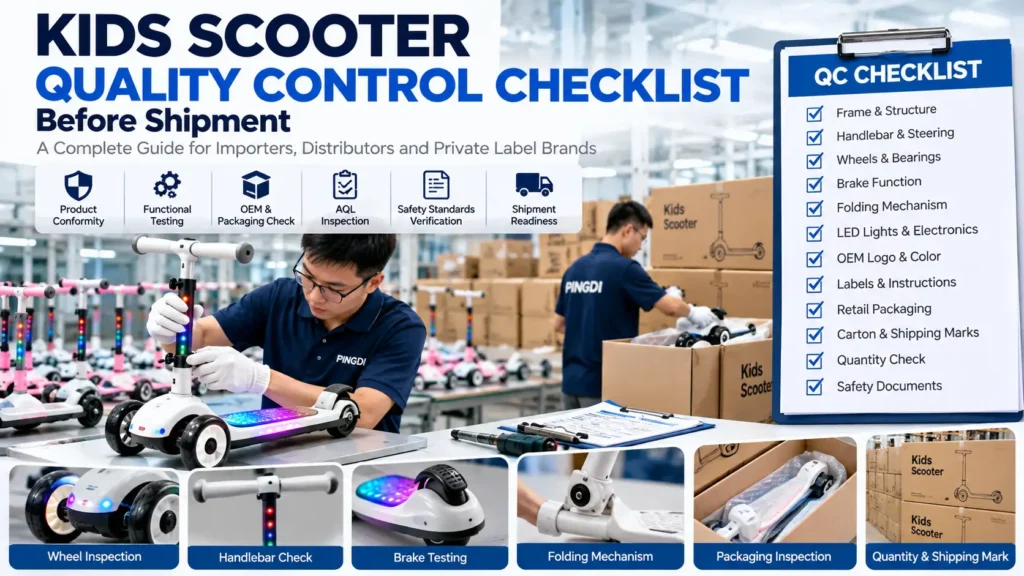
Kids Scooter Quality Control Checklist Before Shipment: A Guide for Importers

A kids scooter quality control checklist is one of the most important tools for importers, distributors and private-label brands purchasing children’s scooters from China. A scooter may look attractive in a product catalog and perform well during sample evaluation, but mass production can introduce problems that are not visible in the original sample. Common issues include loose handlebars, inconsistent wheel rotation, defective brakes, damaged folding mechanisms, incorrect LED functions, mismatched colors, misplaced logos and packaging errors. These problems can create additional costs, shipment delays, customer complaints and potential safety risks. For importers purchasing hundreds or thousands of scooters, identifying defects before shipment is generally more practical than dealing with nonconforming goods after delivery. This guide explains how to organize a professional kids scooter pre-shipment inspection, what components to examine, how AQL sampling works and what buyers should do when defects are discovered. Guangzhou Pingdi Technology Co., Ltd. supports international importers, distributors, wholesalers and private-label brands through children’s mobility product sourcing, OEM/ODM coordination, supplier communication, production follow-up, quality inspection and export support. 1. Why Quality Control Matters When Importing Kids Scooters Children’s scooters contain multiple components that must work together. Depending on the model, these may include: A defect in one component can affect product performance, customer satisfaction or safety. For example, a poorly secured handlebar may create a functional or safety concern even when the scooter’s appearance is acceptable. Similarly, a scooter with incorrect retail packaging may be difficult to distribute despite meeting the approved mechanical specifications. For B2B importers, quality control should address three objectives: Product Conformity Does the finished product match the approved sample and technical specification? Functional Performance Do the relevant components operate according to the agreed requirements? Shipment Readiness Are the quantities, labels, packaging and shipping marks correct? A professional inspection plan should be established before mass production, not created on the day of shipment. 2. What Is a Kids Scooter Pre-Shipment Inspection? A pre-shipment inspection, commonly called PSI, is an inspection of goods near the end of production and before dispatch. Its purpose is to verify that the finished products conform to the buyer’s agreed requirements. Many inspection providers conduct PSI when production is substantially complete and the goods are sufficiently packed for representative sampling. A commonly used operational threshold is at least 80% completion, although the exact inspection timing and packing status should be agreed with the inspection company. QIMA A typical inspection may cover: The inspector compares selected production units against the approved specification, reference sample and inspection checklist. The result is documented in an inspection report. However, PSI is not a guarantee that every unit is defect-free, and routine factory inspection does not replace mandatory laboratory testing. 3. Prepare the Approved Product Specification Before inspection begins, the buyer should provide a complete specification package. This is particularly important for OEM and private-label kids scooter orders. A useful inspection reference package includes: Without an agreed reference, inspectors may have difficulty determining whether a difference is acceptable. For example, a slightly different handlebar color may be a cosmetic defect, a contractual deviation or an approved variation. The answer depends on the buyer’s agreed specification. At PINGDI, specification coordination is an important part of managing OEM and wholesale sourcing projects. 4. Kids Scooter Frame and Structural Inspection The frame and deck form the main structure of a scooter. During inspection, relevant checks may include: Frame Assembly Verify that the product is assembled according to the approved specification. Visible Damage Check for cracks, deformation, damage and other visible defects. Fasteners Inspect accessible screws, bolts and fastening points. Surface Finishing Check for scratches, coating defects, uneven finishing and visible manufacturing problems. Deck Condition Examine the deck for damage, deformation and workmanship inconsistencies. Product Dimensions Compare relevant dimensions with the approved specification. Component Alignment Check that assembled components are correctly positioned. Where structural strength or durability testing is required, it should follow the applicable test method and approved acceptance criteria. A visual inspection alone cannot establish structural compliance. 5. Handlebar and Steering System Inspection The handlebar and steering system are important functional areas. Inspection should be adapted to the selected scooter design. Handlebar Installation Check whether the handlebar is installed correctly and securely. Height Adjustment For adjustable models, verify the available adjustment positions and operation. Locking Mechanism Check that the adjustment lock operates according to the approved design. Steering Movement Evaluate steering movement and look for abnormal resistance, looseness or interference. Handle Grips Inspect grip installation, appearance and security. Alignment Verify that the handlebar and steering components are correctly aligned. For scooters using lean-to-steer mechanisms, the inspection procedure should reflect that specific steering design. A scooter with conventional handlebar steering should not be inspected using an inappropriate lean-to-steer checklist. 6. Kids Scooter Wheel and Bearing Inspection Wheel quality can affect the riding experience and product durability. Common inspection points include: Wheel Installation Verify that the wheels are installed correctly. Wheel Rotation Check for abnormal resistance, rubbing or inconsistent movement. Wheel Appearance Inspect visible defects, damage and material inconsistencies. Axles and Fasteners Check accessible wheel attachment points. Wheel Specifications Compare the wheel configuration and dimensions against the approved specification. Bearing Performance Where applicable, evaluate rotation and abnormal noise according to the inspection plan. LED Wheel Function For scooters with illuminated wheels, check whether the agreed lighting function operates correctly. Wheel materials, sizes and bearing specifications should be confirmed from the product specification rather than inferred from photographs. 7. Kids Scooter Brake Inspection Brake performance is an important inspection area for scooters equipped with braking systems. Many children’s kick scooters use a rear foot brake. Some models may incorporate different braking mechanisms. A practical brake inspection can include: The inspection method should reflect the actual brake design. Where a relevant safety standard requires a defined braking performance test, the applicable procedure and acceptance criteria should be used. An inspector pressing the rear brake by hand is not equivalent to completing a formal laboratory braking test. 8. Folding Mechanism and Adjustable Component Inspection Foldable kids scooters contain additional mechanical components.

Kids Scooter Quality Control Checklist Before Shipment: A Guide for Importers Read More »
2115a166 8455 48ee 84fa 97c710e66cc2

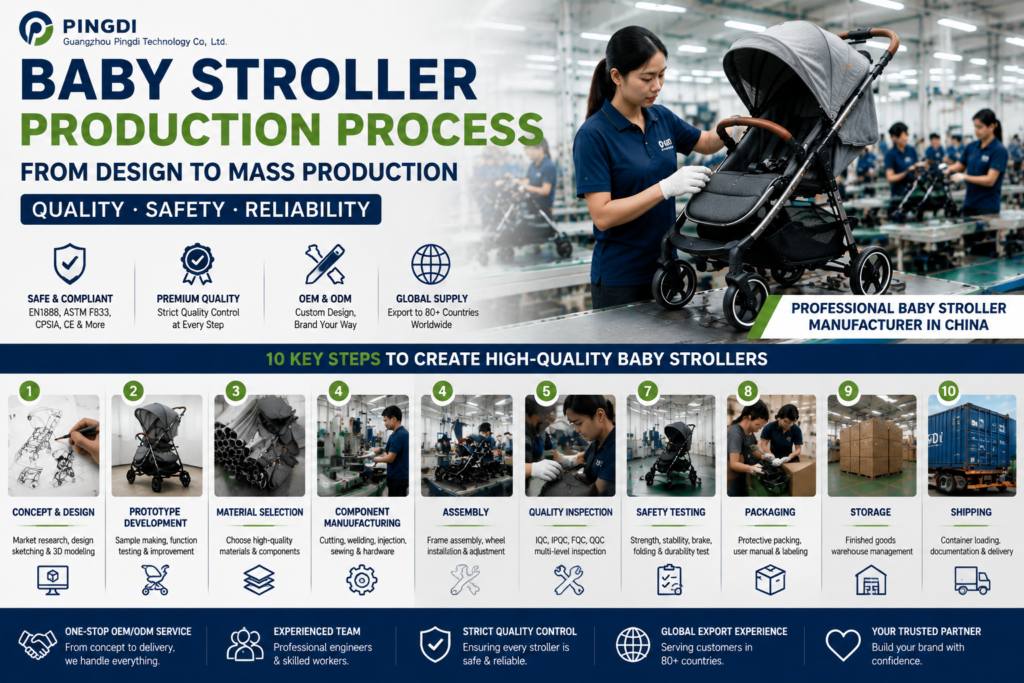
Baby Stroller Production Process: From Design to Mass Production (2026 Complete Guide)

Introduction: How Are Baby Strollers Manufactured? When international buyers purchase baby strollers from China, many focus on: However, professional buyers understand that the real difference between suppliers is hidden inside the manufacturing process. A reliable OEM Baby Stroller Manufacturer China does not simply assemble products. A professional factory manages the entire process, including: Understanding the complete baby stroller production process helps importers evaluate whether a manufacturer has the capability to deliver safe, reliable, and market-ready products. This guide explains how professional baby stroller factories transform an idea into a finished product. 1. Product Concept and Market Research Every successful baby stroller starts with market research. Before developing a new product, manufacturers analyze: Different markets have different expectations. For example: European Market Customers often focus on: North American Market Buyers usually prefer: Latin American Market Important factors include: A professional Baby Stroller Manufacturer China develops products based on market demand rather than simply copying existing models. 2. Industrial Design and Product Development After confirming the product concept, engineers begin the design process. The design stage includes: Appearance Design Designers develop: The goal is to create products that are attractive to consumers. Structural Design Engineers focus on: A good structural design improves: Engineering Optimization Before production, engineers evaluate: This stage helps balance: Design + Quality + Cost 3. Prototype Development Before mass production, professional factories create prototypes. Prototype development allows manufacturers and customers to evaluate: During prototype testing, engineers check: Folding System Testing: Wheel Performance Checking: Frame Strength Testing: 4. Material Selection and Component Preparation Material quality directly affects the final product. A professional baby stroller factory carefully selects: Frame Materials Common materials include: High-quality frames provide: Fabric Materials Important factors include: Wheels and Hardware Components include: Each component must meet product requirements. 5. Component Manufacturing Before final assembly, different parts are manufactured separately. Main production processes include: Metal Processing Including: Plastic Injection Plastic components include: Injection molding ensures: Fabric Sewing Professional sewing teams produce: Precision sewing improves product appearance and durability. 6. Baby Stroller Assembly Process After all components are prepared, products enter the assembly line. The assembly process usually includes: Step 1: Frame Assembly Workers install: Step 2: Wheel Installation Including: Workers check wheel rotation and alignment. Step 3: Seat Installation Including: Step 4: Functional Adjustment Workers adjust: 7. Quality Control During Production Quality control is one of the most important parts of baby stroller manufacturing. Professional factories use multiple inspection stages. IQC: Incoming Quality Control Before production: Inspect: Only approved materials enter production. IPQC: In-Process Quality Control During assembly: Inspect: Problems are identified early. FQC: Final Quality Control Before packaging: Test: OQC: Shipment Inspection Before loading: Confirm: 8. Safety Testing and Compliance Baby strollers are safety-related products. Professional manufacturers consider international requirements such as: Testing commonly evaluates: A reliable factory integrates safety requirements into product development from the beginning. 9. Packaging and Mass Production After approval, the factory begins mass production. Mass production includes: Professional manufacturers optimize packaging to: 10. Shipment Preparation Before shipment, factories prepare: Products are loaded into containers and shipped worldwide. A professional manufacturer supports buyers throughout the entire process. Why Choose an Experienced OEM Baby Stroller Manufacturer? The production process determines: An experienced factory can help buyers: ✔ Reduce production risks ✔ Improve product quality ✔ Launch products faster ✔ Control manufacturing costs ✔ Build long-term supply chains Why Choose Pingdi Factory? Guangzhou Pingdi Technology specializes in OEM and ODM children’s products, including: Our capabilities include: ✔ Product Design Support ✔ OEM & ODM Manufacturing ✔ Quality Control System ✔ Production Management ✔ Customized Packaging ✔ Export Support From initial concept to final shipment, Pingdi Factory provides complete manufacturing solutions for global baby product brands. Frequently Asked Questions (FAQ) 1. How long does baby stroller production take? Production time depends on product complexity, customization requirements, and order quantity. 2. Can I customize my own baby stroller design? Yes. Professional OEM manufacturers support: 3. What is the MOQ for OEM baby strollers? MOQ depends on: 4. Do Chinese factories provide safety testing? Yes. Experienced manufacturers can support testing requirements according to target markets. 5. How do I choose a reliable baby stroller factory? Evaluate: Conclusion The journey from a baby stroller concept to mass production requires professional design, engineering expertise, strict quality control, and experienced manufacturing management. Choosing the right OEM Baby Stroller Manufacturer China allows brands and importers to create reliable products while reducing supply chain risks. A professional factory is not only a supplier—it is a manufacturing partner that supports your brand growth. At Pingdi Factory, we help global customers transform ideas into high-quality baby products through professional OEM and ODM solutions. Planning a Baby Stroller Sourcing Project? Tell us your target market, preferred stroller type, estimated order quantity and customization requirements. Our team can review your request and discuss the next steps for your project. Looking for a Reliable Baby Stroller Sourcing Partner in China? Guangzhou Pingdi Technology Co., Ltd. supports importers, distributors and private-label brands with supplier coordination, OEM/ODM project management, quality inspection and shipment arrangements. Request a Baby Stroller Quotation

Baby Stroller Production Process: From Design to Mass Production (2026 Complete Guide) Read More »

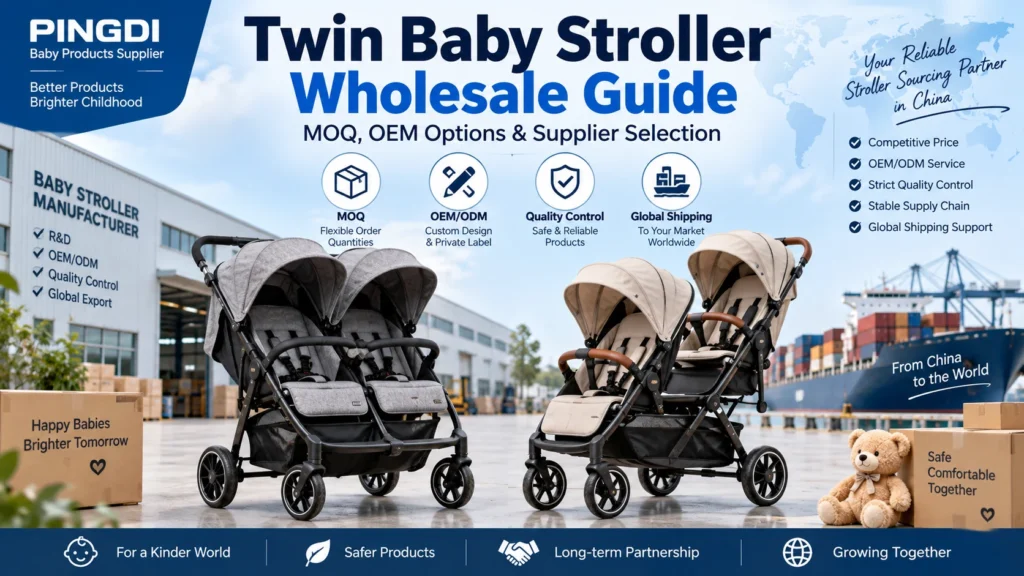
Twin Baby Stroller Wholesale Guide: MOQ, OEM Options & Supplier Selection

Sourcing a twin baby stroller is very different from buying a standard single stroller. For importers, distributors and baby-product brands, the challenge is not simply finding the lowest FOB price. A twin stroller has two seating positions, a more complex frame structure, higher load requirements, larger packaging dimensions and often more demanding folding, braking and stability requirements. A quotation that looks attractive at the beginning can become expensive if the stroller has an oversized carton, inconsistent frame quality, poor folding performance or requires modifications after testing. This is why professional buyers searching for twin baby stroller wholesale suppliers should evaluate the complete project: Product design → MOQ → OEM requirements → compliance → quality control → packaging → loading → delivery This guide explains how to source twin and double baby strollers from China, how MOQ works, which OEM options are realistic, what affects wholesale pricing and how to select a supplier for long-term cooperation. 1. Twin Baby Stroller vs Double Stroller vs Tandem Stroller Before requesting quotations, buyers should first define exactly what type of stroller they need. The terms twin stroller, double stroller and tandem stroller are sometimes used interchangeably in B2B sourcing, but the actual configurations can be different. Side-by-Side Twin Stroller Two seats are positioned next to each other. Advantages can include equal seating space and easier access to both children. However, overall width becomes an important consideration for doors, elevators, retail positioning and packaging. Tandem Double Stroller One seat is positioned in front of or behind the other. This configuration can reduce overall width but creates different requirements for frame geometry, seat arrangement, folding and weight distribution. Convertible Double Stroller Some products can be configured for one or two children or offer different seat/carrycot arrangements. These models provide greater flexibility but normally involve more components, accessories and engineering complexity. When contacting a double stroller manufacturer China supplier, send reference photos or drawings rather than simply asking: “Please quote your best twin stroller.” The more clearly the product is defined, the more meaningful the quotation will be. 2. What Is the Typical MOQ for Twin Baby Stroller Wholesale? There is no universal MOQ. Current B2B listings illustrate this clearly: some standard models advertise very small trial quantities, while other double/twin stroller programs show MOQs around 50, 100, 172, 180, 300 or 500 pieces depending on model and supplier. For serious importers, the better question is: Why does this particular stroller have this MOQ? MOQ can be affected by several factors. Standard Model If you select an existing stroller with standard colors and packaging, the supplier may accept a relatively low MOQ. This is useful for distributors testing a new market. Custom Color Fabric, plastic and metal-frame color requirements can increase MOQ because suppliers need to purchase materials according to minimum production quantities. Private Label Packaging Customized cartons, manuals, labels and packaging materials have their own printing MOQs. Structural Modification Changing frame construction, seat arrangement, folding systems or tooling can turn a normal wholesale project into an ODM development project. Mixed-Model Orders For distributors purchasing several baby products, a supply-chain partner may be able to consolidate different models or categories into one shipment. PINGDI therefore evaluates MOQ based on the complete project configuration, rather than promising one artificially low MOQ for every buyer. 3. Don’t Compare Twin Stroller Prices Before Comparing Specifications Suppose Supplier A quotes: US$48 Supplier B quotes: US$56 Does that mean Supplier A is cheaper? Not necessarily. The quotation may differ because of: Even carton dimensions can materially affect the importer’s final landed cost. A twin stroller is naturally larger than many single strollers. If one supplier can optimize the folding structure and carton volume without compromising product integrity, container utilization may improve substantially. For wholesale buyers, therefore: FOB price is only one component of product cost. The better comparison is: Product Cost + Packaging + Freight + Compliance + QC + Defect Risk This is particularly important when purchasing hundreds or thousands of units. 4. What OEM Options Are Available for Twin Baby Strollers? For brands searching for an OEM twin baby stroller, customization usually falls into several levels. Level 1 — Branding The simplest private-label project may include: This generally requires less development than changing the stroller itself. Level 2 — Color and Appearance Buyers may customize: This is one of the most common requirements for a private label baby stroller project. Level 3 — Configuration Depending on the base model, buyers may request different: Level 4 — Structural ODM This can involve: At this stage, the project should no longer be managed as a simple logo customization order. Development cost, tooling, sample rounds, testing and production MOQ should all be evaluated separately. 5. OEM Does Not Mean Every Change Is Free This is an important issue for first-time importers. Some buyers send a reference stroller and request: “Change the frame, wheels, fabric, seat, folding mechanism and packaging, but keep the original MOQ and price.” That is usually unrealistic. Customization has to be divided into: existing-component customization and new-development customization. Changing an available fabric color is fundamentally different from developing a new folding joint. PINGDI’s preferred process is to review the buyer’s requested changes first and divide them into: Available → Requires MOQ → Requires Tooling → Requires Testing This gives buyers a much clearer development budget before they commit to the project. 6. What Safety Requirements Should Importers Consider? Compliance must be determined according to the destination market and exact stroller configuration. For Europe, EN 1888 is a key standard associated with wheeled child conveyances. Buyers searching the current China stroller supply market will frequently encounter EN1888-related product claims and documentation. However, importers should not accept a supplier’s statement such as: “EN1888 available.” as sufficient evidence by itself. Before mass production, check: Requirements also differ by destination market. A product intended for Europe should not automatically be assumed to meet U.S., UK, Middle Eastern or other market requirements simply because an EN1888 report exists. For a professional OEM project, compliance

Twin Baby Stroller Wholesale Guide: MOQ, OEM Options & Supplier Selection Read More »

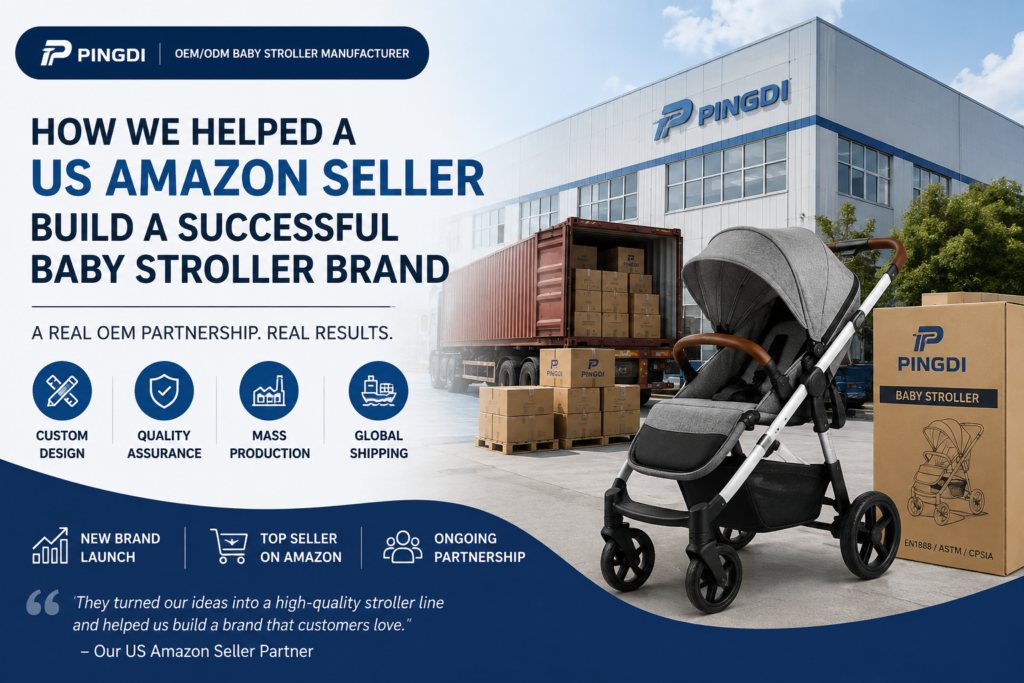
How We Helped a US Amazon Seller Build a Successful Baby Stroller Brand with Our OEM Solution

A Successful Private Label Baby Stroller Manufacturing Case Study Introduction: From Amazon Seller to Baby Product Brand Owner Launching a successful baby product brand on Amazon requires much more than finding a popular product. Many Amazon sellers start their journey by searching for products with market potential, but long-term success depends on: For baby products, especially baby strollers, customers expect: A generic product with no differentiation is becoming increasingly difficult to compete with. Baby stroller suppliers targeting the U.S. market should also understand applicable product safety and compliance requirements published by the U.S. Consumer Product Safety Commission (CPSC) Successful Amazon sellers are moving toward: Private Label + OEM Manufacturing This approach allows sellers to: This case study explains how Pingdi Factory helped a US Amazon seller transform an initial product idea into a successful baby stroller brand through our OEM manufacturing solution. Project Overview Customer Background The customer was a US-based Amazon seller specializing in baby and children’s products. Before cooperation, the customer mainly sold existing products through Amazon. However, they faced several challenges: Challenge 1: Strong Market Competition The customer found that many baby stroller listings on Amazon looked similar. Problems included: The customer wanted a product that could stand out. Challenge 2: Lack of Manufacturing Experience Although the customer understood Amazon operations, they did not have experience with: They needed a reliable: OEM Baby Stroller Manufacturer China to support the entire process. Challenge 3: Building a Long-Term Brand The customer did not want to simply sell another product. Their goal was: Project Requirements Product Category Private Label Baby Stroller Market United States Amazon Marketplace Cooperation Model OEM Manufacturing Main Requirements: Step 1: Understanding the Amazon Market Positioning Before product development, our team worked with the customer to understand: This step was important because successful Amazon products are created based on market demand. We analyzed: Competitor Weaknesses Common problems found in existing listings: Customer Expectations US parents usually focus on: Based on these insights, we helped the customer define the product direction. Step 2: OEM Baby Stroller Product Development As an experienced: Custom Baby Stroller Manufacturer China we supported the customer from concept to finished product. Product Design Optimization Our engineering team helped improve: Frame Structure Focused on: Folding System Optimized: Seat Design Improved: Step 3: Creating a Private Label Baby Stroller Brand A successful Amazon product requires strong branding. We supported: Logo Customization Including: Packaging Design Including: Product Appearance Including: The goal was not only to manufacture a stroller, but to help create a recognizable baby product brand. Step 4: Prototype Development and Testing Before mass production, we developed samples for evaluation. The process included: First Prototype Checked: Customer Testing The customer evaluated: Improvement Stage Based on feedback, we optimized: Step 5: Manufacturing Process After sample approval, production started. The manufacturing process included: Material Inspection Checking: Frame Production Including: Sewing Process Producing: Assembly Including: Step 6: Quality Control for Amazon Sales For Amazon sellers, product reviews directly influence sales. A few negative reviews can affect: Therefore, quality control was critical. Our QC System Included: IQC Incoming material inspection IPQC Production process inspection FQC Finished product testing OQC Shipment inspection Product Testing Focus We checked: Step 7: Supporting Amazon Brand Growth Our support did not stop at production. We helped the customer prepare: This allowed the Amazon seller to focus on: Project Results Through cooperation with Pingdi Factory, the customer successfully achieved: A Customized Baby Stroller Brand Including: ✔ Private label product ✔ Custom design ✔ Brand packaging ✔ Stable manufacturing supply Business Benefits The customer gained: Why Amazon Sellers Need an OEM Manufacturing Partner Many Amazon sellers understand: But manufacturing is a completely different field. A professional OEM partner helps solve: Product Development Problems Turning ideas into real products. Manufacturing Problems Ensuring: Supply Chain Problems Managing: Why Choose Pingdi Factory? Guangzhou Pingdi Technology specializes in OEM and ODM children’s products. Our products include: Our OEM Advantages 1. Product Development Support Helping brands with: 2. Private Label Manufacturing Supporting: 3. Quality Management Including: 4. Global Export Experience Supporting buyers from: FAQ Q1: Can you help Amazon sellers create private label baby strollers? Yes. We support Amazon sellers with: Q2: What is the MOQ for private label baby strollers? MOQ depends on: Q3: Can I customize an existing stroller design? Yes. We support: Q4: Do you support Amazon FBA sellers? Yes. We can support Amazon sellers with manufacturing, packaging, and export preparation. Q5: Why choose OEM instead of buying existing products? OEM allows brands to: Conclusion: Building Brands Through Professional OEM Manufacturing Building a successful Amazon baby product brand requires more than selling products. It requires: Through professional OEM solutions, Pingdi Factory helped a US Amazon seller transform from a product seller into a baby stroller brand owner. For Amazon sellers, private label brands, and baby product companies looking for a reliable: OEM Baby Stroller Manufacturer China Pingdi Factory provides complete manufacturing solutions from concept development to mass production.

How We Helped a US Amazon Seller Build a Successful Baby Stroller Brand with Our OEM Solution Read More »

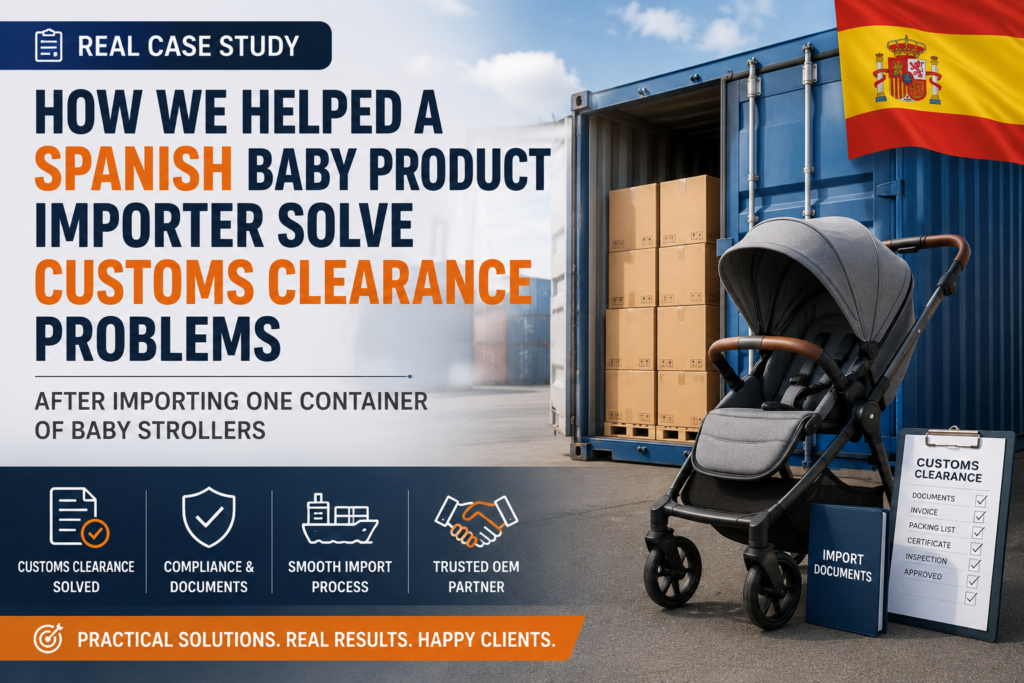
How We Helped a Spanish Baby Product Importer Solve Customs Clearance Problems After Importing One Container of Baby Strollers

A Real OEM Baby Stroller Import Support Case Study Introduction: Successful Importing Requires More Than Manufacturing For international baby product importers, purchasing from China is not only about finding a factory with competitive prices. A successful import project requires support throughout the entire supply chain: Many buyers think the supplier’s responsibility ends when products leave the factory. However, experienced manufacturers understand that international cooperation requires long-term support. Especially for first-time importers, challenges may appear during: This case study explains how Pingdi Factory helped a Spanish baby product importer solve customs clearance problems after importing one container of baby strollers from China. Through effective communication, document support, and supply chain coordination, we helped the customer successfully complete the import process and receive the products. Project Overview Customer Background The customer was a Spanish baby product importer specializing in: The company was expanding its product range and looking for a reliable: Baby Stroller Supplier China for long-term cooperation. After evaluating several suppliers, the customer selected Pingdi Factory because of: Project Requirements Product Customized Baby Strollers Quantity One Container Shipment Market Spain / European Union Cooperation Model OEM Manufacturing Customer Requirements The customer needed: Step 1: Product Development and Production Preparation Before production, our team communicated with the customer regarding: As a professional: OEM Baby Stroller Manufacturer China we understand that European buyers usually have higher requirements regarding: Product Customization The project included: Custom Colors The customer selected colors according to their market positioning. Brand Customization Including: Product Details Our engineering team optimized: Step 2: Strict Quality Control Before Shipment Before shipping, quality control was performed throughout production. Our QC process included: IQC – Incoming Quality Control Inspection of: IPQC – Production Inspection Monitoring: FQC – Final Product Inspection Checking: OQC – Shipment Inspection Before loading: Confirmed: Step 3: Container Shipment Preparation After production completion, the products were prepared for export. The shipment included: Our logistics team worked with the customer to confirm: The container was successfully shipped from China to Spain. Step 4: Customs Clearance Problem Appeared After the container arrived in Spain, the customer encountered unexpected customs clearance difficulties. The main problems included: Problem 1: Document Verification Issues The customs broker requested additional confirmation regarding: Problem 2: Import Process Delay Because of incomplete communication between different parties, the clearance process became slower than expected. The customer was concerned about: Problem 3: Lack of Previous Import Experience Although the customer had experience selling baby products, they had limited experience handling complex import situations. They needed support from a supplier who understood international trade procedures. Step 5: How Pingdi Factory Helped Solve the Problem Instead of simply saying: “Products have already shipped.” Our team actively participated in solving the problem. Solution 1: Document Review and Confirmation We reviewed all available export documents: Including: We communicated with the customer and logistics partners to ensure information consistency. Solution 2: Supplier Communication Support Our team maintained communication between: We helped clarify: This reduced misunderstandings during the clearance process. Solution 3: Providing Product Information Support For baby products, customs and import authorities may require clear product information. We provided: Helping the customer complete the required procedures. Solution 4: Continuous Follow-Up During the process, we kept communication active. We updated the customer regarding: This helped reduce customer anxiety during the delay. Step 6: Successful Customs Clearance and Delivery After cooperation between all parties, the customs clearance issue was successfully resolved. The customer finally received: The customer appreciated our support because we provided assistance beyond normal manufacturing responsibilities. Project Results Through this cooperation: Customer Achieved: ✔ Successful import completion ✔ Reduced clearance risks ✔ Received products on schedule ✔ Established confidence in the supplier Pingdi Factory Provided: ✔ OEM manufacturing ✔ Export support ✔ Documentation assistance ✔ Supply chain coordination ✔ Long-term partnership service Why International Buyers Need More Than a Baby Stroller Factory When choosing a supplier, many buyers only compare: However, professional importers understand that a reliable partner should provide: Manufacturing Capability Ability to produce stable quality products. Export Experience Understanding: Problem-Solving Ability Supporting customers when unexpected situations happen. Why Choose Pingdi Factory? Guangzhou Pingdi Technology provides professional OEM and ODM solutions for global children’s product buyers. Our products include: Our Advantages 1. OEM Manufacturing Experience Supporting: 2. Quality Management System Including: 3. International Customer Support Serving customers from: 4. Long-Term Partnership Approach We believe successful cooperation continues after shipment. Our goal is helping customers build reliable supply chains. FAQ Q1: Can a Chinese baby stroller supplier help with customs clearance problems? Yes. Experienced suppliers can support customers with documents, product information, and communication with logistics partners. Q2: What documents are needed when importing baby strollers from China? Common documents include: Q3: How can I reduce customs problems when importing baby products? Prepare documents early and work with experienced suppliers and logistics partners. Q4: Why choose a manufacturer with export experience? Because experienced manufacturers understand: Q5: Does Pingdi support European baby product importers? Yes. We support global customers with OEM manufacturing and export cooperation. Conclusion: A Reliable Supplier Supports Your Business Beyond Production Importing baby strollers from China is a complete process involving: The best suppliers are not only factories. They are partners who help customers solve problems and grow their businesses. Through professional OEM manufacturing and international support, Pingdi Factory helped a Spanish baby product importer successfully solve customs clearance problems after importing one container of baby strollers from China. If you are looking for a reliable: Baby Stroller Manufacturer China with manufacturing capability and export experience, Pingdi Factory is ready to support your next project.

How We Helped a Spanish Baby Product Importer Solve Customs Clearance Problems After Importing One Container of Baby Strollers Read More »

Scroll to Top