Uncategorized

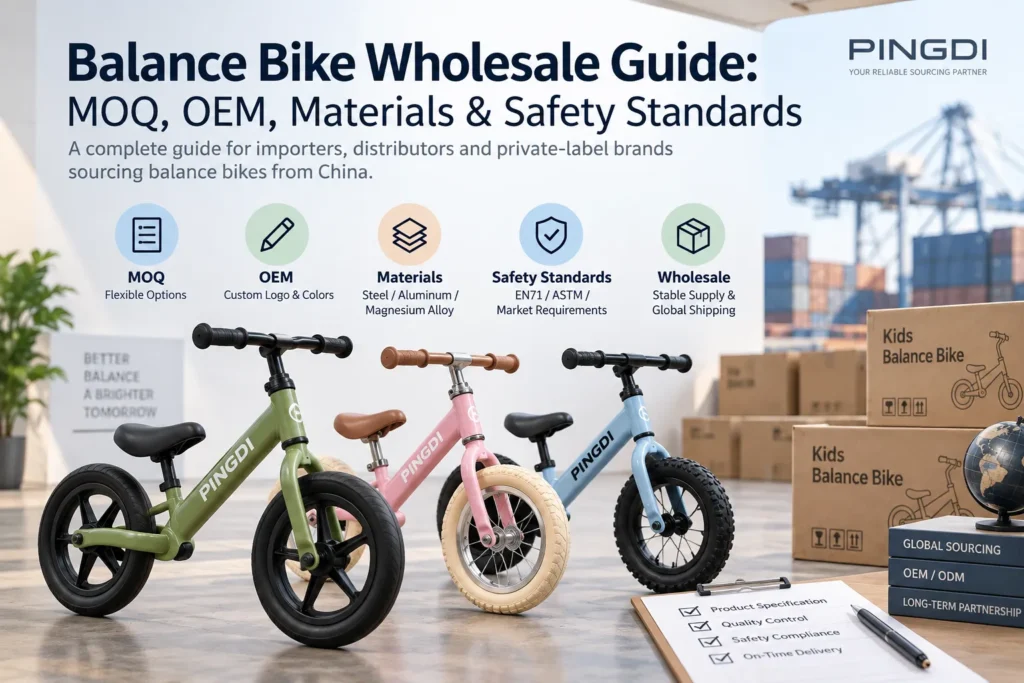
Balance Bike Wholesale Guide: MOQ, OEM, Materials & Safety Standards

Sourcing balance bikes from China is not simply a matter of finding the lowest FOB price. For importers, distributors and private-label brands, the real purchasing decision involves MOQ, frame material, wheel configuration, OEM requirements, packaging, quality consistency, safety requirements and supplier capability. Two balance bikes may look almost identical in supplier photos while having very different frame materials, components, product weight, packaging and production costs. This guide explains the key points professional buyers should evaluate when sourcing balance bikes wholesale from China, from MOQ and OEM customization to materials, quality control and destination-market requirements. 1. What Should Buyers Confirm Before Requesting a Balance Bike Quotation? Before asking ten suppliers for a price, prepare a basic purchasing specification. At minimum, a professional RFQ should include: This is particularly important when comparing a balance bike manufacturer in China because quotations based on different specifications cannot be compared accurately. A $12 product and a $20 product may appear similar in photos while using different frames, wheels, bearings, surface finishes and packaging. At PINGDI, we prefer to establish a comparable specification before evaluating supplier quotations. This helps buyers understand what they are actually paying for rather than selecting a supplier from a price spreadsheet alone. 2. What Is the Typical MOQ for Balance Bike Wholesale Orders? There is no universal balance bike MOQ. Current Chinese B2B listings show anything from very small trial quantities to several hundred pieces, while customized models commonly move toward higher production quantities. For example, current supplier listings include 50-, 100-, 200-, 300- and 500-piece MOQs depending on model and supplier. Alibaba For professional sourcing, it is better to think about MOQ in three levels. Existing Model Without Customization If you select an existing production model and standard color, suppliers may accept a relatively lower MOQ. This can be suitable for: Existing Model With OEM Branding Adding a logo, custom carton, manual or labels normally introduces additional production requirements. The product MOQ may remain manageable, but packaging suppliers can have their own printing MOQ. Custom Color or Product Configuration Custom frame colors, components, molded parts or more substantial modifications usually require a higher commitment. Therefore, importers should ask: “What is the MOQ for this exact configuration?” rather than simply: “What is your MOQ?” That small difference produces a much more useful answer. 3. Steel vs Aluminum vs Magnesium Alloy Balance Bikes Frame material is one of the most important variables when sourcing kids balance bikes wholesale. There is no single material that is best for every market. Steel Frame Balance Bikes Steel remains common in value-oriented children’s mobility products. Advantages can include established production processes, broad supplier availability and competitive cost. For importers targeting price-sensitive retail channels, steel-frame models may offer a practical balance between cost and product positioning. However, buyers should evaluate: Do not compare a steel-frame quotation directly with an aluminum or magnesium model without considering the different construction and positioning. Aluminum Balance Bikes Aluminum frames are often considered for lighter-weight product ranges. Reduced weight can be commercially attractive because parents frequently consider portability when choosing children’s mobility products. For B2B buyers, aluminum models can support a more premium retail position, but the complete product specification still matters. A lightweight frame does not automatically mean that every component is high quality. Evaluate the fork, wheels, bearings, seat, handlebar and other components together. Magnesium Alloy Balance Bikes Magnesium alloy models are increasingly visible in higher-positioned balance bike ranges, especially designs using integrated or distinctive frame shapes. Current B2B sourcing pages prominently feature magnesium-alloy options alongside steel and aluminum products. Alibaba.com Seller Central They can provide strong visual differentiation for brands seeking a more distinctive product. However, buyers should evaluate: Material should therefore be selected according to target customer, retail positioning and landed-cost objective, rather than simply choosing whichever material sounds more premium. 4. EVA Wheels vs Pneumatic Tires Wheel configuration can significantly change product cost, weight, maintenance requirements and riding characteristics. EVA Wheels EVA wheels are popular because they are lightweight and require little maintenance. For distributors focused on simple assembly, low maintenance and competitive pricing, EVA can be practical. Pneumatic Tires Air-filled tires can provide different riding characteristics and are often used on more bicycle-like models. However, they also introduce considerations such as inflation, tubes/valves, maintenance and replacement parts. Before confirming an order, specify: Avoid approving a bulk order based solely on appearance. 5. OEM Balance Bike Options for Private-Label Brands For many importers, OEM balance bike sourcing does not mean developing an entirely new product. Most private-label projects begin with an existing platform and customize selected elements. Common OEM options include: Logo Brand logos can potentially be applied to the frame, fork or other suitable areas depending on product design. Custom Colors Frame, fork, wheels, grips and saddle colors may be customized subject to production MOQ. Labels Product labels, warning labels, barcode labels and carton labels can be prepared according to buyer requirements. Instruction Manual Manuals can be customized with the buyer’s brand, language and required product information. Private-Label Packaging For private label balance bike programs, packaging can include customized artwork, brand information, product specifications and shipping marks. Selected Components Depending on the model and factory capability, buyers may also select different seats, grips, wheels or accessories. At PINGDI, we recommend creating an OEM confirmation sheet before mass production. The document should clearly identify: Product model → Color → Logo → Components → Labels → Manual → Packaging → Carton marks. This is far safer than confirming important OEM details across dozens of WhatsApp or email messages. 6. How Does OEM Affect Balance Bike MOQ and Cost? Customization affects more than the unit price. For example, a custom color may require a minimum production batch. A printed carton may have a separate packaging MOQ. A custom molded component may require tooling. When evaluating an OEM balance bike supplier, ask suppliers to separate costs into: Product cost OEM cost Packaging cost Tooling cost, if applicable Testing cost, if applicable Sample cost This makes quotations easier to compare.

Balance Bike Wholesale Guide: MOQ, OEM, Materials & Safety Standards Read More »
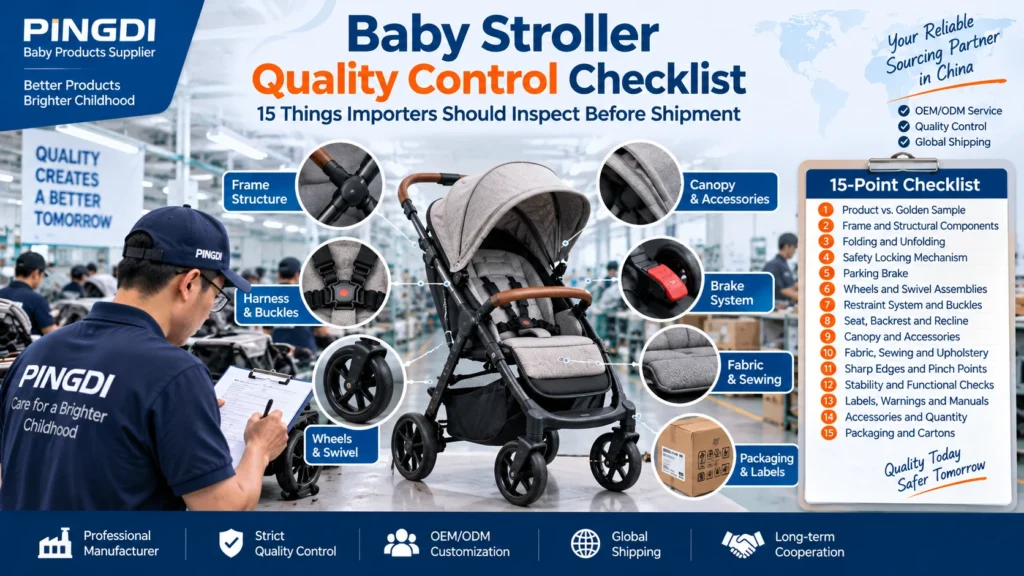
Baby Stroller Quality Control Checklist: 15 Things Importers Should Inspect Before Shipment

A baby stroller can look perfect in a product photo and still create serious problems after shipment. Loose wheels, inconsistent brakes, poorly fitted folding locks, missing accessories, scratched frames, incorrect warning labels or weak cartons may not appear during quotation or sample approval. They often appear during mass production. For importers, distributors and private-label brands, this creates an important question: How do you know the 500 or 2,000 strollers being shipped are consistent with the sample you originally approved? The answer is not another product photo. It is a structured baby stroller quality control process. A professional pre-shipment inspection should verify the actual production batch against the approved product specification, golden sample, packaging requirements and purchase order. This guide provides a practical 15-point baby stroller inspection checklist that importers can use before authorizing shipment. Why Baby Stroller Pre-Shipment Inspection Matters Laboratory testing and production inspection serve different purposes. A test report can help demonstrate that a tested product meets applicable requirements. It does not automatically prove that every unit in a later mass-production batch is correctly assembled or identical to the tested configuration. A stroller pre-shipment inspection, on the other hand, evaluates the actual goods prepared for shipment. This matters because production problems can include: For U.S.-market strollers, CPSC requirements address hazards including stability, brakes, restraint systems, latches and folding mechanisms, structural integrity, wheels and other areas. The U.S. mandatory stroller rule is found in 16 CFR Part 1227 and incorporates ASTM F833 requirements. That makes many of these areas important not only for product quality but also for safety management. 1. Verify the Product Against the Approved Golden Sample The first QC step should happen before inspecting individual components. Put the mass-production stroller next to the approved sample. Compare: For an OEM baby stroller manufacturer project, this is especially important because customized products may involve several component changes. A factory may consider a replacement wheel or slightly different fabric “equivalent.” The importer may not. PINGDI therefore recommends establishing an approved sample and final specification sheet before mass production. The question during QC should be: Does production match what the buyer approved? Not simply: “Does the stroller look acceptable?” 2. Inspect the Frame and Structural Components The frame is one of the most important areas in any baby stroller quality inspection. Inspect: Look for visible cracks, deformation, poor welding, loose connections or inconsistent assembly. For painted or coated frames, also inspect surface finishing. A stroller may function correctly when first unfolded but develop problems after repeated loading if structural components or connections are inconsistent. This is why frame inspection should never be reduced to a cosmetic check. 3. Check Folding and Unfolding Folding is one of the most frequently operated functions of a stroller. Every sampled unit should fold and unfold correctly according to the approved design. Inspect: Perform the operation repeatedly rather than testing it once. The U.S. stroller safety framework specifically addresses latches and folding mechanisms among the hazards covered by the standard. A mechanism that works once but becomes unreliable after several cycles deserves investigation before shipment. 4. Inspect the Safety Lock A stroller should not unintentionally fold during normal use. Inspect the locking system to confirm: This is particularly important when an OEM modification affects the handle, frame or folding system. Structural modifications should be reviewed during development rather than first discovered during final inspection. 5. Test the Parking Brake The brake is another critical inspection point. The inspector should check: The U.S. CPSC stroller requirements specifically include parking-brake performance. For importers, however, the QC objective is broader than merely checking whether the brake “works.” The operation should also be consistent across sampled production units. If one unit requires very little force while another is extremely difficult to engage, there may be an assembly or component-control issue. 6. Check Wheels and Swivel Assemblies Wheel problems can quickly turn into customer complaints. Inspect: Push the stroller on a suitable surface. It should track and steer consistently according to its design. Listen for abnormal noise and check for excessive wheel movement. Wheel and swivel assembly detachment is also specifically addressed within the U.S. stroller safety requirements. For baby stroller wholesale orders, wheel consistency across the production batch deserves particular attention. 7. Inspect the Restraint System and Buckles The harness should match the approved configuration and operate correctly. Check: The restraint system should not be evaluated only visually. Actually fasten, adjust and release it. CPSC identifies restraining-system performance as part of the applicable stroller requirements in the United States. 8. Check Seat, Backrest and Reclining Functions If the stroller has an adjustable backrest, test every intended position. Inspect: For twin or double strollers, inspect both seating positions independently. One seat functioning correctly does not prove the second has been assembled correctly. This is particularly important for the twin baby stroller wholesale projects you are developing. 9. Inspect the Canopy and Moving Accessories Open and close the canopy several times. Check: Then inspect other moving accessories such as: A component may appear attractive in photos while being frustrating to use because of excessive resistance or poor alignment. QC should evaluate function as well as appearance. 10. Check Fabric, Sewing and Upholstery Fabric quality strongly affects the buyer’s perception of the finished stroller. Inspect: For private-label orders, compare color against the approved reference rather than relying on memory or photographs. Material changes can also have compliance implications. If a supplier substitutes fabric, coating or plastic material after the product was tested, the importer should determine whether the change affects applicable testing or documentation. 11. Inspect Sharp Edges, Pinch Points and Accessible Components Run a structured visual and functional inspection around areas accessible during normal use. Pay particular attention to: The CPSC stroller framework addresses issues including scissoring, shearing, pinching, exposed coil springs and protective components. A production inspector should not claim that a visual QC check replaces formal safety testing. Instead, the objective is to detect obvious production deviations or workmanship problems before shipment. 12. Perform Stability and Functional Checks

Baby Stroller Quality Control Checklist: 15 Things Importers Should Inspect Before Shipment Read More »

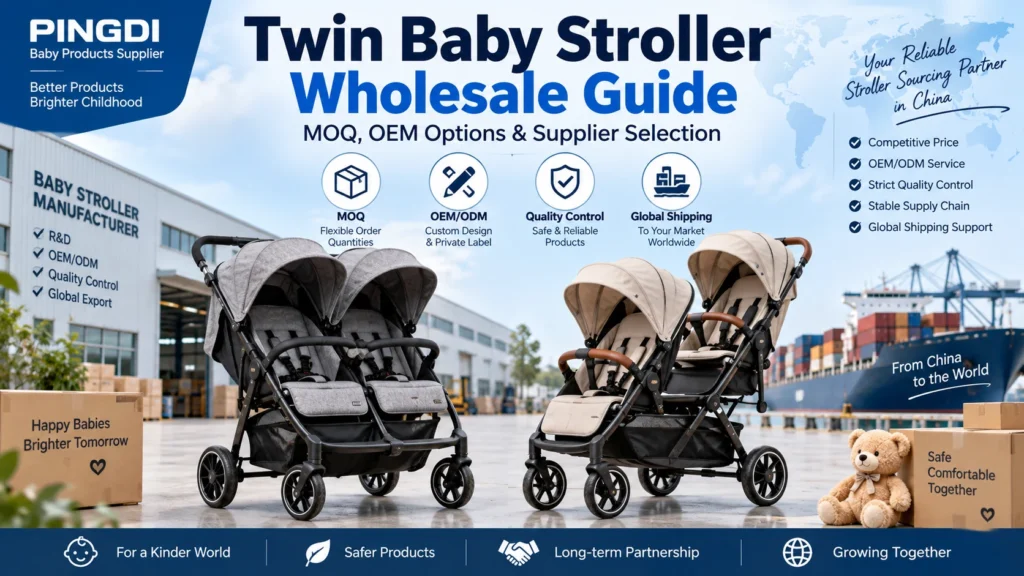
Twin Baby Stroller Wholesale Guide: MOQ, OEM Options & Supplier Selection

Sourcing a twin baby stroller is very different from buying a standard single stroller. For importers, distributors and baby-product brands, the challenge is not simply finding the lowest FOB price. A twin stroller has two seating positions, a more complex frame structure, higher load requirements, larger packaging dimensions and often more demanding folding, braking and stability requirements. A quotation that looks attractive at the beginning can become expensive if the stroller has an oversized carton, inconsistent frame quality, poor folding performance or requires modifications after testing. This is why professional buyers searching for twin baby stroller wholesale suppliers should evaluate the complete project: Product design → MOQ → OEM requirements → compliance → quality control → packaging → loading → delivery This guide explains how to source twin and double baby strollers from China, how MOQ works, which OEM options are realistic, what affects wholesale pricing and how to select a supplier for long-term cooperation. 1. Twin Baby Stroller vs Double Stroller vs Tandem Stroller Before requesting quotations, buyers should first define exactly what type of stroller they need. The terms twin stroller, double stroller and tandem stroller are sometimes used interchangeably in B2B sourcing, but the actual configurations can be different. Side-by-Side Twin Stroller Two seats are positioned next to each other. Advantages can include equal seating space and easier access to both children. However, overall width becomes an important consideration for doors, elevators, retail positioning and packaging. Tandem Double Stroller One seat is positioned in front of or behind the other. This configuration can reduce overall width but creates different requirements for frame geometry, seat arrangement, folding and weight distribution. Convertible Double Stroller Some products can be configured for one or two children or offer different seat/carrycot arrangements. These models provide greater flexibility but normally involve more components, accessories and engineering complexity. When contacting a double stroller manufacturer China supplier, send reference photos or drawings rather than simply asking: “Please quote your best twin stroller.” The more clearly the product is defined, the more meaningful the quotation will be. 2. What Is the Typical MOQ for Twin Baby Stroller Wholesale? There is no universal MOQ. Current B2B listings illustrate this clearly: some standard models advertise very small trial quantities, while other double/twin stroller programs show MOQs around 50, 100, 172, 180, 300 or 500 pieces depending on model and supplier. For serious importers, the better question is: Why does this particular stroller have this MOQ? MOQ can be affected by several factors. Standard Model If you select an existing stroller with standard colors and packaging, the supplier may accept a relatively low MOQ. This is useful for distributors testing a new market. Custom Color Fabric, plastic and metal-frame color requirements can increase MOQ because suppliers need to purchase materials according to minimum production quantities. Private Label Packaging Customized cartons, manuals, labels and packaging materials have their own printing MOQs. Structural Modification Changing frame construction, seat arrangement, folding systems or tooling can turn a normal wholesale project into an ODM development project. Mixed-Model Orders For distributors purchasing several baby products, a supply-chain partner may be able to consolidate different models or categories into one shipment. PINGDI therefore evaluates MOQ based on the complete project configuration, rather than promising one artificially low MOQ for every buyer. 3. Don’t Compare Twin Stroller Prices Before Comparing Specifications Suppose Supplier A quotes: US$48 Supplier B quotes: US$56 Does that mean Supplier A is cheaper? Not necessarily. The quotation may differ because of: Even carton dimensions can materially affect the importer’s final landed cost. A twin stroller is naturally larger than many single strollers. If one supplier can optimize the folding structure and carton volume without compromising product integrity, container utilization may improve substantially. For wholesale buyers, therefore: FOB price is only one component of product cost. The better comparison is: Product Cost + Packaging + Freight + Compliance + QC + Defect Risk This is particularly important when purchasing hundreds or thousands of units. 4. What OEM Options Are Available for Twin Baby Strollers? For brands searching for an OEM twin baby stroller, customization usually falls into several levels. Level 1 — Branding The simplest private-label project may include: This generally requires less development than changing the stroller itself. Level 2 — Color and Appearance Buyers may customize: This is one of the most common requirements for a private label baby stroller project. Level 3 — Configuration Depending on the base model, buyers may request different: Level 4 — Structural ODM This can involve: At this stage, the project should no longer be managed as a simple logo customization order. Development cost, tooling, sample rounds, testing and production MOQ should all be evaluated separately. 5. OEM Does Not Mean Every Change Is Free This is an important issue for first-time importers. Some buyers send a reference stroller and request: “Change the frame, wheels, fabric, seat, folding mechanism and packaging, but keep the original MOQ and price.” That is usually unrealistic. Customization has to be divided into: existing-component customization and new-development customization. Changing an available fabric color is fundamentally different from developing a new folding joint. PINGDI’s preferred process is to review the buyer’s requested changes first and divide them into: Available → Requires MOQ → Requires Tooling → Requires Testing This gives buyers a much clearer development budget before they commit to the project. 6. What Safety Requirements Should Importers Consider? Compliance must be determined according to the destination market and exact stroller configuration. For Europe, EN 1888 is a key standard associated with wheeled child conveyances. Buyers searching the current China stroller supply market will frequently encounter EN1888-related product claims and documentation. However, importers should not accept a supplier’s statement such as: “EN1888 available.” as sufficient evidence by itself. Before mass production, check: Requirements also differ by destination market. A product intended for Europe should not automatically be assumed to meet U.S., UK, Middle Eastern or other market requirements simply because an EN1888 report exists. For a professional OEM project, compliance

Twin Baby Stroller Wholesale Guide: MOQ, OEM Options & Supplier Selection Read More »

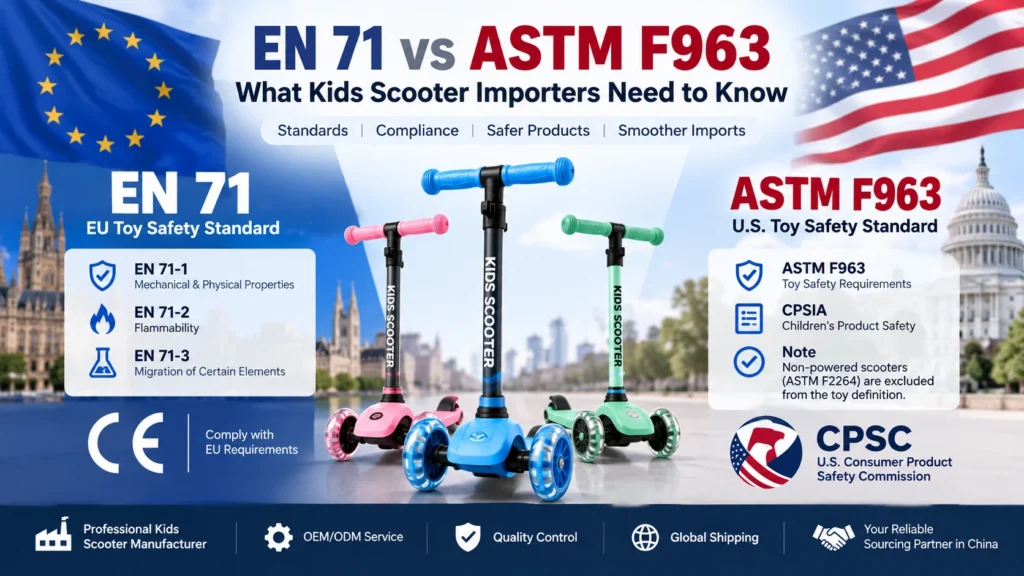
EN 71 vs ASTM F963: What Kids Scooter Importers Need to Know

If you import kids scooters from China, one of the first questions you may ask a supplier is: “Does this scooter comply with EN 71 or ASTM F963?” Unfortunately, the answer is often more complicated than a simple “yes.” A supplier may send an EN 71 test report, another may advertise “CE + ASTM,” while a third may claim that the same report can be used for Europe and the United States. For importers, distributors and private-label brands, this creates a significant sourcing risk. The most important question is not: “Do you have EN 71 or ASTM?” It is: “What regulations and standards actually apply to this specific scooter in my destination market?” EN 71 and ASTM F963 are both associated with children’s product safety, but they belong to different regulatory systems and are not interchangeable. More importantly, certain non-powered scooters in the United States are expressly excluded from ASTM F963’s definition of toys and are instead addressed through other requirements. Understanding this distinction before confirming an OEM order can prevent incorrect testing, labeling problems, shipment delays and unnecessary compliance costs. 1. What Is EN 71? EN 71 is a family of European standards addressing the safety of toys. For importers of products classified as toys in the European Union, EN 71 can form an important part of demonstrating conformity with EU toy-safety requirements. Different parts address different types of hazards. Common examples include: EN 71-1 — Mechanical and Physical Properties This is particularly relevant to toy scooters because it covers mechanical and physical hazards. EN 71-2 — Flammability This addresses flammability requirements for toys. EN 71-3 — Migration of Certain Elements This addresses migration limits for specified elements from toy materials. However, buyers should not treat “EN71 certified” as a complete compliance statement. The applicable requirements depend on the product itself, its materials, intended age, construction and market classification. For toy scooters specifically, European Commission guidance explains that EN 71-1 distinguishes between toy scooters intended for children with body mass of 20 kg or less and those intended for children with body mass of 50 kg or less. That is why PINGDI asks buyers to confirm the intended user, maximum user weight and destination market during the product-specification stage rather than waiting until the shipment is ready. 2. What Is ASTM F963? ASTM F963 is the widely recognized U.S. toy safety standard. Under U.S. law, the applicable version of ASTM F963 has been incorporated into the mandatory federal toy-safety framework through 16 CFR Part 1250. The current CPSC-accepted version for applicable children’s toys manufactured after April 20, 2024 is ASTM F963-23. ASTM F963 addresses numerous potential toy hazards, although the applicable sections depend on the particular product. For children’s toys subject to the rule and intended primarily for children 12 years old or younger, third-party testing by a CPSC-accepted laboratory and certification requirements can apply. This leads to a very common sourcing misunderstanding. A supplier may say: “This is a children’s product, therefore ASTM F963 applies.” That conclusion should not automatically be accepted for a scooter. 3. Does ASTM F963 Apply to Every Kids Scooter? No. This is probably the most important point in this entire guide. The U.S. Consumer Product Safety Commission states that the definition of a toy for purposes of ASTM F963 does not include: non-powered scooters as defined in ASTM F2264. The exclusion also covers recreational powered scooters and pocket bikes as defined in ASTM F2641. Therefore, an importer should not automatically request an ASTM F963 report simply because the product is marketed for children. The actual product must first be classified correctly. For example, depending on the product design and intended use, questions may include: This is where experienced sourcing and compliance coordination becomes important. A test report is useful only when the correct standard has been applied to the correct product. 4. EN 71 vs ASTM F963: The Key Differences For purchasing teams, the easiest way to understand the difference is to stop thinking of EN 71 and ASTM F963 as two versions of the same certificate. They belong to different compliance frameworks. Area European Union United States Common toy standard EN 71 series ASTM F963 Regulatory framework EU toy-safety legislation CPSIA / CPSC rules including 16 CFR Part 1250 Market marking CE marking for toys No equivalent CE mark Importer obligations Yes Yes Product classification matters Yes Yes All scooters automatically covered? No No Non-powered scooter issue Toy-scooter classification must be established ASTM F2264-defined non-powered scooters excluded from ASTM F963 toy definition This table is deliberately simplified. It should not be used as a substitute for a compliance assessment of a particular SKU. That distinction is important for importers because two scooters that look almost identical may have different intended ages, user-weight limits, structures or functions. Those differences can affect the compliance route. 5. EN 71 Requirements for Toy Scooters EN 71-1 contains specific provisions for toy scooters. European Commission guidance explains that toy scooters are separated according to intended body mass, including the 20 kg and 50 kg groups. It also explains that the lower-weight category corresponds to products intended for very young children and can trigger additional provisions. Depending on the product, evaluation can involve issues such as: Mechanical strength The scooter needs to withstand the applicable mechanical stresses without creating unacceptable hazards. Steering system The handlebar and steering structure are important safety components. Folding mechanisms For foldable models, locking and folding structures require particular attention. Wheels and axles Wheel retention, structural integrity and moving components can affect product safety. Accessible edges and points The finished product should not introduce prohibited hazardous edges or points. Warnings and instructions Warnings need to match the product’s intended user and applicable requirements. For a 3 wheel kids scooter manufacturer, therefore, compliance should influence engineering and material selection from the beginning of development. It should not be treated as paperwork added after production. 6. What Does CE Mean for a Kids Scooter? Another frequent question from buyers is: “Does the scooter have CE?”

EN 71 vs ASTM F963: What Kids Scooter Importers Need to Know Read More »

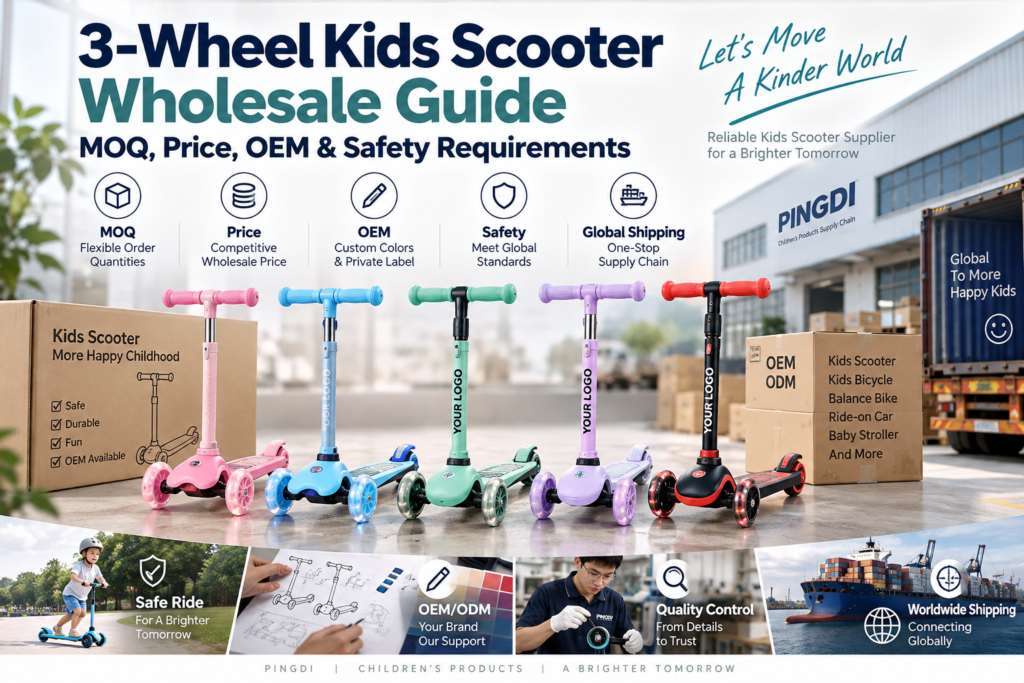
3-Wheel Kids Scooter Wholesale Guide: MOQ, Price, OEM & Safety Requirements

For importers, distributors and children’s product brands, sourcing a 3 wheel kids scooter is not simply a matter of finding the lowest FOB price.3 wheel kids scooter wholesale project for Two scooters that look almost identical in a supplier’s catalog may have very different deck structures, wheel materials, steering systems, plastic quality, bearings, packaging, weight limits and durability. These differences affect not only the wholesale price but also product safety, customer complaints, return rates and the long-term reputation of your brand. Before placing a bulk order with a 3 wheel kids scooter manufacturer in China, buyers should therefore understand four key issues: MOQ, real product cost, OEM capability and market-specific safety requirements. This guide explains what professional buyers should evaluate before ordering 3-wheel kids scooters from China and how to reduce sourcing risks throughout the project. Why Are 3-Wheel Kids Scooters Popular in the Wholesale Market? Three-wheel scooters are particularly attractive for younger riders because the two-front-wheel or dual-rear-wheel structure can provide greater stability than many traditional two-wheel designs. Typical wholesale product configurations include: For distributors, this also creates opportunities to build a product range at several price points instead of importing only one model. A buyer might, for example, develop an entry-level model for supermarkets, a mid-range foldable model for distributors and a customized premium version for its own brand. The challenge is maintaining consistent quality across these different specifications. 1. What Is the Typical MOQ for 3-Wheel Kids Scooters? MOQ is one of the first questions buyers ask when contacting a kids scooter supplier in China. There is no universal MOQ. Current B2B marketplace listings show considerable variation: some suppliers advertise MOQs around 100 units, while other models are listed at 1,000 or even 2,200 units. This illustrates why buyers should treat online MOQ figures as model-specific indications rather than an industry-wide rule. The actual MOQ depends on several factors. Existing model with standard colors If you select an existing design, existing packaging and a standard factory color, the MOQ can usually be lower. This is the best option for buyers who want to: Customized color or logo When custom colors, printed logos, special wheels or customized cartons are required, MOQ normally increases because individual components have their own production minimums. Full OEM/ODM project A completely customized scooter may involve: In this situation, the commercial MOQ needs to be evaluated together with tooling and development costs. At PINGDI, we recommend that buyers define their required customization before negotiating MOQ. A low MOQ is not necessarily useful if the supplier cannot maintain the required specification during mass production. 2. How Much Does a 3-Wheel Kids Scooter Cost? Another common sourcing mistake is comparing quotations based only on product photos. A professional 3 wheel kids scooter wholesale quotation should be evaluated according to the actual specification. Important cost factors include: Frame and handlebar material Plastic content, aluminum tubing, steel components, wall thickness and surface treatment all affect cost. A small reduction in material specification may reduce the FOB price but can also influence durability. Wheels Buyers should confirm: “PU wheels” alone is not a complete specification. Deck construction The deck is one of the major structural components of a scooter. Buyers should evaluate: Steering system Many toddler scooters use a lean-to-steer mechanism. The quality of the steering components affects riding stability and product life, so the internal structure should be reviewed instead of judging only the exterior appearance. Folding mechanism Foldable models are convenient for retail and transportation but introduce additional mechanical components. The locking mechanism should therefore be included in the QC and safety evaluation. Packaging Retail packaging can create a surprisingly large cost difference. Options include: For e-commerce buyers, packaging strength is particularly important because parcel delivery conditions differ from traditional container distribution. 3. Why the Cheapest Scooter Quote Can Become Expensive Suppose Supplier A offers a scooter at USD X and Supplier B is several percent cheaper. Choosing Supplier B appears to save money. But what if the cheaper model has: If these issues result in returns, replacements or customer complaints, the real landed cost can exceed the initial saving. Professional importers should therefore calculate: Product Cost + QC Risk + Defect Cost + Logistics Cost + After-Sales Cost rather than comparing FOB prices alone. At PINGDI, our sourcing process focuses on specification-to-specification comparison. When we compare quotations from different production sources, we first try to make sure the key material and functional specifications are aligned. Otherwise, two prices are not truly comparable. 4. What OEM Options Are Available? For buyers searching for an OEM kids scooter manufacturer, customization normally falls into several levels. Level 1 — Private Label The simplest option. A buyer selects an existing scooter and adds: This approach requires relatively little product development and is suitable for many wholesalers and new brands. Level 2 — Product Configuration Customization The buyer may change: This provides greater differentiation without developing an entirely new platform. Level 3 — Structural OEM/ODM For established brands, deeper development may include: This requires stronger engineering management. Before paying tooling charges, buyers should clarify ownership, maintenance, expected tooling life and whether the same tooling can be used for another customer’s product. 5. Private Label Kids Scooter: What Should Buyers Prepare? If you are developing a private label kids scooter, prepare a product specification sheet before requesting final quotations. It should include: Target age For example: 3+ years Target user weight This is especially important because product classification and testing may depend on intended use and user characteristics. Target market EU, UK and US requirements should not simply be treated as interchangeable. Required dimensions Including deck, wheel and handlebar measurements. Materials Specify important structural materials instead of using vague terms such as “high quality.” Branding Logo location, print method and color references. Packaging Retail box artwork, manual, labels, barcode and master carton requirements. The clearer the RFQ, the more accurate the supplier quotation will be. 6. Safety Requirements for the European Market Safety requirements should be considered before production, not after

3-Wheel Kids Scooter Wholesale Guide: MOQ, Price, OEM & Safety Requirements Read More »

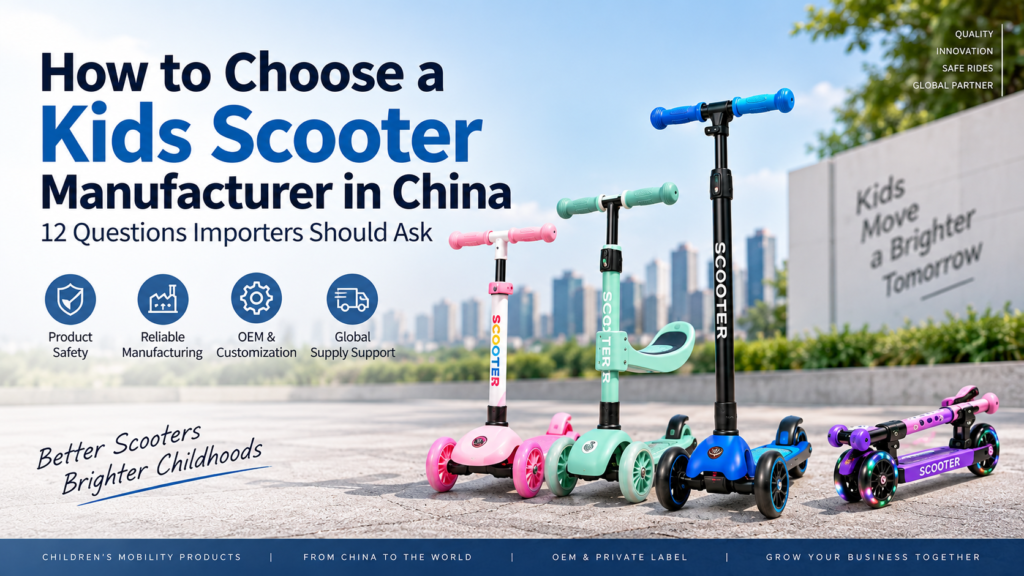
How to Choose a Kids Scooter Manufacturer in China: 12 Questions Importers Should Ask

Choosing a kids scooter manufacturer in China is not only about comparing FOB prices. For importers, distributors, wholesalers, and children’s product brands, the real challenge is finding a supplier that can consistently control materials, product safety, tooling, assembly quality, packaging, testing, production schedules, and OEM requirements across repeat orders. Two suppliers may offer almost identical-looking three-wheel scooters at very different prices. However, the differences may be hidden in the aluminum tube thickness, plastic material, PU wheel quality, bearings, folding mechanism, steering system, brake design, packaging, or quality-control process. These differences may not be obvious from a quotation sheet. Therefore, before selecting a kids scooter supplier in China, professional buyers should look beyond unit price and ask questions that reveal the supplier’s actual capabilities. Here are 12 questions every importer should ask before placing a wholesale kids scooter order. 1. Are You a Kids Scooter Manufacturer, Trading Company, or Supply-Chain Partner? This should be one of the first questions. China’s children’s scooter supply chain includes specialized manufacturers, assemblers, component factories, trading companies, and sourcing companies. Each model can work for different types of buyers. A specialized kids scooter factory in China may offer strong production control for a narrow product range. Meanwhile, a supply-chain partner may provide access to multiple factories and make it easier to source scooters together with balance bikes, baby strollers, ride-on cars, and other children’s mobility products. The important issue is transparency. Ask the supplier: Do not automatically assume that “factory” always means better or that “trading company” always means worse. Instead, determine who actually controls the project. For a standard scooter order, factory-direct purchasing may work well. For a multi-category sourcing program, however, centralized supplier management and quality control can sometimes be more efficient. 2. What Types of Kids Scooters Do You Specialize In? Not every scooter supplier specializes in the same product category. A professional kids scooter manufacturer in China may focus on one or more of the following: Current B2B marketplace listings show particularly strong supplier activity around three-wheel scooters, foldable models, adjustable handlebars, light-up wheels, seats, and PU wheels. This matters because specialization affects tooling, component sourcing, assembly experience, defect prevention, and cost. For example, if your target product is a toddler three-wheel scooter with a removable seat, choosing a supplier primarily focused on adult stunt scooters may not be ideal. Ask for the supplier’s top-selling models, major export markets, annual production volume, and recent projects in your target product category. 3. Which Materials and Components Are Used? A low quotation means very little if the specifications are unclear. Before comparing prices, request a detailed specification sheet. For a typical 3 wheel scooter manufacturer, important components may include: Frame and Handlebar Ask about aluminum or steel specifications, tube dimensions, wall thickness, surface treatment, and adjustable-height mechanism. Deck Check the material, dimensions, anti-slip surface, structural design, and maximum recommended load. Wheels PU wheels are common in current wholesale kids scooter listings. Ask about: Steering System For toddler scooters, determine whether the product uses lean-to-steer or conventional steering. Brake Check the material, coverage, durability, and braking performance. When comparing two quotations, make sure the specifications are genuinely comparable. Otherwise, a USD 1 difference may simply represent different materials rather than a better price. 4. What Safety Standards Apply to My Target Market? This is one of the most important questions—and buyers should be careful with generic claims such as: “Our scooter has CE.” A professional supplier should first ask: Which country are you selling in? Product classification can vary according to scooter design, intended age, rider weight, propulsion method, and intended use. For example, European Commission guidance distinguishes scooters regarded as toys from certain sports/transport kick scooters. It notes that scooters regarded as toys are subject to relevant EN 71 requirements, while EN 14619 applies to certain muscle-powered kick scooters for users with a body mass above 35 kg and below 100 kg. Classification should therefore be evaluated according to the actual product. The U.S. is another reason buyers should avoid generic compliance statements. CPSC guidance specifically excludes non-powered scooters defined in ASTM F2264 from its definition of toys, even though other children’s-product requirements may still apply depending on the product. Therefore, don’t simply ask: “Do you have EN71 or ASTM?” Instead ask: “Which standards and regulatory requirements apply to this exact scooter model in my destination market, and can you provide the corresponding current test reports?” This is a much better supplier-screening question. 5. Can You Provide Valid Test Reports for the Exact Product? A PDF certificate alone is not enough. Before placing an order, check whether the test report actually corresponds to the product you intend to buy. Verify: If you change important materials, structural components, coatings, or other specifications during an OEM project, ask whether the existing report still covers the modified product. For U.S. children’s products subject to CPSC safety rules, the importer or domestic manufacturer bears certification responsibilities, and applicable children’s products generally require third-party testing by a CPSC-accepted laboratory. For buyers, the key lesson is simple: Never treat “certificate available” as the end of compliance verification. 6. What Is Your MOQ for Wholesale Kids Scooters? MOQ is another major concern for importers searching for wholesale kids scooters. There is no universal MOQ. Current supplier listings illustrate how widely it can vary: depending on supplier, model and purchasing conditions, advertised minimums range from relatively small trial quantities to hundreds or even around 1,000 units for some models. Therefore, ask separately: What is the MOQ per order? What is the MOQ per model? What is the MOQ per color? What is the MOQ for custom packaging? What is the MOQ for a private logo? Can multiple models be mixed in one shipment? This is particularly important for new importers. Instead of purchasing a large quantity of one untested model simply to reach MOQ, a mixed-model order may allow you to test different price points and designs. 7. What OEM Kids Scooter Customization Can You Provide? For importers building their own

How to Choose a Kids Scooter Manufacturer in China: 12 Questions Importers Should Ask Read More »

1764c0fd 1095 4055 b1b0 5825f2014a89

Ride On Cars Wholesale for Mexico: Import Cost, MOQ & Supplier Guide

For importers, wholesalers, toy distributors, e-commerce sellers, and retail chains looking for ride on cars wholesale Mexico sourcing opportunities, China offers a mature supply chain with a wide range of 12V and 24V kids electric vehicles. However, successful importing requires more than finding a low factory price. However, finding a low factory price is only one part of a successful import project. Buyers also need to understand MOQ, product specifications, customs classification, shipping costs, Mexican labeling requirements, quality control, and the reliability of the Chinese supplier. If you are planning to purchase ride on cars wholesale for Mexico, this guide explains the most important factors to consider before placing your first order. Why Source Ride On Cars from China for Mexico? China has one of the world’s most developed supply chains for children’s electric ride-on toys. A professional ride on car manufacturer in China can typically provide a broad range of products, including: For Mexican importers, this creates several advantages. First, buyers can build a complete product range using different price levels. A distributor may source entry-level 12V products for mass-market retailers while also offering larger 24V models for customers seeking premium products. Second, Chinese suppliers usually provide extensive OEM options. Importers can customize colors, logos, packaging, accessories, motors, batteries, wheels, and other specifications. Finally, China’s mature children’s-product supply chain makes it possible to consolidate different products into a broader purchasing program. Popular Ride On Cars for the Mexico Market Choosing the right models is more important than simply choosing the cheapest models. 1. 12V Ride On Cars The 12V ride on car remains an important wholesale category because it can offer a practical balance between cost, size, performance, and retail pricing. Common features include: For a first-time importer, established 12V models can be easier to test than highly customized products. 2. 24V Ride On Cars Larger 24V ride on cars are attractive to buyers looking for higher-performance or premium products. They may feature: However, buyers should not assume that a 24V product has exactly the same Mexican customs classification or compliance path as a 12V model. Mexico’s tariff schedules specifically identify certain rechargeable-battery ride-on toys of up to 12V under 9503.00.02, so products outside that description should be classified according to their actual specifications with a Mexican customs broker. 3. Two-Seater Ride On Cars Two-seater ride on cars can help distributors create a higher-value product range. However, bigger products also mean larger cartons. Therefore, importers should compare not only FOB price but also CBM and container capacity. 4. Kids Electric UTVs Off-road and UTV-inspired designs are another important category for wholesalers. Typical purchasing terms include: These models can provide stronger visual differentiation for online stores and retail displays. What Is the MOQ for Ride On Cars Wholesale? One of the first questions Mexican importers ask is: “What is your MOQ?” There is no universal MOQ. The actual ride on car MOQ depends on: For an existing model with standard colors and packaging, some suppliers may accept relatively small trial orders. However, deeper OEM projects normally require higher quantities. For example, custom cartons, unique body colors, special accessories, exclusive graphics, or new molds can increase the practical MOQ. Therefore, buyers should ask two questions: What is the total MOQ? and What is the MOQ per model or color? This distinction is important when building a mixed container. Should New Mexican Importers Start with a Small Order? For a new distributor, buying the maximum possible quantity is not always the best strategy. A first order should test: For example, instead of investing heavily in one model, an importer may consider a carefully planned mixed order if the supplier’s MOQ allows it. After collecting real sales data, the buyer can increase quantities for the strongest products. This approach can reduce inventory risk while building a more data-driven purchasing strategy. Understanding the Real Import Cost Many buyers compare suppliers using only FOB price. That can be a serious mistake. The real cost of importing kids electric cars from China to Mexico can include: Product Cost + Packaging + Inland Logistics + Export Charges + Ocean Freight + Insurance + Import Duties + Taxes + Customs Clearance + Local Transportation + Warehousing Therefore: Landed Cost = Total Cost to Bring the Product into Your Warehouse This number is much more useful than factory price alone. For example, Supplier A may offer a cheaper ride-on car but use a much larger carton. Supplier B may charge slightly more per unit but achieve significantly better container utilization. Depending on freight rates, Supplier B could ultimately provide the lower landed cost. HS Code and Customs Classification in Mexico This is an area where importers should be particularly careful. Mexico’s foreign-trade rules list tariff fraction 9503.00.02 for certain wheeled toys designed to be ridden by children, including products powered by rechargeable batteries of up to 12V. Other wheeled toys can fall under different tariff classifications depending on their characteristics. Therefore, do not simply copy an HS code from: Instead, send your Mexican customs broker: and ask the broker to confirm the applicable Mexican tariff fraction and current import requirements before shipment. This is especially important for 24V ride on cars. Mexican Labeling Requirements for Ride On Toys Mexico’s NOM-015-SCFI-2007 establishes commercial information requirements for toys sold in Mexico. Depending on the product, required information includes items such as the generic product name, quantity information, country of origin, importer details, recommended age, and battery or power information. Mandatory label information is generally required in Spanish under the standard. For battery-powered ride-on toys, importers should prepare labels before mass shipment rather than discovering problems after the container reaches Mexico. A professional supplier should be able to support customized: The Mexican importer and its customs/compliance professionals should approve the final labeling before shipment. Safety and Compliance Electric ride-on toys combine mechanical, electrical, and battery-related risks. Therefore, buyers should evaluate: Mexico has developed toy-safety requirements referencing international mechanical, flammability, and electrical toy standards; electrical toys are specifically addressed in the relevant

Ride On Cars Wholesale for Mexico: Import Cost, MOQ & Supplier Guide Read More »

Baby & Kids Mobility Products Supplier China – Strollers, Ride-On Cars, Balance Bikes & Scooters

Baby Stroller MOQ Explained: How Many Units Should Importers Order from China?

For importers, wholesalers, distributors, Amazon sellers, and baby product brands sourcing from China, understanding baby stroller MOQ is one of the first steps before placing an order. MOQ can directly affect your unit price, customization options, packaging costs, inventory planning, and overall sourcing strategy. “What is your MOQ for baby strollers?” The answer, however, is rarely as simple as 100, 300, or 500 units. The baby stroller MOQ (Minimum Order Quantity) depends on the stroller model, customization requirements, packaging, materials, colors, production process, and whether you are purchasing an existing design or developing a completely new OEM product. For a new importer, ordering too many units can create inventory and cash-flow pressure. Ordering too few may result in higher unit costs, limited customization options, and inefficient international shipping. So, how many baby strollers should you actually order from China? This guide explains how stroller MOQ works, why Chinese manufacturers establish minimum order quantities, and how importers can determine the right order volume for different stages of their business. What Does MOQ Mean in Baby Stroller Manufacturing? MOQ stands for Minimum Order Quantity. It represents the smallest production quantity that a manufacturer is normally willing to accept for a particular product or production configuration. For example, a baby stroller manufacturer in China might offer: These numbers are examples rather than universal rules. The actual MOQ varies significantly between suppliers and projects. The important point for importers is that MOQ is not an arbitrary number created by the factory. It is usually determined by manufacturing economics. Factories must consider raw material purchasing, production line setup, fabric cutting, frame painting, logo printing, packaging production, labor, quality inspection, and many other fixed costs before mass production begins. When the production quantity becomes too small, these costs must be distributed across fewer units, significantly increasing the unit price. Why Do Baby Stroller Manufacturers Have MOQs? Understanding why factories establish MOQs can help importers negotiate more effectively. 1. Raw Material Minimum Orders A baby stroller contains dozens or even hundreds of individual components. Typical materials and parts include: Suppliers of these components often have their own minimum production quantities. For example, if you request a unique fabric color, the textile supplier may require hundreds of meters of fabric. Similarly, a customized powder-coating color may require the production line to prepare a dedicated batch. Therefore, the stroller manufacturer’s MOQ is partly determined by its upstream supply chain. 2. Production Line Setup Costs Before mass production begins, the factory must prepare equipment, workers, materials, tools, and inspection standards. Production setup may involve: Whether the factory produces 50 strollers or 500 strollers, many setup processes remain the same. Larger production runs therefore reduce the setup cost per unit. 3. Custom Packaging MOQ Packaging is frequently overlooked by first-time importers. If you require a private label baby stroller, you may also need: Packaging factories normally have their own MOQs. For example, the stroller factory may technically be able to manufacture 100 units, but the carton supplier may require 500 customized cartons. This can increase the practical MOQ for the entire project. 4. Custom Colors Increase MOQ Color customization is one of the most common OEM requests. Buyers often ask: “Can I order 100 black, 100 beige, 100 green, and 100 pink?” From a marketing perspective, this makes sense because importers want to test several colors. From a manufacturing perspective, however, every additional color increases complexity. The factory may need to change: Therefore, you should always ask your supplier about both: Total MOQ and MOQ per color. A supplier might accept 500 units total but require at least 100 units per color. What Is a Typical Baby Stroller MOQ in China? There is no universal MOQ, but buyers can use the following ranges as a general reference. 50–100 Units: Small Trial Orders This quantity may be possible when: This approach can be useful for: However, the unit price is usually higher. 100–300 Units: Market Testing Orders For many new buyers, this is a more practical starting range. It provides enough inventory to test: while limiting inventory risk. A 100–300-unit order may also provide better pricing than extremely small orders. For a new baby stroller wholesale business, this can be a reasonable way to validate the market before committing to a larger container order. 300–500 Units: Typical Commercial Orders Once a buyer has validated the product, 300–500 units often provide a better balance between: At this volume, factories may offer greater flexibility for: This is often where a project begins to move from simple wholesale purchasing toward genuine OEM baby stroller manufacturing. 500–1,000 Units: Established Importers and Brands For experienced importers with established distribution channels, larger production runs can significantly improve purchasing economics. Potential advantages include: This volume is particularly suitable for wholesalers, national distributors, retail chains, and growing private-label brands. 1,000+ Units: Large OEM and Private Label Projects Large-volume projects typically offer the greatest customization flexibility. An established buyer may request: For significant OEM projects, manufacturers may also work with customers on exclusive molds and new product development. However, larger orders require more careful inventory planning. A lower factory price does not automatically mean a better business decision if the products remain in your warehouse for twelve months. Standard Product vs OEM Baby Stroller MOQ This distinction is extremely important. Standard Baby Stroller If you select an existing factory model with standard materials and colors, the manufacturer can often offer a lower MOQ. Why? Because the factory already has: This is the lowest-risk option for new importers. OEM Baby Stroller OEM projects involve customization. Typical OEM requests include: The more customization required, the higher the MOQ may become. ODM / New Product Development A completely new stroller is different again. If the project requires: the manufacturer must invest substantially more time and resources before production begins. Therefore, ODM projects usually require higher development budgets and production commitments than purchasing existing models. How Many Baby Strollers Should a New Importer Order? The correct answer depends on your sales capability rather than

Baby Stroller MOQ Explained: How Many Units Should Importers Order from China? Read More »

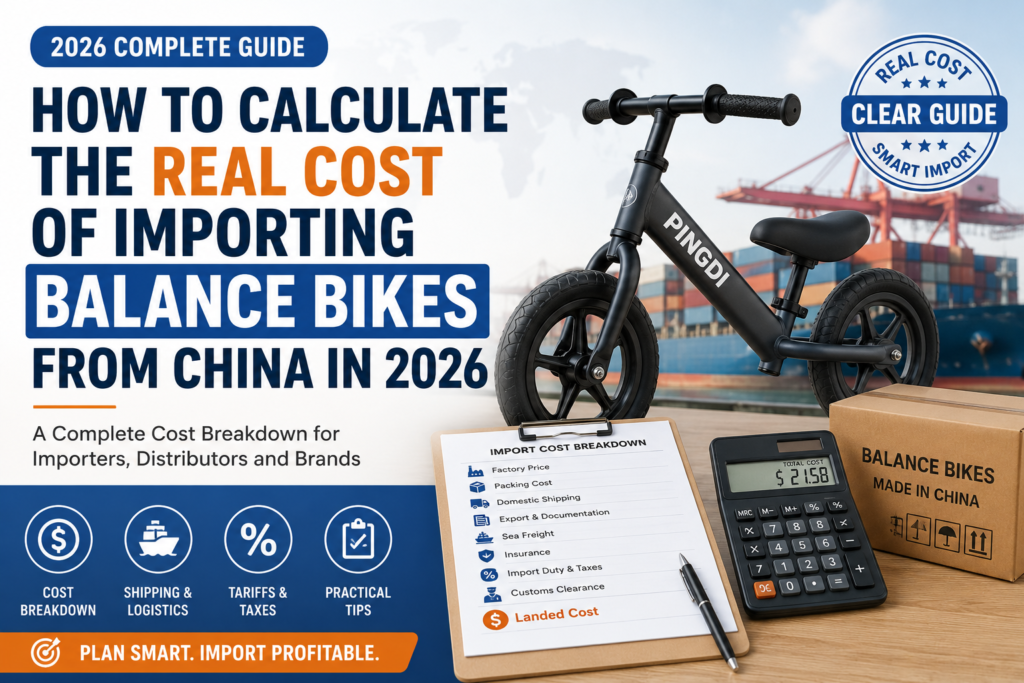
How to Calculate the Real Cost of Importing Balance Bikes from China in 2026 (Complete Guide)

Introduction: Understanding the Real Cost Behind Balance Bike Imports For global children’s product brands, importing balance bikes from China has become an attractive business opportunity. Balance bikes are popular because they help young children develop: The market demand continues to grow, especially in: For importers, distributors, and private-label brands, sourcing from China provides advantages including: However, many first-time buyers make a common mistake: They only calculate the factory quotation. The real import cost includes much more: Understanding the complete cost structure helps buyers: This guide explains how to calculate the real cost of importing balance bikes from China in 2026. 1. Main Factors That Affect Balance Bike Import Cost The final cost of importing balance bikes depends on several factors. 1. Balance Bike Factory Price The factory price is the biggest part of your total investment. The price depends on: A professional Balance Bike Manufacturer China usually offers different product ranges. Entry-Level Balance Bikes Features: Suitable for: Advantages: Mid-Range Balance Bikes Features: Suitable for: This segment is popular because it balances: Premium Balance Bikes Features: Suitable for: Higher product cost can create: 2. Material Selection and Its Impact on Cost Material choice directly affects balance bike pricing. Steel Frame Balance Bike Advantages: Disadvantages: Aluminum Balance Bike Advantages: Suitable for: Wooden Balance Bike Advantages: Suitable for: Wheel Type Cost Difference Common options: EVA Wheels Advantages: Rubber Wheels Advantages: The choice affects: 3. MOQ and Its Influence on Import Cost MOQ means: Minimum Order Quantity It is one of the most important factors for new buyers. Standard Balance Bike MOQ For existing models: Advantages: Suitable for: OEM Customized Balance Bike MOQ Customized products usually require higher MOQ. Reasons: However, OEM provides: 4. OEM Customization Costs Many global buyers choose: Private Label Balance Bike Manufacturing because they want to build their own brands. Customization includes: Logo Customization Options: Color Customization Including: Packaging Customization Including: Product Modification Advanced OEM projects may include: A professional OEM Balance Bike Supplier can help control customization costs. 5. Shipping Cost From China Shipping is another important part of import cost. Balance bikes are larger products, so most buyers choose sea freight. Sea Freight Advantages: Options: Full Container Load (FCL) Suitable for: Less Container Load (LCL) Suitable for: Air Freight Suitable for: Disadvantage: Higher transportation cost. 6. Import Duties and Customs Clearance Cost Many new importers underestimate customs-related expenses. The total landed cost may include: Before importing, buyers should confirm: 7. Packaging Cost Packaging affects both: Professional suppliers optimize packaging to reduce: Packaging options: Standard Export Packaging Suitable for: Retail Packaging Suitable for: Includes: 8. Sample Cost Before Mass Production Professional buyers should always test samples. Sample costs may include: Although samples increase initial expense, they reduce risks. Samples help confirm: 9. How to Calculate Total Landed Cost The correct formula: Product Cost Customization Cost Packaging Cost Shipping Cost Import Duties Customs Fees Local Transportation = Total Landed Cost Example: Product price: $25/unit Packaging: $1/unit Shipping: $5/unit Import fees: $2/unit Final landed cost: $33/unit Only after calculating landed cost can buyers determine real profit. 10. How to Improve Balance Bike Profit Margin Successful brands focus on more than reducing purchase price. Choose the Right Supplier A reliable factory provides: Optimize Product Design Reduce unnecessary costs through: Build a Private Label Brand Private label products usually achieve better margins because they provide: Why Choose Pingdi Factory for Balance Bike Manufacturing? Guangzhou Pingdi Technology specializes in OEM and ODM children’s mobility products. Our products include: Our Manufacturing Advantages OEM Balance Bike Solutions Supporting: Professional Production Management Including: Global Export Experience Supporting buyers from: FAQ Q1: How much does it cost to import balance bikes from China? The cost depends on: Q2: What is the MOQ for OEM balance bikes? MOQ depends on: Q3: Is importing balance bikes from China profitable? Yes. Many brands source from China because of competitive production costs and flexible OEM options. Q4: How do I find a reliable balance bike supplier? Check: Q5: Can I create my own balance bike brand? Yes. Many Chinese manufacturers support: Conclusion: Calculate Before You Import Importing balance bikes from China can create strong business opportunities, but successful buyers must understand the complete cost structure. The real cost is not only the factory price. Professional importers consider: Choosing an experienced: OEM Balance Bike Manufacturer China helps brands reduce sourcing risks and build competitive children’s product businesses. At Pingdi Factory, we help global buyers develop reliable balance bikes through professional OEM and ODM manufacturing solutions.

How to Calculate the Real Cost of Importing Balance Bikes from China in 2026 (Complete Guide) Read More »

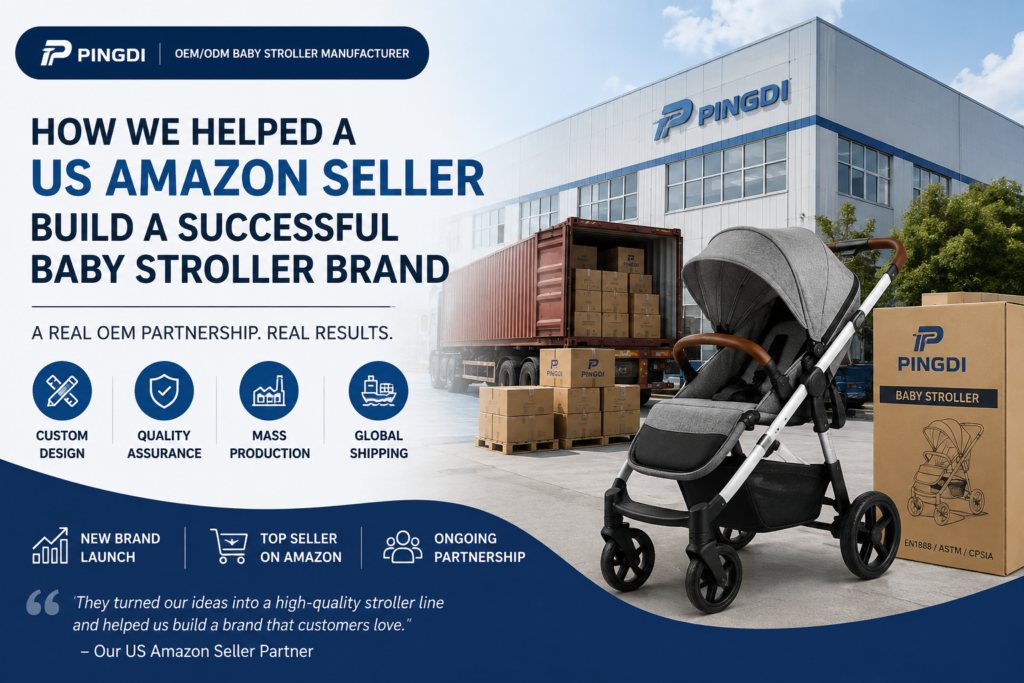
How We Helped a US Amazon Seller Build a Successful Baby Stroller Brand with Our OEM Solution

A Successful Private Label Baby Stroller Manufacturing Case Study Introduction: From Amazon Seller to Baby Product Brand Owner Launching a successful baby product brand on Amazon requires much more than finding a popular product. Many Amazon sellers start their journey by searching for products with market potential, but long-term success depends on: For baby products, especially baby strollers, customers expect: A generic product with no differentiation is becoming increasingly difficult to compete with. Baby stroller suppliers targeting the U.S. market should also understand applicable product safety and compliance requirements published by the U.S. Consumer Product Safety Commission (CPSC) Successful Amazon sellers are moving toward: Private Label + OEM Manufacturing This approach allows sellers to: This case study explains how Pingdi Factory helped a US Amazon seller transform an initial product idea into a successful baby stroller brand through our OEM manufacturing solution. Project Overview Customer Background The customer was a US-based Amazon seller specializing in baby and children’s products. Before cooperation, the customer mainly sold existing products through Amazon. However, they faced several challenges: Challenge 1: Strong Market Competition The customer found that many baby stroller listings on Amazon looked similar. Problems included: The customer wanted a product that could stand out. Challenge 2: Lack of Manufacturing Experience Although the customer understood Amazon operations, they did not have experience with: They needed a reliable: OEM Baby Stroller Manufacturer China to support the entire process. Challenge 3: Building a Long-Term Brand The customer did not want to simply sell another product. Their goal was: Project Requirements Product Category Private Label Baby Stroller Market United States Amazon Marketplace Cooperation Model OEM Manufacturing Main Requirements: Step 1: Understanding the Amazon Market Positioning Before product development, our team worked with the customer to understand: This step was important because successful Amazon products are created based on market demand. We analyzed: Competitor Weaknesses Common problems found in existing listings: Customer Expectations US parents usually focus on: Based on these insights, we helped the customer define the product direction. Step 2: OEM Baby Stroller Product Development As an experienced: Custom Baby Stroller Manufacturer China we supported the customer from concept to finished product. Product Design Optimization Our engineering team helped improve: Frame Structure Focused on: Folding System Optimized: Seat Design Improved: Step 3: Creating a Private Label Baby Stroller Brand A successful Amazon product requires strong branding. We supported: Logo Customization Including: Packaging Design Including: Product Appearance Including: The goal was not only to manufacture a stroller, but to help create a recognizable baby product brand. Step 4: Prototype Development and Testing Before mass production, we developed samples for evaluation. The process included: First Prototype Checked: Customer Testing The customer evaluated: Improvement Stage Based on feedback, we optimized: Step 5: Manufacturing Process After sample approval, production started. The manufacturing process included: Material Inspection Checking: Frame Production Including: Sewing Process Producing: Assembly Including: Step 6: Quality Control for Amazon Sales For Amazon sellers, product reviews directly influence sales. A few negative reviews can affect: Therefore, quality control was critical. Our QC System Included: IQC Incoming material inspection IPQC Production process inspection FQC Finished product testing OQC Shipment inspection Product Testing Focus We checked: Step 7: Supporting Amazon Brand Growth Our support did not stop at production. We helped the customer prepare: This allowed the Amazon seller to focus on: Project Results Through cooperation with Pingdi Factory, the customer successfully achieved: A Customized Baby Stroller Brand Including: ✔ Private label product ✔ Custom design ✔ Brand packaging ✔ Stable manufacturing supply Business Benefits The customer gained: Why Amazon Sellers Need an OEM Manufacturing Partner Many Amazon sellers understand: But manufacturing is a completely different field. A professional OEM partner helps solve: Product Development Problems Turning ideas into real products. Manufacturing Problems Ensuring: Supply Chain Problems Managing: Why Choose Pingdi Factory? Guangzhou Pingdi Technology specializes in OEM and ODM children’s products. Our products include: Our OEM Advantages 1. Product Development Support Helping brands with: 2. Private Label Manufacturing Supporting: 3. Quality Management Including: 4. Global Export Experience Supporting buyers from: FAQ Q1: Can you help Amazon sellers create private label baby strollers? Yes. We support Amazon sellers with: Q2: What is the MOQ for private label baby strollers? MOQ depends on: Q3: Can I customize an existing stroller design? Yes. We support: Q4: Do you support Amazon FBA sellers? Yes. We can support Amazon sellers with manufacturing, packaging, and export preparation. Q5: Why choose OEM instead of buying existing products? OEM allows brands to: Conclusion: Building Brands Through Professional OEM Manufacturing Building a successful Amazon baby product brand requires more than selling products. It requires: Through professional OEM solutions, Pingdi Factory helped a US Amazon seller transform from a product seller into a baby stroller brand owner. For Amazon sellers, private label brands, and baby product companies looking for a reliable: OEM Baby Stroller Manufacturer China Pingdi Factory provides complete manufacturing solutions from concept development to mass production.

How We Helped a US Amazon Seller Build a Successful Baby Stroller Brand with Our OEM Solution Read More »

Scroll to Top