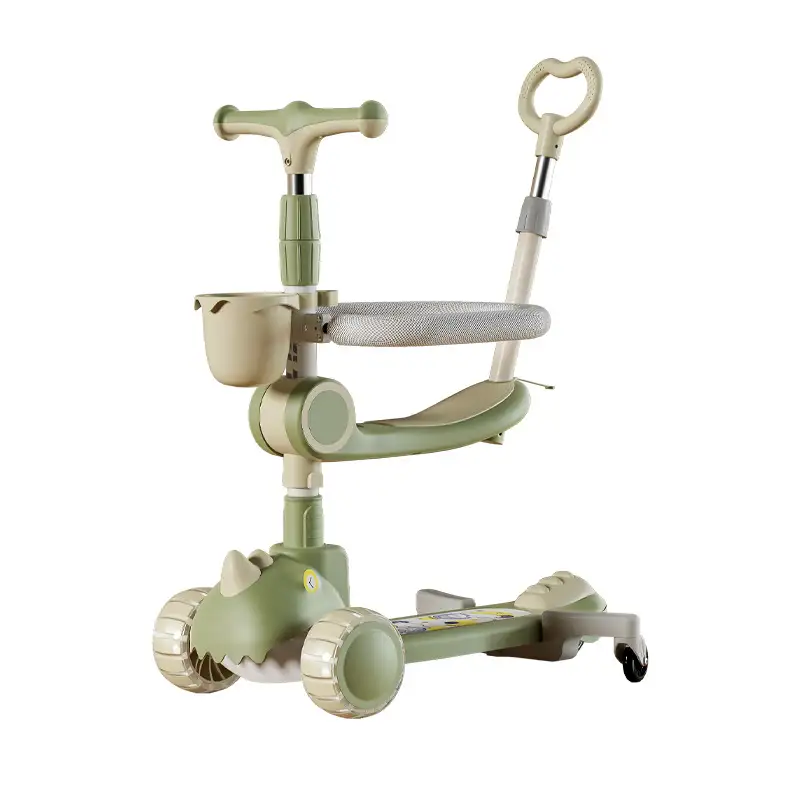
Finding a children’s scooters manufacturer in China is relatively easy. Finding the right supply partner for a long-term wholesale or private-label program is much more difficult.
Two children’s scooters may look almost identical in supplier photos while having very different frame materials, plastic quality, wheels, bearings, steering systems, packaging and quality-control standards.
For importers and distributors, these differences affect more than the purchase price. They can influence product consistency, customer complaints, compliance risk, container utilization and the total landed cost of an order.
This is why professional buyers should not select a kids scooter supplier in China based only on FOB price.
Before placing your next order, evaluate these 12 areas.
1. Does the Supplier Understand Your Type of Children’s Scooter?
“Children’s scooter” covers several different product structures.
Common products include:
- 3-wheel kids scooters
- toddler scooters
- scooters with seats
- sit-and-ride scooters
- foldable kids scooters
- lean-to-steer scooters
- LED wheel scooters
- 2-wheel kick scooters
- plastic children’s scooters
A supplier that performs well with a basic metal kick scooter is not automatically the best supplier for a multifunctional toddler scooter with a seat, LED wheels and molded plastic components.
This distinction matters because different models involve different manufacturing processes and upstream suppliers.
For example, a three-wheel plastic scooter may involve injection-molded components, PU wheels, bearings, metal steering tubes, printing, packaging and assembly.
Before requesting prices, define exactly which product platform you need.
For current models, buyers can explore our kids scooter wholesale collection and compare suitable configurations before preparing an RFQ.
2. Manufacturer, Trading Company or Sourcing Partner?
International buyers frequently search Google for terms such as:
- children’s scooters manufacturer China
- kids scooter factory China
- kids scooter supplier China
- toddler scooter manufacturer
- 3 wheel kids scooter manufacturer
But the word “manufacturer” should not be the only supplier-selection criterion.
A direct factory can be an excellent choice when its production specialization matches the buyer’s exact product.
A sourcing and project-management company can be useful when a buyer needs multiple scooter designs, mixed categories or coordination among different manufacturing resources.
The important question is transparency.
Buyers should understand:
- Who manufactures the product?
- Who manages the order?
- Who controls the approved specifications?
- Who follows production?
- Who coordinates inspection?
- Who handles quality problems?
- Who manages packaging and shipment?
Guangzhou Pingdi Technology Co., Ltd. operates as a China-based sourcing and OEM/ODM project management partner rather than presenting itself as the owner of every manufacturing facility.
We coordinate suitable manufacturing resources according to product specifications, order quantity, target market and customization requirements.
For professional importers, a transparent supply structure is more useful than simply seeing the word “factory” on a website.
3. Compare Specifications Before Comparing Prices
One of the most common sourcing mistakes is comparing quotations before confirming that the products are actually equivalent.
Suppose Supplier A quotes $8.50 and Supplier B quotes $9.20.
The $8.50 scooter is not necessarily cheaper if it uses different:
- frame specifications
- plastic materials
- wheel sizes
- PU quality
- bearings
- steering components
- deck construction
- handlebar structure
- packaging
Ask each supplier to provide a comparable specification sheet.
For a 3 wheel kids scooter, for example, the RFQ should ideally define the wheel configuration, handlebar adjustment, deck size, steering system, seat requirements, folding structure and packaging.
Only after specifications are aligned does a price comparison become meaningful.
4. What Is the MOQ?
There is no universal kids scooter MOQ.
Current B2B marketplace listings show that minimum quantities vary considerably by supplier, model and customization level. 阿里巴巴
MOQ may depend on:
- whether the model already exists
- stock component availability
- custom colors
- Pantone requirements
- logo printing
- custom packaging
- instruction manuals
- component modifications
- new tooling
Therefore, instead of asking only:
What is your MOQ?
ask:
What is the MOQ for the standard model, custom logo, custom color and full private-label packaging?
This provides much more useful purchasing information.
5. What Determines Children’s Scooter Wholesale Price?
Buyers searching for children’s scooters wholesale should calculate total landed cost rather than focusing exclusively on unit price.
Important cost variables include:
Frame and structure — Material selection, dimensions and construction affect cost.
Wheels and bearings — Wheel diameter, PU quality, lighting and bearing specifications can change both cost and performance.
Plastic components — Material selection, molding quality and component thickness matter.
Functions — Seats, folding mechanisms, LED wheels, music and other functions increase component complexity.
Packaging — Brown cartons, color boxes and customized retail packaging have different costs.
Order quantity — Component purchasing and production efficiency may change at different volumes.
Testing requirements — Destination-market requirements can add testing and documentation costs.
A quotation should therefore be evaluated against an agreed specification, not simply against a competitor’s headline price.
6. What OEM Options Are Available?
A serious OEM kids scooter program goes beyond printing a logo.
Depending on the selected product and manufacturing conditions, customization can include:
- Pantone colors
- product logo
- deck graphics
- wheel colors
- LED wheel options
- handlebar components
- packaging artwork
- instruction manuals
- warning labels
- barcodes
- shipping marks
More extensive ODM projects may involve component or structural changes.
Before development begins, create an approved specification sheet that identifies every customized element.
This document becomes one of the most important references during sampling, mass production and inspection.
7. Does the Supplier Understand Safety Requirements?
This is particularly important for children’s products.
The applicable requirements depend on the product design, age grading and destination market.
Importers should establish the target market before approving mass production.
For example, buyers may need to evaluate applicable requirements associated with EN 71 or ASTM F963, depending on the product and market.
Do not rely simply on:
“EN71 available.”
Ask:
- Which exact model was tested?
- Which report applies to the product?
- Does the tested construction match my order?
- Were materials or components changed?
- Which market is the report intended to support?
- Is additional testing required for my actual product?
Compliance documentation needs to correspond to the product being imported.
8. Order a Sample Before Mass Production
For most new supplier relationships, a sample is a relatively inexpensive risk-control step.
Evaluate:
- appearance
- dimensions
- handlebar adjustment
- steering
- wheel rotation
- folding mechanism
- seat mechanism
- deck
- brake
- fasteners
- molded plastic parts
- printing
- labels
- packaging
Do not evaluate only how the scooter looks.
Operate the product.
Fold it repeatedly if it is foldable. Adjust the handlebar. Check wheel movement. Inspect connections and fasteners.
For an OEM order, retain an approved reference sample wherever practical.
9. How Does the Supplier Control Mass-Production Quality?
A good sample does not guarantee a good shipment.
The bigger question is:
Can the supplier reproduce the approved specification consistently across hundreds or thousands of units?
A kids scooter quality control plan can include checks for:
- handlebar stability
- steering operation
- wheel rotation
- folding locks
- seat locks
- fasteners
- deck condition
- brake function
- plastic molding
- sharp edges
- surface finish
- scratches
- color consistency
- logo position
- packaging
- warning labels
- manuals
- barcodes
- carton markings
OEM orders should also be compared against the approved specification and reference sample.
10. Check Packaging Before Confirming the Order
Packaging is frequently underestimated in scooter sourcing.
It affects both:
product protection and landed cost.
Ask for:
- individual box dimensions
- master carton dimensions
- units per carton
- net weight
- gross weight
- CBM
- 20GP loading estimate
- 40HQ loading estimate
A scooter that costs $0.30 less at the factory can ultimately be more expensive if inefficient packaging significantly reduces container loading quantity.
For e-commerce customers, packaging durability can become even more important.
11. Can the Supplier Handle Multiple Models?
Distributors often do not want 2,000 identical scooters.
They may want:
- 3-wheel toddler scooters
- scooters with seats
- folding scooters
- different colors
- balance bikes
- other children’s mobility products
This creates a different sourcing challenge.
The buyer now has to coordinate multiple:
- MOQs
- factories
- production schedules
- inspections
- packaging requirements
- shipping dates
This is one area where a sourcing/project-management partner can provide value.
Pingdi supports buyers that need to coordinate multiple children’s mobility products rather than treating every SKU as an isolated transaction.
12. What Happens When Something Goes Wrong?
This question should be asked before the purchase order, not after a quality problem occurs.
Ask prospective suppliers:
How do you handle a production defect?
What happens if inspection fails?
How are replacement components handled?
Who is responsible for corrective action?
How do you prevent the same defect in the next order?
A long-term children’s scooter supplier should have a repeatable corrective-action process.
For distributors, consistency across the second, third and fifth order is often more valuable than saving a few cents on the first order.
A Practical Children’s Scooter Supplier Checklist
Before selecting a children’s scooters manufacturer in China, your sourcing file should ideally contain:
| Area | What the Buyer Should Confirm |
|---|---|
| Product | Exact scooter type and configuration |
| Specifications | Materials, dimensions, wheels and components |
| MOQ | Standard and OEM MOQ separately |
| Price | Comparable specification and Incoterm |
| Sample | Approved before production |
| OEM | Color, logo, graphics and packaging |
| Safety | Requirements for destination market |
| QC | Inspection criteria and approved sample |
| Packaging | Dimensions, weight and CBM |
| Loading | Estimated container quantity |
| Production | Expected schedule |
| After-sales | Corrective-action procedure |
The goal is not simply to find the lowest-priced factory.
The goal is to build a supply program that produces a repeatable product at a commercially viable landed cost.
Why Importers Work With Pingdi
Guangzhou Pingdi Technology Co., Ltd. is a China-based children’s mobility product sourcing and OEM/ODM project management company.
We work with importers, distributors, wholesalers and private-label brands sourcing products such as:
- kids scooters
- baby strollers
- balance bikes
- kids electric ride-on vehicles
- children’s bicycles
For kids scooter projects, our role can include product matching, supplier coordination, OEM/ODM coordination, sampling, production follow-up, inspection coordination, mixed-product consolidation and export planning.
We do not position ourselves as the owner of every factory used for every project. Instead, manufacturing is coordinated through suitable manufacturing partners according to the requirements of the buyer.
This structure is particularly useful for buyers who need several children’s mobility products or want one China-based team coordinating different parts of their sourcing project. 拼迪工厂
FAQ
How do I find a reliable children’s scooters manufacturer in China?
Start by defining the exact scooter type and specification. Then evaluate suppliers based on samples, manufacturing capability, quality control, testing documentation, OEM capability, packaging and repeat-order consistency rather than price alone.
What is the MOQ for children’s scooters wholesale?
There is no single industry-wide MOQ. It varies according to product model, supplier, quantity and customization. Custom colors, logos and private-label packaging can change minimum quantities.
Can children’s scooters be customized with my brand?
Yes, depending on the model and supplier. Typical OEM options include colors, logos, deck graphics, wheels, packaging, manuals, labels and barcodes.
What should I check before importing kids scooters from China?
Confirm specifications, samples, destination-market requirements, quality-control criteria, packaging, labeling, carton dimensions and shipping data before mass production.