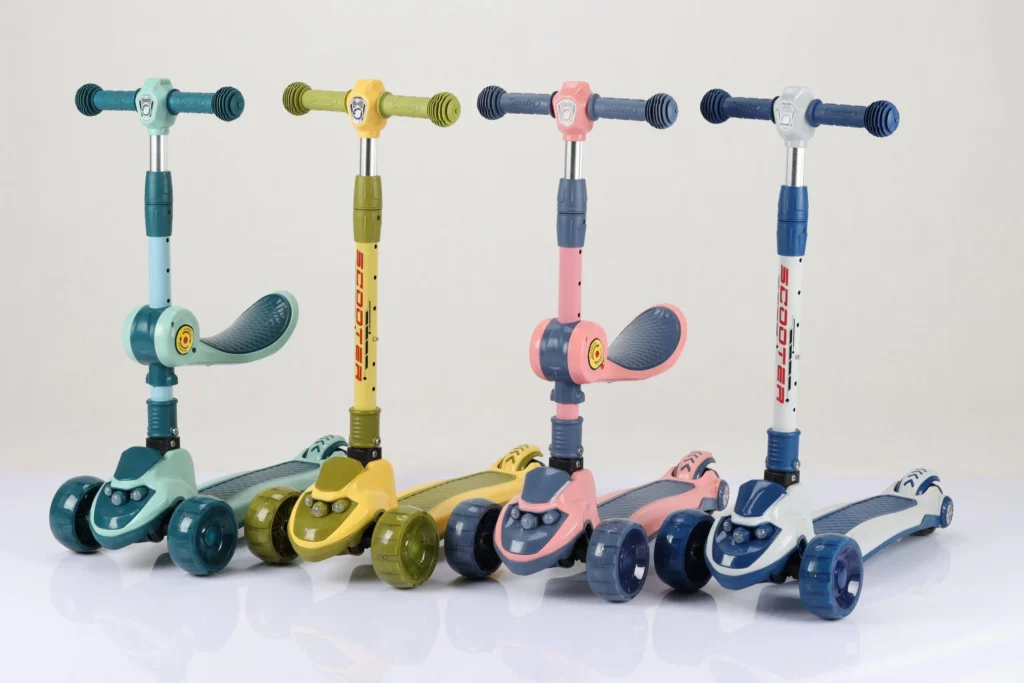
An in-depth sourcing guide for importers, distributors, wholesalers and private-label brands looking for reliable three-wheel toddler scooters from China.
Finding a 3-wheel kids scooter manufacturer in China is relatively easy. Finding the right manufacturing partner for consistent quality, suitable product specifications, market compliance and long-term wholesale supply requires a more systematic approach.
Two three-wheel scooters may look nearly identical in product photographs. However, their steering mechanisms, deck structures, wheel materials, handlebar adjustment systems and manufacturing quality can be very different.
For an importer ordering 500 or 2,000 units, these differences can affect product performance, customer complaints, replacement costs and brand reputation.
A professional buying decision should therefore go beyond FOB price and catalog appearance.
This guide explains how to select three-wheel kids scooters, compare technical specifications, evaluate OEM and private-label options, verify manufacturing partners and manage bulk orders from China.
It also explains how Guangzhou Pingdi Technology Co., Ltd. (PINGDI) supports international B2B buyers through product sourcing, manufacturing partner coordination, OEM/ODM project management, quality inspection arrangements and export preparation.
1. Why Three-Wheel Kids Scooters Are an Important Wholesale Category
Three-wheel scooters are a recognizable category within the children’s mobility market.
Many designs feature two front wheels and one rear wheel, with a relatively wide standing deck and a steering system designed for younger riders.
These product characteristics make three-wheel scooters relevant to distributors serving toddler and preschool product ranges.
For wholesale buyers, the category offers several product-positioning options:
- Entry-level three-wheel scooters.
- Adjustable-handlebar toddler scooters.
- Lean-to-steer kids scooters.
- Foldable three-wheel scooters.
- LED-wheel models.
- Scooters with detachable seats.
- Private-label scooters with customized colors and packaging.
However, product suitability depends on the specific design, intended age group and applicable safety requirements.
Importers should avoid assuming that every three-wheel scooter is appropriate for every child within a broad age range.
The manufacturer’s recommended age, tested load capacity and instructions should be reviewed for the actual model.
2. Main Types of 3-Wheel Kids Scooters Available for OEM and Wholesale
Before contacting a toddler scooter manufacturer in China, buyers should identify which product category matches their market.
Standard Three-Wheel Toddler Scooter
This is a common product platform for importers developing an entry-level children’s scooter collection.
Typical design features may include a wide deck, adjustable handlebar and rear brake.
It can be suitable for projects prioritizing a straightforward product configuration and established component options.
Lean-to-Steer Three-Wheel Scooter
Lean-to-steer scooters use a steering mechanism that responds to the rider’s leaning movement.
For importers, the quality of the steering assembly is an important evaluation point.
The steering response should be consistent, and relevant moving components should be assessed for durability and applicable safety requirements.
Foldable Three-Wheel Kids Scooter
A folding mechanism may improve storage and packaging convenience.
However, folding systems introduce additional components that require careful evaluation.
Buyers should examine locking reliability, unintended folding risks, accessible gaps and consistency between the approved sample and mass production.
Three-Wheel Scooter with LED Wheels
LED-wheel models are often selected for product differentiation.
The buyer should verify the actual lighting mechanism, wheel construction and applicable safety requirements.
A wheel design change should not automatically be treated as a cosmetic modification.
Three-Wheel Scooter with Detachable Seat
Some products offer a seat attachment or convertible configuration.
These designs require additional attention to intended use, stability, attachment security and product classification.
The supplier should clearly explain which configurations have been evaluated and which documents support them.
3. Compare Technical Specifications Before Requesting a Quotation
Professional importers should compare scooters using written specifications rather than relying only on photographs.
The following table provides illustrative RFQ specification ranges, not confirmed specifications of a particular PINGDI model or verified industry averages.
| Specification | Illustrative Buying Reference | What Importers Should Confirm |
|---|---|---|
| Wheel configuration | 2 front + 1 rear | Actual design |
| Front wheel diameter | 100–130 mm | Approved wheel drawing |
| Rear wheel diameter | 75–100 mm | Approved component |
| Handlebar height | 60–85 cm adjustable | Adjustment range and locking |
| Deck length | 28–35 cm | Usable standing area |
| Product net weight | 2.0–3.5 kg | Measured sample weight |
| Declared maximum rider weight | Model-dependent | Tested and documented limit |
| Wheel material | PU or other specified material | Exact composition and hardness |
| Deck material | Reinforced plastic or composite construction | Material grade and structure |
| Steering system | Lean-to-steer or other design | Mechanism specification |
| Brake system | Model-specific rear brake | Performance and construction |
| Folding function | Optional | Locking and safety assessment |
| LED wheels | Optional | Actual wheel configuration |
Important: These values are examples for comparing supplier offers. They are not recommended safety limits, and they should not be published as specifications for a product unless verified.
A proper supplier quotation should identify the exact model number and technical specification.
For private-label projects, the approved specification should become part of the purchase agreement.
4. Wheel Materials, Bearings and Steering Systems: What Really Affects Quality?
The wheel assembly is one of the most important areas to examine during a kids scooter supplier evaluation.
A scooter with visually attractive wheels may still have inconsistent rolling performance, poor component fit or insufficient durability.
Wheel material
Ask the supplier to identify the actual wheel material and relevant construction details.
The word “PU” alone does not provide enough information to evaluate quality.
Material formulation, wheel dimensions and manufacturing consistency can affect performance.
Bearings
Bearing specifications should be verified against the actual sample and component documentation.
Buyers should not rely only on marketing descriptions such as “premium bearings.”
Steering system
Lean-to-steer mechanisms should be evaluated for smooth movement, appropriate resistance and consistency.
Importers should compare multiple samples where practical.
Brake assembly
The brake should be assessed against the applicable product requirements and approved specification.
Its materials, construction and assembly consistency deserve attention during product evaluation.
Practical quality review
Ask the manufacturing partner for component drawings, material specifications and available test records.
Where necessary, arrange independent testing or technical assessment before bulk production.
5. How to Evaluate a 3-Wheel Kids Scooter Manufacturer in China
Finding a reliable manufacturer involves more than identifying a factory with attractive products.
Buyers should verify the manufacturing entity, production capabilities and quality-management arrangements.
Supplier verification checklist
| Audit Area | Questions to Ask |
|---|---|
| Legal identity | Is the company properly registered? |
| Factory relationship | Who actually manufactures the scooter? |
| Product specialization | Does the factory regularly produce this type? |
| Tooling | Who owns and maintains the molds? |
| Component sourcing | How are suppliers approved? |
| Quality control | What inspection stages are used? |
| Testing | Which reports cover the selected model? |
| OEM capability | Which modifications are technically feasible? |
| Capacity | Can the factory support the planned order? |
| Traceability | Can relevant production batches be identified? |
A supplier’s business license and production photographs are useful starting points, but they should not replace appropriate verification.
For larger orders or more complex customization projects, a factory visit or independent audit may be justified.
Manufacturer versus trading company
A direct manufacturer operates the relevant production facilities.
A sourcing company or trading company may coordinate production through selected manufacturing partners.
Neither model automatically guarantees superior results.
For importers, the important questions are whether the supply arrangement is transparent, who controls the specification and who is accountable for order execution.
6. OEM and Private-Label Customization Options
OEM three-wheel kids scooters can be customized in several ways, depending on the product platform and manufacturing capabilities.
Common options include:
Brand logo: Logo placement on suitable product components or packaging.
Color combinations: Customized handlebars, decks, wheel accents and other parts.
Retail packaging: Branded cartons, product illustrations, barcodes and instructions.
Handlebar design: Selected grip or adjustment configurations where technically supported.
Wheel options: Approved alternative colors or wheel configurations.
Product accessories: Model-compatible accessories assessed for safety and suitability.
Not every customization requires new tooling, but some modifications can affect cost, MOQ, testing or production lead time.
OEM project comparison
| Customization | Typical Project Impact |
|---|---|
| Existing color selection | Usually relatively straightforward |
| Logo printing | Artwork and process approval |
| Custom carton | Printing MOQ and artwork approval |
| New plastic color | Material and production MOQ review |
| Alternative wheels | Component and compliance assessment |
| Structural modification | Engineering and tooling assessment |
| New scooter design | Full ODM development planning |
Before approving customization, buyers should request a written technical assessment.
Changes affecting materials, construction or safety-related features may require additional testing.
7. Understanding MOQ for Wholesale Three-Wheel Kids Scooters
There is no universal minimum order quantity for every three-wheel kids scooter manufacturer.
MOQ depends on the model, available stock, component requirements, customization and factory production arrangements.
Current B2B marketplace examples vary substantially. One publicly listed three-wheel scooter offer specifies a minimum order of 2,200 pieces, illustrating why a published MOQ should be treated as supplier- and model-specific rather than an industry standard.
For commercial planning, buyers can evaluate three purchasing scenarios.
Scenario A: Standard model
The buyer selects an existing scooter configuration, standard colors and standard packaging.
This may offer greater flexibility because the factory does not need to procure special components.
Scenario B: Private-label model
The buyer requires custom logos, retail packaging and selected color options.
Minimum quantities may be influenced by printing, materials and component suppliers.
Scenario C: New ODM development
The buyer requires structural changes, new tooling or a substantially different design.
MOQ should be negotiated together with engineering costs, tooling ownership, sample development and projected order volume.
Illustrative order planning
| Order Scenario | Quantity Example | Main Consideration |
|---|---|---|
| Trial order | 200 units | Supplier willingness and model availability |
| Initial wholesale launch | 500 units | SKU selection and packaging |
| Distributor replenishment | 1,000 units | Consistency and lead time |
| Larger OEM program | 2,000 units | Component planning and customization |
These quantities are illustrative purchasing scenarios, not PINGDI’s guaranteed MOQs or current supplier offers.
Actual minimums must be confirmed through a model-specific quotation.
8. How to Compare Wholesale Prices Correctly
Importers often request quotations from several suppliers and select the lowest unit price.
However, the cheapest offer may not represent the best overall purchasing value.
A meaningful comparison should use the same product specifications and commercial terms.
Example of a quotation comparison
| Item | Supplier A | Supplier B |
|---|---|---|
| Scooter model | Standard three-wheel | Standard three-wheel |
| Wheel specification | Must be confirmed | Must be confirmed |
| Deck construction | Must be confirmed | Must be confirmed |
| Logo customization | Included or excluded | Included or excluded |
| Packaging | Standard or custom | Standard or custom |
| Testing documentation | Scope to be reviewed | Scope to be reviewed |
| Inspection | Agreed separately | Agreed separately |
| Incoterm | FOB / other | FOB / other |
| MOQ | Quoted quantity | Quoted quantity |
A professional buyer should compare the final approved configuration, not just a product title.
For a more detailed discussion of pricing and order minimums, read the 3-Wheel Kids Scooter Wholesale Guide.
9. Safety Standards for Three-Wheel Kids Scooters
Safety compliance should be considered before placing a wholesale order.
However, the applicable standards depend on the scooter’s classification, design, intended use and destination market.
European Union
Certain scooters designed and intended as toys fall within the EU toy safety framework.
Relevant EN 71 requirements may apply to products classified as toys.
EN 14619 covers kick scooters within its defined scope and should not automatically be treated as the applicable standard for every toddler scooter.
The European Commission has published guidance explaining that toy scooters and sports or transportation scooters must be assessed according to their characteristics and intended use.
Buyers should confirm the applicable legal framework before requesting specific test reports.
Official reference: European Commission Guidance on Scooters
United States
The U.S. Consumer Product Safety Commission explains that ASTM F963, incorporated through 16 CFR Part 1250, applies to covered toys.
However, certain non-powered scooters are excluded from the ASTM F963 toy definition, and other applicable product safety requirements may need to be considered.
Therefore, importers should not assume that an ASTM F963 report alone establishes compliance for every three-wheel scooter.
Official reference: CPSC Toy Safety Business Guidance
Documents to request
Depending on the applicable requirements, buyers may need:
- Complete product test reports.
- Product specifications and sample identification.
- Applicable declarations or certificates.
- Labeling and warning information.
- Technical documentation.
- Records of relevant product modifications.
Reports should match the actual scooter model and relevant configuration.
10. Quality Control Before Mass Production
A successful wholesale scooter project should include quality controls throughout production.
Incoming inspection
Relevant components and materials should be checked against approved specifications.
In-process inspection
Assembly procedures and component installation should be monitored.
Final inspection
Finished scooters should be evaluated for workmanship, configuration and agreed functional requirements.
Pre-shipment inspection
The buyer may arrange an independent inspection before shipment.
Suggested QC checklist
| Inspection Item | Buyer Verification |
|---|---|
| Model and color | Match approved sample |
| Handlebar | Correct adjustment and locking |
| Steering mechanism | Correct operation |
| Wheel assemblies | Approved components and installation |
| Deck | Approved construction |
| Brake | Correct installation and operation |
| Folding mechanism | Correct operation, if applicable |
| Labels | Required information |
| Retail packaging | Approved artwork |
| Carton quantity | Matches packing list |
Inspection acceptance criteria should be agreed before production.
Routine quality checks do not replace applicable product safety testing.
11. Packaging, CBM and Container Planning
Packaging has a direct effect on freight costs and the landed cost of imported scooters.
Buyers should request final carton dimensions, gross weight, packing quantity and packaging specifications.
Example CBM calculation
Suppose a hypothetical export carton measures:
60 × 30 × 25 cm
Carton volume:
0.60 × 0.30 × 0.25 = 0.045 CBM
For 500 cartons:
500 × 0.045 = 22.5 CBM
This is a mathematical illustration, not a verified carton specification.
Actual container capacity depends on loading configuration, stacking restrictions, weight and other shipment requirements.
Packaging details to confirm
- Retail box dimensions.
- Master carton dimensions.
- Units per carton.
- Gross and net weight.
- Packaging material.
- Product labels.
- Instructions and warnings.
- Shipping marks.
- Carton protection.
A buyer should approve the final packaging specification before bulk printing and shipment planning.
12. How to Manage Mixed-Model Wholesale Orders
Distributors may want to order several scooter models or colors in one shipment.
For example, a buyer may want to combine:
- Standard three-wheel toddler scooters.
- Foldable three-wheel scooters.
- LED-wheel models.
- Scooters with seats.
- Selected two-wheel scooters.
Mixed-model purchasing can help distributors create a broader product assortment.
However, the feasibility depends on individual factory MOQs, component availability, production schedules and shipment planning.
A sourcing partner may help coordinate information across manufacturing partners, but mixed orders should not be promised without confirming the actual supply conditions.
13. Why Sample Approval Matters
Before bulk production, importers should approve a sample representing the agreed product configuration.
The sample review should cover the scooter’s construction, materials, dimensions, operation, accessories, labeling and packaging where relevant.
The approved sample should be supported by written specifications.
For OEM projects, buyers should document:
- Final model number.
- Approved color references.
- Logo artwork.
- Material and component specifications.
- Packaging artwork.
- Required compliance documentation.
- Agreed inspection criteria.
If a relevant product change occurs after approval, its effect should be evaluated before implementation.
This process helps reduce misunderstandings between the buyer and manufacturing partner.
14. How PINGDI Supports 3-Wheel Kids Scooter Sourcing
Guangzhou Pingdi Technology Co., Ltd. is a China-based B2B sourcing and OEM/ODM project management company specializing in children’s mobility products.
We work with suitable manufacturing partners to support international importers, wholesalers, distributors and private-label brands.
PINGDI does not claim to own every manufacturing facility involved in a sourcing project.
Instead, our role is to help buyers organize supplier communication, product specifications, customization requirements, quality-control arrangements and export coordination.
Product sourcing and model matching
We help buyers communicate product requirements and evaluate available models from suitable manufacturing partners.
OEM/ODM project coordination
We assist with communication concerning logos, colors, packaging, samples and product specifications.
Supplier documentation follow-up
We can coordinate requests for available product specifications, test reports and relevant manufacturing information.
Quality inspection coordination
We help organize agreed inspection arrangements and follow up on identified production issues.
Order and shipment coordination
We assist with communication concerning production schedules, packaging data, mixed-model requirements and shipment preparation.
Our objective is to support transparent purchasing decisions and consistent project communication.
Final regulatory compliance, certification and testing responsibilities remain with the responsible economic operators and appropriately qualified service providers.
15. What Importers Should Include in a 3-Wheel Kids Scooter RFQ
A complete Request for Quotation helps suppliers provide more accurate offers.
Include the following information:
| RFQ Field | Buyer Information |
|---|---|
| Destination market | Country or region |
| Scooter category | Standard / folding / LED / seat |
| Estimated quantity | Units per model |
| Target age group | Intended users |
| Required specifications | Dimensions and components |
| Customization | Logo, colors, packaging |
| Compliance requirements | Applicable market requirements |
| Sample requirements | Quantity and configuration |
| Shipping terms | Preferred Incoterm |
| Delivery schedule | Target shipment period |
Buyers should attach product photographs or reference specifications where available.
A detailed RFQ makes it easier to compare suppliers on an equivalent basis.
16. Frequently Asked Questions
How do I find a reliable 3-wheel kids scooter manufacturer in China?
Verify the manufacturing source, product specifications, production capabilities, quality-control procedures, relevant test documentation and OEM experience.
What is the MOQ for 3-wheel kids scooters?
MOQ varies by model, supplier and customization. Request a model-specific quotation rather than relying on a general industry estimate.
Can I customize 3-wheel kids scooters with my own brand?
Many manufacturing partners can support selected logo, color and packaging modifications. More extensive changes require technical evaluation.
Are LED wheels available for OEM scooter projects?
LED-wheel options are available on some models, subject to product compatibility, component availability and relevant safety assessment.
Which safety standards apply to toddler scooters?
Applicable requirements depend on product classification, design, intended use and destination market. Buyers should not assume that one standard covers every scooter.
Can I order several scooter colors in one shipment?
Potentially, depending on color-specific minimums, manufacturing schedules and commercial terms.
Can PINGDI help coordinate factory verification and quality inspection?
PINGDI can assist with manufacturing partner information requests, documentation follow-up and agreed third-party inspection arrangements.
Conclusion: Choose a Scooter Supply Partner, Not Just a Low Price
A successful three-wheel kids scooter wholesale project starts with selecting the right product specification and manufacturing arrangement.
Importers should compare wheel construction, steering systems, deck materials, customization options, quality-control procedures and applicable safety requirements before approving bulk production.
MOQ and unit price matter, but they should be evaluated alongside product consistency, documentation, packaging and delivery planning.
For private-label brands, clear specifications and sample approval are particularly important.
The most effective sourcing approach combines product selection, supplier verification, OEM coordination, quality management and transparent communication.
Looking for 3-Wheel Kids Scooters from China?
PINGDI supports international B2B buyers with three-wheel kids scooter sourcing, OEM/ODM coordination, supplier documentation follow-up, quality inspection arrangements and export project management.
View Our 3-Wheel Kids Scooter Product
Read Our 3-Wheel Scooter Wholesale Guide
Explore Our Kids Scooter Sourcing Guide
Contact PINGDI for an OEM or Wholesale Quotation
Share your destination market, preferred scooter model, estimated quantity and customization requirements so our team can discuss suitable sourcing options.
Guangzhou Pingdi Technology Co., Ltd.
B2B Kids Mobility Product Sourcing & OEM/ODM Project Coordination
Website: https://pingdifactory.com
Email: 2783426797@qq.com