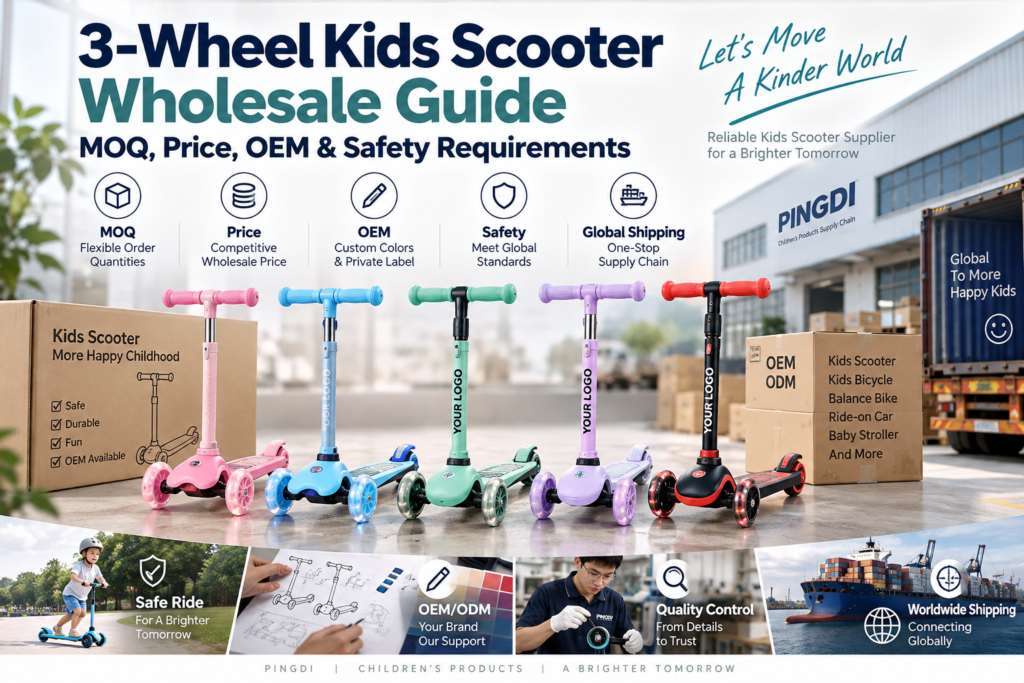
For importers, distributors and children’s product brands, sourcing a 3 wheel kids scooter is not simply a matter of finding the lowest FOB price.3 wheel kids scooter wholesale project for
Two scooters that look almost identical in a supplier’s catalog may have very different deck structures, wheel materials, steering systems, plastic quality, bearings, packaging, weight limits and durability.
These differences affect not only the wholesale price but also product safety, customer complaints, return rates and the long-term reputation of your brand.
Before placing a bulk order with a 3 wheel kids scooter manufacturer in China, buyers should therefore understand four key issues:
MOQ, real product cost, OEM capability and market-specific safety requirements.
This guide explains what professional buyers should evaluate before ordering 3-wheel kids scooters from China and how to reduce sourcing risks throughout the project.
Why Are 3-Wheel Kids Scooters Popular in the Wholesale Market?
Three-wheel scooters are particularly attractive for younger riders because the two-front-wheel or dual-rear-wheel structure can provide greater stability than many traditional two-wheel designs.
Typical wholesale product configurations include:
- 3-wheel toddler scooters
- Lean-to-steer kids scooters
- Adjustable-height scooters
- Foldable kids scooters
- Scooters with removable seats
- Light-up wheel scooters
- PU-wheel scooters
- Plastic-deck scooters
- Aluminum-handlebar scooters
- OEM/private-label scooters
For distributors, this also creates opportunities to build a product range at several price points instead of importing only one model.
A buyer might, for example, develop an entry-level model for supermarkets, a mid-range foldable model for distributors and a customized premium version for its own brand.
The challenge is maintaining consistent quality across these different specifications.
1. What Is the Typical MOQ for 3-Wheel Kids Scooters?
MOQ is one of the first questions buyers ask when contacting a kids scooter supplier in China.
There is no universal MOQ.
Current B2B marketplace listings show considerable variation: some suppliers advertise MOQs around 100 units, while other models are listed at 1,000 or even 2,200 units. This illustrates why buyers should treat online MOQ figures as model-specific indications rather than an industry-wide rule.
The actual MOQ depends on several factors.
Existing model with standard colors
If you select an existing design, existing packaging and a standard factory color, the MOQ can usually be lower.
This is the best option for buyers who want to:
- Test a new market
- Add a new scooter category
- Evaluate a supplier
- Reduce first-order inventory risk
Customized color or logo
When custom colors, printed logos, special wheels or customized cartons are required, MOQ normally increases because individual components have their own production minimums.
Full OEM/ODM project
A completely customized scooter may involve:
- New tooling
- Structural modification
- Custom injection-molded parts
- New deck design
- Exclusive colors
- Custom packaging
- New testing
In this situation, the commercial MOQ needs to be evaluated together with tooling and development costs.
At PINGDI, we recommend that buyers define their required customization before negotiating MOQ. A low MOQ is not necessarily useful if the supplier cannot maintain the required specification during mass production.
2. How Much Does a 3-Wheel Kids Scooter Cost?
Another common sourcing mistake is comparing quotations based only on product photos.
A professional 3 wheel kids scooter wholesale quotation should be evaluated according to the actual specification.
Important cost factors include:
Frame and handlebar material
Plastic content, aluminum tubing, steel components, wall thickness and surface treatment all affect cost.
A small reduction in material specification may reduce the FOB price but can also influence durability.
Wheels
Buyers should confirm:
- PU or other wheel material
- Front/rear wheel dimensions
- Wheel hardness
- LED/light-up function
- Bearing specification
- Wheel structure
“PU wheels” alone is not a complete specification.
Deck construction
The deck is one of the major structural components of a scooter.
Buyers should evaluate:
- Deck dimensions
- Material
- Reinforcement structure
- Anti-slip surface
- Maximum recommended load
- Flex and impact performance
Steering system
Many toddler scooters use a lean-to-steer mechanism.
The quality of the steering components affects riding stability and product life, so the internal structure should be reviewed instead of judging only the exterior appearance.
Folding mechanism
Foldable models are convenient for retail and transportation but introduce additional mechanical components.
The locking mechanism should therefore be included in the QC and safety evaluation.
Packaging
Retail packaging can create a surprisingly large cost difference.
Options include:
- Brown carton
- Color box
- Mail-order carton
- Customized retail box
- Gift box
- Printed master carton
For e-commerce buyers, packaging strength is particularly important because parcel delivery conditions differ from traditional container distribution.
3. Why the Cheapest Scooter Quote Can Become Expensive
Suppose Supplier A offers a scooter at USD X and Supplier B is several percent cheaper.
Choosing Supplier B appears to save money.
But what if the cheaper model has:
- Lower-grade bearings
- Less consistent injection molding
- Weaker packaging
- Higher assembly variation
- Unstable wheel quality
- Poor color consistency
If these issues result in returns, replacements or customer complaints, the real landed cost can exceed the initial saving.
Professional importers should therefore calculate:
Product Cost + QC Risk + Defect Cost + Logistics Cost + After-Sales Cost
rather than comparing FOB prices alone.
At PINGDI, our sourcing process focuses on specification-to-specification comparison. When we compare quotations from different production sources, we first try to make sure the key material and functional specifications are aligned.
Otherwise, two prices are not truly comparable.
4. What OEM Options Are Available?
For buyers searching for an OEM kids scooter manufacturer, customization normally falls into several levels.
Level 1 — Private Label
The simplest option.
A buyer selects an existing scooter and adds:
- Brand logo
- Sticker
- Color
- Manual
- Packaging
- Barcode
- Shipping marks
This approach requires relatively little product development and is suitable for many wholesalers and new brands.
Level 2 — Product Configuration Customization
The buyer may change:
- Wheels
- Handlebar grips
- Deck graphics
- Color combinations
- Seat
- Height settings
- Accessories
- Packaging
This provides greater differentiation without developing an entirely new platform.
Level 3 — Structural OEM/ODM
For established brands, deeper development may include:
- New deck
- New steering system
- New folding mechanism
- New plastic components
- Exclusive tooling
- Structural engineering changes
This requires stronger engineering management.
Before paying tooling charges, buyers should clarify ownership, maintenance, expected tooling life and whether the same tooling can be used for another customer’s product.
5. Private Label Kids Scooter: What Should Buyers Prepare?
If you are developing a private label kids scooter, prepare a product specification sheet before requesting final quotations.
It should include:
Target age
For example:
3+ years
Target user weight
This is especially important because product classification and testing may depend on intended use and user characteristics.
Target market
EU, UK and US requirements should not simply be treated as interchangeable.
Required dimensions
Including deck, wheel and handlebar measurements.
Materials
Specify important structural materials instead of using vague terms such as “high quality.”
Branding
Logo location, print method and color references.
Packaging
Retail box artwork, manual, labels, barcode and master carton requirements.
The clearer the RFQ, the more accurate the supplier quotation will be.
6. Safety Requirements for the European Market
Safety requirements should be considered before production, not after the goods are completed.
For toy scooters placed on the European market, buyers need to determine the appropriate product classification and applicable requirements.
EN 71-1 contains specific provisions for toy scooters, including strength and steering-tube requirements as well as warnings and instructions. It distinguishes toy scooters by user body mass and requires appropriate protective-equipment and maximum-user-weight warnings.
For example, safety evaluation can involve issues such as:
- Structural strength
- Steering-tube performance
- Folding/locking mechanisms
- Sharp edges and accessible hazards
- Stability
- Wheels and axles
- User-weight marking
- Warnings
- Assembly instructions
- Usage instructions
The European Commission has also published guidance distinguishing toy scooters from other scooter categories, so product classification should be confirmed rather than assumed from appearance alone.
For an importer, the practical lesson is simple:
Tell the supplier the destination market before approving the product specification.
Do not buy a generic scooter first and ask for “CE/EN71” paperwork immediately before shipment.
7. What About Kids Scooters for the United States?
This requires particular care.
It is common to see suppliers casually advertise “ASTM F963” for children’s products. However, the U.S. CPSC explicitly states that non-powered scooters as defined in ASTM F2264 are excluded from the ASTM F963 toy standard’s scope.
Therefore, an importer should not assume that a generic ASTM F963 report automatically establishes compliance for every children’s scooter.
The applicable requirements depend on the actual product, intended age, design and classification.
For U.S.-bound projects, buyers should establish the applicable standards with a qualified laboratory or compliance professional before mass production.
This is one reason PINGDI asks for the destination market during the RFQ stage rather than treating testing as a final shipping-document issue.
8. What Should Be Inspected Before Mass Production?
A professional kids scooter factory China project should establish a confirmed sample before bulk manufacturing.
The approved sample can define:
- Color
- Materials
- Dimensions
- Wheel specification
- Handlebar
- Logo
- Printing
- Folding function
- Packaging
- Accessories
We strongly recommend maintaining an approved or “golden” sample for comparison during production and final inspection.
This prevents a common sourcing problem:
The pre-production sample is excellent, but the mass-produced product is slightly different.
A documented specification plus an approved sample gives both sides a much clearer quality reference.
9. Quality Control Checklist for 3-Wheel Kids Scooters
For bulk kids scooters wholesale orders, visual inspection alone is not enough.
A QC plan can include checks for:
Appearance
Scratches, color differences, molding defects, printing and logo position.
Assembly
Fasteners, handlebar installation, wheel installation and component fit.
Steering
Movement, return, consistency and abnormal resistance.
Wheels
Rotation, alignment, bearing performance and visible defects.
Folding System
Locking and unlocking operation where applicable.
Height Adjustment
Adjustment positions and locking security.
Deck
Surface, anti-slip area and structural condition.
Packaging
Carton condition, labels, manuals, accessories and quantities.
Functional/Load Checks
According to the approved specification and applicable testing plan.
For large programs, inspection should be designed around the actual product risk rather than using the same generic checklist for every scooter.
10. How Long Does OEM Scooter Production Take?
Lead time depends heavily on customization.
An existing model with standard materials may move relatively quickly.
A private-label project adds artwork confirmation, printing and packaging preparation.
A new OEM project may require:
Concept → Engineering → Prototype → Tooling → Sample → Testing → Approval → Mass Production
This is why buyers should avoid asking only:
“What’s your production time?”
A better question is:
“Please provide the complete project timeline from artwork/sample confirmation to final shipment.”
PINGDI manages projects using defined milestones so buyers can follow sampling, approval, production, inspection and shipment instead of receiving only a final completion date.
11. Can Different Scooter Models Be Mixed in One Container?
For distributors, this can be commercially important.
A buyer may want:
- 3-wheel toddler scooters
- Foldable kids scooters
- Balance bikes
- Kids bicycles
- Ride-on cars
rather than a full container of one SKU.
This is where supply-chain coordination becomes useful.
PINGDI supports multi-product sourcing and shipment consolidation for qualified B2B projects, helping importers coordinate products from different production lines or suppliers through one project-management process.
This can reduce the operational burden of managing multiple purchase orders, QC schedules and shipment dates separately.
12. How to Choose a 3-Wheel Kids Scooter Supplier in China
Do not choose a supplier using quotation price alone.
Evaluate at least:
Product specialization — Does the supplier actually understand children’s scooters?
Engineering capability — Can it support your OEM requirements?
Production consistency — Can mass production reproduce the approved sample?
Testing capability — Does the supplier understand requirements for your destination market?
Quality control — Is inspection documented?
Communication — Are specifications confirmed clearly?
Traceability — Can quality issues be traced to batches or production records?
Export experience — Does the team understand packaging, documentation and international delivery?
For a deeper supplier-audit checklist, buyers should also read our guide:
How to Choose a Kids Scooter Manufacturer in China: 12 Questions Importers Should Ask.
13. Why Work With PINGDI for Kids Scooter Projects?
For international buyers, managing a scooter project requires more than locating a factory.
PINGDI works with importers, distributors, wholesalers and private-label brands to coordinate children’s mobility products from China.
Our support can include:
Product Sourcing
Matching product requirements with suitable production resources.
OEM/ODM Coordination
Managing specifications, colors, branding, packaging and product development.
Supplier Management
Coordinating production requirements and project milestones.
Quality Control
Checking production against approved specifications and samples.
Compliance Coordination
Helping buyers prepare products and documentation for the intended destination market, while applicable legal requirements should always be confirmed for the specific product and jurisdiction.
Multi-Product Consolidation
Coordinating different children’s mobility products for combined shipment where appropriate.
Instead of asking buyers to manage multiple factories independently, our objective is to provide one China-side project-management point for the complete procurement process.
14. Request a 3-Wheel Kids Scooter Wholesale Quote
If you are sourcing 3 wheel kids scooters wholesale from China, send us the following information:
- Product photo or reference model
- Target quantity
- Destination country
- Required colors
- Logo requirements
- Packaging requirements
- Target age/user weight
- Required certification or testing
- Expected delivery date
Our team can then evaluate the specification and prepare a suitable sourcing or OEM proposal.
Whether you need an existing wholesale scooter, a private label kids scooter, or a customized OEM project, the goal should be the same:
Build the correct specification first, then optimize price — not the other way around.
Pingback: Kids Scooter Manufacturer China: Complete Sourcing Guide for Importers - pingdifactory