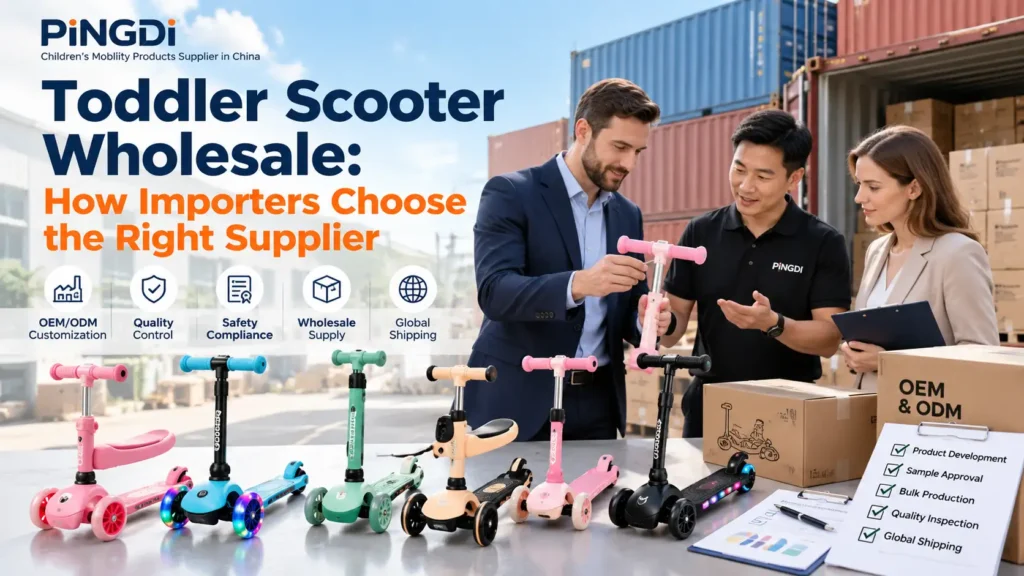
Choosing a toddler scooter supplier is not simply a matter of comparing FOB prices.
For importers, distributors and private-label brands, two toddler scooters that look almost identical in a supplier’s catalog can perform very differently after they reach the market.
The differences may be hidden in the wheel material, steering mechanism, deck structure, plastic quality, handlebar locking system, seat connection, bearings, packaging, production consistency and quality-control process.
These details directly influence product safety, customer complaints, return rates and the long-term reputation of your brand.
For this reason, professional buyers sourcing toddler scooters wholesale should evaluate the complete supply program—not only the unit price.
This guide explains how importers can evaluate a toddler scooter manufacturer or supplier in China, compare OEM options, control product quality and reduce sourcing risks before placing a bulk order.
1. Start With the Product, Not the Supplier’s Price
One of the most common sourcing mistakes is sending several suppliers a photo and asking:
“What is your best price?”
The quotations may look comparable, but the products may not actually have the same specifications.
A typical 3 wheel toddler scooter may differ in:
- frame and deck materials;
- wheel diameter and material;
- bearing specification;
- handlebar height range;
- steering mechanism;
- folding structure;
- seat configuration;
- maximum recommended load;
- LED wheel design;
- brake construction;
- packaging;
- accessories.
Even relatively small specification differences can affect manufacturing cost.
Before comparing quotations, importers should therefore create a basic product specification sheet.
For example:
| Specification | Requirement |
|---|---|
| Product | 3 Wheel Toddler Scooter |
| Configuration | Sit / Stand or Stand Only |
| Steering | Lean-to-Steer |
| Handlebar | Adjustable |
| Wheels | PU / LED optional |
| Seat | Optional |
| Color | Custom |
| Logo | OEM |
| Packaging | Retail Color Box |
| Market | EU / USA / UK / Other |
| Order Type | Wholesale / Private Label |
Once every supplier is quoting against the same specification, price comparisons become much more meaningful.
2. Choose the Right Toddler Scooter Configuration
“Toddler scooter wholesale” is not one single product category.
Importers can now choose from several configurations depending on their retail channel and target age group.
Standard 3-Wheel Toddler Scooter
This is one of the most common configurations.
Two front wheels and one rear wheel create a relatively stable platform for younger users.
For wholesalers looking for an entry-level SKU, this can offer a straightforward balance between product cost, packaging size and retail positioning.
Kids Scooter With Seat
A kids scooter with seat adds another usage configuration and can create a more differentiated retail proposition.
When evaluating this type, buyers should pay additional attention to the seat attachment, adjustment mechanism and structural stability.
2-in-1 and 3-in-1 Toddler Scooters
Convertible models are increasingly common in children’s mobility ranges.
Depending on the design, one product may support several configurations such as sitting, standing or parent-assisted use.
The sourcing challenge is that additional components also create additional quality-control points.
LED Kids Scooters
LED wheels and deck lighting can improve visual differentiation, particularly for online retail and gift-oriented channels.
But importers should evaluate whether lighting components, batteries where applicable, wiring, wheel construction and packaging introduce additional compliance or durability considerations.
PINGDI currently coordinates multiple scooter configurations including standard 3-wheel models, seat models, LED models and convertible designs for B2B sourcing projects.
3. Do Not Choose a Supplier Only by MOQ
Toddler scooter MOQ is naturally one of the first questions asked by importers.
However, the lowest MOQ is not automatically the best offer.
MOQ depends on factors such as:
- existing product configuration;
- custom colors;
- logo printing;
- packaging;
- component customization;
- exclusive tooling;
- production schedule;
- raw-material requirements.
For example, purchasing an existing model in an existing color may require significantly less production coordination than developing a private-label product with a custom Pantone color, printed logo and customized retail box.
Importers should therefore ask suppliers to separate:
Standard Product MOQ
from:
OEM / Private Label MOQ
This makes it easier to decide whether to test a product first or move directly into a customized program.
4. Compare the Real Wholesale Cost
When buyers search for kids scooters wholesale from China, FOB unit price often becomes the headline number.
But the cheapest quotation may not produce the lowest landed cost.
Consider:
Product Cost + Packaging + Testing + Inspection + Inland Logistics + Export Costs + Freight + Import Charges + Defect/Return Risk
Suppose Supplier A is slightly cheaper than Supplier B.
If Supplier A uses weaker cartons and the shipment experiences higher packaging damage, the apparent saving can disappear quickly.
The same applies to poor wheel performance, loose handlebars, inconsistent colors or missing accessories.
Professional importers therefore evaluate total sourcing cost, not simply factory quotation.
5. Evaluate the Supplier’s OEM Capability
For brands and distributors, OEM toddler scooter capability can become more important than the initial price.
Common customization requirements include:
Custom Colors
Frame, deck, wheels, handles, seats and other plastic components may be coordinated in different color combinations.
Always confirm colors through approved references or samples rather than relying only on computer images.
Custom Logo
Depending on the product structure, branding options may include:
- printed logo;
- sticker;
- product graphics;
- packaging logo;
- instruction manual branding.
Private-Label Packaging
Packaging is particularly important for distributors and retail brands.
A professional private label kids scooter project may involve:
- color box;
- product photography;
- barcode;
- warning labels;
- instruction manual;
- carton marks;
- shipping labels;
- market-specific information.
Product Configuration
Depending on the model, importers may also evaluate alternative wheels, seats, handlebars, lighting features and accessories.
The key is to freeze the specification before mass production.
6. Check Product Quality Before You Discuss Mass Production
A sample that looks attractive in photographs is not enough.
For a 3 wheel kids scooter wholesale program, buyers should inspect the product systematically.
Important areas include:
Steering
The steering system should operate consistently and correspond to the intended product design.
Check excessive movement, interference and assembly consistency.
Handlebar and Locking System
Check adjustment positions, locking mechanisms and component fit.
Wheels and Bearings
Rotate every wheel and check for abnormal resistance, excessive movement or inconsistent assembly.
Deck
Inspect dimensions, surface condition, anti-slip features and structural consistency.
Brake
Where fitted, inspect position, operation and assembly.
Seat and Conversion Mechanisms
For toddler scooters with seats, check the attachment system and every intended configuration.
Edges, Openings and Accessible Components
These need to be evaluated according to the intended user, product design and applicable safety requirements.
This is why product selection and quality control should begin before the purchase order—not after production has already finished.
7. Confirm Safety Requirements for the Destination Market
Children’s mobility products require careful market-specific compliance planning.
The applicable requirements can vary according to the destination country, product classification, construction, intended age and functionality.
Buyers sourcing for Europe, the United States, the UK or other markets should not simply ask:
“Do you have CE?”
A better question is:
“What requirements apply to this exact model, configuration, age grading and destination market?”
For example, EN 71 is relevant to many products classified as toys in European markets, while U.S. requirements need to be evaluated according to the exact product classification. ASTM documentation itself distinguishes non-powered scooters from the general F963 toy standard and points to a scooter-specific specification. ASTM Store
Importers should therefore confirm requirements with qualified testing/compliance professionals for the actual product being imported rather than relying on a generic certificate from a different model.
Before ordering, request relevant:
- test reports;
- model identification;
- product photos;
- age grading;
- warning information;
- material information where required;
- labeling details;
- packaging information.
Most importantly, verify that the documents correspond to the product you are actually purchasing.
8. Ask Whether the Test Report Matches Your Product
This deserves its own section because it is a common sourcing risk.
A supplier may send a test report for a scooter, but importers should verify:
Is this report actually for my model?
Compare:
- product name;
- model number;
- product photographs;
- construction;
- materials;
- tested configuration;
- report date;
- applicable standard.
Changing significant components or configurations can potentially affect the relevance of existing test documentation.
For an OEM project, discuss compliance before finalizing the product—not one week before shipment.
9. Evaluate Quality Control, Not Just the Sample
One good sample does not prove that 2,000 production units will be equally good.
The real question is:
Can the supply chain reproduce the approved specification consistently?
A professional QC process should consider multiple stages.
Pre-Production Confirmation
Freeze:
- specifications;
- colors;
- logo;
- packaging;
- accessories;
- labels;
- carton marks.
During-Production Follow-Up
Monitor whether mass production follows the approved specification.
Pre-Shipment Inspection
Before final payment and shipment, inspect randomly selected finished units.
Typical checkpoints can include:
- appearance;
- quantity;
- dimensions;
- assembly;
- steering;
- wheel rotation;
- handlebar locking;
- brake operation;
- accessories;
- labels;
- packaging;
- carton condition.
For importers, this is often far less expensive than resolving quality problems after the container reaches the destination country.
10. Packaging Matters More Than Many Buyers Expect
A scooter can leave the production facility in perfect condition and still arrive damaged.
This is particularly important when importing products over long distances.
Check:
- individual product protection;
- color box strength;
- master carton quality;
- internal positioning;
- exposed components;
- accessories;
- carton dimensions;
- gross/net weight;
- shipping marks.
Packaging dimensions also influence logistics economics.
A small reduction in carton volume multiplied across hundreds or thousands of units can materially affect container utilization.
For this reason, packaging should be treated as part of product development rather than an afterthought.
11. Ask About Lead Time—but Ask the Right Question
Instead of asking:
“How many days for production?”
ask the supplier to separate the schedule into:
Sample → Sample Approval → Packaging Approval → Material Preparation → Production → Inspection → Shipment
This gives the importer a more realistic timeline.
OEM projects naturally require more preparation than standard wholesale orders.
Seasonal buyers should also leave additional time for:
- testing;
- artwork changes;
- sample revisions;
- peak-season production;
- inspection;
- shipping.
12. Trading Company or Factory: What Actually Matters?
Importers frequently search for a toddler scooter manufacturer China because they assume buying directly from a factory always reduces risk.
In practice, supplier structure is only one part of the decision.
A factory can be strong at one specific scooter but weak at another product category. A sourcing and project-management company can coordinate several specialized manufacturing resources and provide a single point of contact for a broader product range.
The important question is transparency.
Buyers should know:
- who manufactures the product;
- who controls the specification;
- who manages quality;
- who coordinates OEM development;
- who is responsible when a problem occurs.
Guangzhou Pingdi Technology Co., Ltd. is a China-based sourcing and OEM/ODM project management company, not the owner of every factory producing the products in our catalog.
We coordinate manufacturing resources according to the buyer’s product, specifications, quantity and target market.
This structure is particularly useful for importers sourcing multiple children’s mobility categories.
13. Why Importers Work With PINGDI
Our role goes beyond sending buyers a product photo and FOB quotation.
PINGDI supports B2B buyers across the sourcing process:
Product Sourcing → Supplier Coordination → Sample Evaluation → OEM/ODM Development → Specification Confirmation → Production Follow-Up → Quality Inspection → Packaging Coordination → Export Delivery
Our main children’s mobility categories include:
- toddler and kids scooters;
- baby strollers;
- balance bikes;
- kids bicycles;
- electric ride-on cars.
This allows an importer to coordinate several product categories through one China-based project team rather than communicating separately with numerous suppliers.
For private-label programs, we can also coordinate requirements such as custom colors, logos, graphics, packaging, manuals, labels and selected product configurations.
Our focus is B2B wholesale and OEM/ODM project management, rather than individual retail orders.
14. Supplier Checklist for Toddler Scooter Importers
Before choosing a toddler scooter wholesale supplier, ask these questions:
- Can you provide a detailed specification sheet?
- What is the MOQ for the standard model?
- What is the MOQ for OEM colors and logos?
- Which parts can be customized?
- What packaging options are available?
- What quality checkpoints are used?
- Can I approve a sample before production?
- What safety documentation is available for this exact model?
- Can you support third-party inspection?
- What is the production timeline?
- How are replacement parts or quality claims handled?
- Can multiple product categories be consolidated for export?
A supplier capable of answering these questions clearly is generally much easier to work with than one competing only on price.
How to Start a Toddler Scooter Wholesale Project
If you are currently sourcing toddler scooters wholesale from China, prepare the following information before requesting quotations:
Destination Market: USA / EU / UK / Mexico / Middle East / Other
Product Type: 3-wheel / seat / convertible / LED
Estimated Quantity: e.g. 500 / 1,000 / 3,000 pcs
Target Price Range: if available
Custom Color: Yes / No
Private Label: Yes / No
Custom Packaging: Yes / No
Required Testing: according to destination market
Target Delivery Date: required shipment window
The more complete the purchasing brief, the more accurately suppliers can evaluate the project.
Request a Toddler Scooter Wholesale Quote
Choosing the right toddler scooter supplier in China is ultimately about controlling risk across the entire order.
Price matters, but so do product specifications, OEM capability, production consistency, compliance preparation, packaging, inspection and communication.
PINGDI helps importers, distributors, wholesalers and private-label brands coordinate these steps through one sourcing and project-management process.
If you are developing a new 3 wheel toddler scooter, kids scooter with seat, OEM kids scooter or broader children’s mobility range, send us your target market, expected quantity and product requirements.
We can evaluate suitable product options, customization requirements, MOQ, packaging and sourcing solutions for your project.