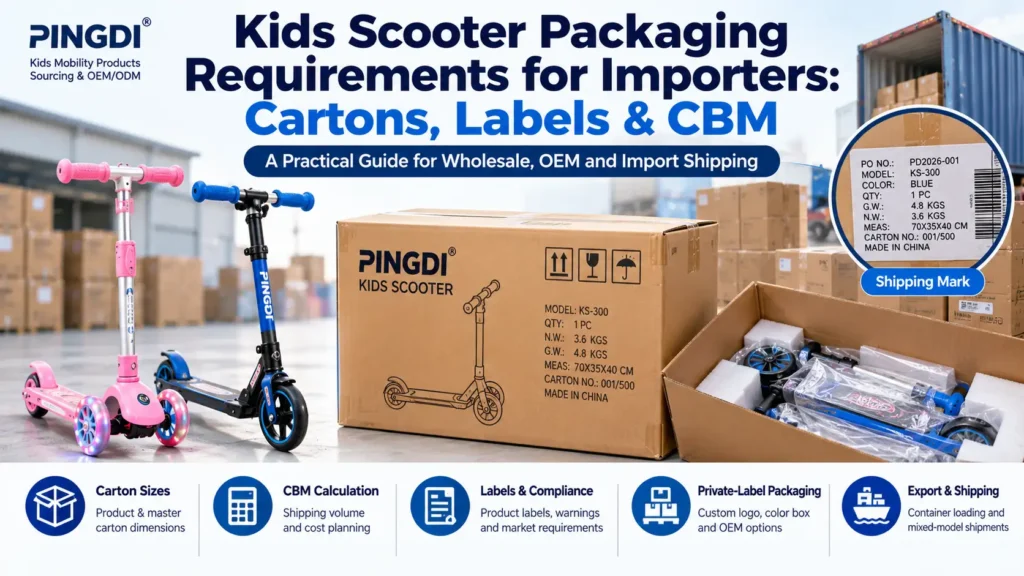
A practical guide to wholesale kids scooter packaging, export cartons, product labeling, shipping volume calculations and private-label order management.
When importing kids scooters from China, a competitive factory quotation does not always mean a competitive landed cost.
Two scooters with similar purchase prices can have different shipping costs because of their carton dimensions, packing quantities and loading efficiency. Incorrect labels, insufficient protection or inconsistent packing lists can also create problems after the goods leave the factory.
For importers, wholesalers and private-label brands, kids scooter packaging requirements should therefore be confirmed before mass production—not immediately before shipment.
A complete packaging specification should address product protection, retail presentation, carton strength, labeling, cubic meter calculations and export documentation.
This guide explains how professional buyers can evaluate kids scooter packaging, calculate CBM, prepare OEM packaging requirements and coordinate mixed-model shipments from China.
1. Why Packaging Matters in Kids Scooter Wholesale
Packaging affects several stages of the purchasing process.
First, it protects the scooter and its components during handling, storage and transportation.
Second, carton dimensions influence freight planning and warehouse space.
Third, product labels and instructions help importers meet applicable market requirements.
Finally, packaging quality affects the customer experience after the product reaches retailers or end users.
For a wholesale distributor purchasing several scooter models, packaging should be evaluated alongside product specifications and quality control.
A three-wheel toddler scooter, for example, may require different internal protection from a foldable two-wheel scooter.
Similarly, a scooter with a detachable seat or LED components may require additional packing arrangements.
The objective is to select packaging that is appropriate for the actual product and distribution environment—not simply the cheapest available box.
2. Common Packaging Types for Wholesale Kids Scooters
Different purchasing projects may require different packaging formats.
Standard export cartons
Standard export cartons are commonly used for transportation and wholesale distribution.
Depending on the product, they may contain protective bags, cushioning materials and internal dividers.
Buyers should confirm the exact materials and construction rather than assume all export cartons offer the same protection.
Retail color boxes
Retail boxes are intended to present the product to consumers.
They may include product photographs, brand information, instructions, warnings and barcodes.
The design should account for both retail presentation and applicable labeling requirements.
Private-label packaging
Private-label packaging allows importers and brands to use approved artwork, logos, colors and product information.
However, custom printing may introduce additional costs and minimum order quantities.
Master cartons
A master carton may contain one or several individual product packages.
Its dimensions, weight and strength affect shipping and warehouse handling.
| Packaging Type | Main Purpose | Buyer Consideration |
|---|---|---|
| Standard export carton | Transportation | Protection and cost |
| Retail color box | Consumer presentation | Artwork and required information |
| Private-label box | Brand identity | Printing MOQ and approval |
| Master carton | Bulk handling | Strength, dimensions and weight |
| Internal protective packaging | Component protection | Product fit and movement |
Importers should request photographs or samples of the proposed packaging before approving a bulk order.
3. What Information Should a Kids Scooter Packaging Specification Include?
A packaging specification should provide enough information for suppliers, inspectors and logistics partners to identify the approved packing arrangement.
Recommended fields include:
- Product model and SKU
- Product dimensions
- Packing configuration
- Individual box dimensions
- Master carton dimensions
- Units per carton
- Net and gross weights
- Packaging material specifications
- Internal protection method
- Product and carton labels
- Approved artwork version
- Required manuals and accessories
Example packaging specification
| Item | Illustrative Specification |
|---|---|
| Product | Three-wheel kids scooter |
| Units per carton | 1 |
| Carton length | 70 cm |
| Carton width | 35 cm |
| Carton height | 40 cm |
| Carton volume | 0.098 CBM |
| Gross weight | To be confirmed from packed sample |
| Packaging material | As approved by buyer |
These figures are hypothetical and are not confirmed PINGDI product specifications.
For actual orders, carton measurements should be verified after the final packaging design is approved.
Changes to cushioning materials, accessories or retail packaging can affect the final dimensions.
4. How to Calculate Kids Scooter CBM
CBM stands for cubic meter and is commonly used to measure shipment volume.
Understanding kids scooter CBM calculation helps importers estimate the space required for their orders and compare packaging options.
CBM formula
When dimensions are measured in meters:
CBM = Length × Width × Height
When dimensions are measured in centimeters:
CBM = Length (cm) × Width (cm) × Height (cm) ÷ 1,000,000
For example, a carton measuring:
- Length: 70 cm
- Width: 35 cm
- Height: 40 cm
Has a volume of:
70 × 35 × 40 ÷ 1,000,000 = 0.098 CBM
If an importer purchases 500 cartons:
500 × 0.098 = 49 CBM
This is the combined external volume of the cartons.
It does not mean the cartons can be loaded into a container with exactly 49 cubic meters of usable capacity.
Actual loading depends on carton geometry, stacking restrictions, weight distribution and other operational factors.
5. Mixed-Model Kids Scooter CBM Calculation
Importers frequently purchase several scooter models in one order.
Each model may use a different carton size.
Consider the following hypothetical shipment.
| Product | Cartons | CBM per Carton | Total CBM |
|---|---|---|---|
| Three-wheel scooters | 200 | 0.098 | 19.60 |
| Foldable two-wheel scooters | 150 | 0.075 | 11.25 |
| Scooters with seats | 100 | 0.120 | 12.00 |
| Total | 450 | — | 42.85 |
All values are illustrative.
This calculation helps buyers estimate total carton volume and identify products that occupy more shipping space.
However, a container-loading plan must also consider whether cartons can be safely stacked and arranged.
For mixed-model orders, importers should request a packing list showing the dimensions and quantities of every SKU.
6. How Carton Size Affects Landed Cost
A lower product price does not always result in a lower total import cost.
Packaging volume can influence freight costs, especially when transportation charges depend partly on shipment volume.
A compact foldable scooter may use less space than a larger multifunction scooter, although actual differences depend on the product and packaging design.
When comparing quotations, buyers should consider:
Product purchase price: The agreed price under the applicable trade term.
Packaging cost: Standard or customized boxes and protective materials.
Transportation: Inland and international freight charges.
Handling: Loading, unloading and destination warehouse requirements.
Import charges: Duties, taxes and other applicable costs.
The exact landed-cost calculation depends on the shipment route, Incoterm and destination market.
Importers should avoid making purchasing decisions based only on FOB price or estimated CBM.
Instead, compare the complete cost of each approved packaging arrangement.
7. What Makes a Suitable Kids Scooter Shipping Carton?
A shipping carton should be selected according to the scooter’s weight, shape, component sensitivity and expected transportation conditions.
Corrugated board construction
Corrugated cartons are available in different board constructions and strength grades.
Buyers should request suitable material specifications rather than relying only on descriptions such as “strong export carton.”
Carton compression performance
Stacking conditions can place pressure on cartons during storage and transport.
Where relevant, packaging specifications may include agreed box compression or edge crush performance criteria.
Internal protection
The scooter should be packed to reduce unacceptable movement, abrasion and impact exposure.
Particular attention may be needed around handlebars, wheels, decks, folding joints and accessories.
Closure method
Carton sealing should be appropriate for the product and handling conditions.
Moisture exposure
International shipments may encounter humidity during storage and transport.
Packaging materials should be selected with the expected environment in mind.
For higher-risk shipments, importers can discuss suitable packaging verification methods with their suppliers or inspection providers.
8. Product Labels, Retail Labels and Shipping Marks
These three types of information serve different purposes.
Product labels
Product labels may communicate product identification, traceability information, warnings and details of responsible economic operators.
Exact requirements depend on the product and destination market.
Retail packaging labels
Retail labels may contain branding, product descriptions, barcodes, instructions and consumer-facing information.
Shipping marks
Shipping marks help identify cartons during warehouse handling and international transportation.
Common commercial information includes:
- Purchase order number
- Product model
- SKU or color
- Quantity per carton
- Carton number
- Gross and net weights
- Carton dimensions
- Consignee reference
These fields are not universally mandatory in every shipment.
Example shipping mark
CUSTOMER: ABC IMPORTS
PO NO.: PO-2026-001
MODEL: KS-301
COLOR: BLUE
QTY: 1 PC
CARTON NO.: 001/500
G.W.: As packed
COUNTRY OF ORIGIN: As applicable
This is a commercial example, not a complete legal labeling template.
Shipping marks do not replace legally required product identification, safety warnings or tracking information.
9. U.S. Kids Scooter Labeling Requirements
For products intended for the United States, labeling requirements depend on product classification, intended age and applicable federal rules.
For children’s products, one important consideration is the CPSC tracking-label requirement.
The U.S. Consumer Product Safety Commission explains that children’s products generally require identifying information on the product and its packaging, to the extent practicable.
The information must allow relevant details to be determined, including the manufacturer or private labeler, production location and date, and identifying production information. U.S. Consumer Product Safety Commission
What importers should verify
Before approving packaging artwork, confirm:
- Whether the product is classified as a children’s product
- Applicable safety rules
- Required tracking information
- Product and packaging marking locations
- Applicable warnings
- Instruction requirements
- Certification and testing obligations
CPSC also notes that labeling requirements vary according to product design, components and intended age group. cpsc.gov
Important: A tracking label is not the same as a Children’s Product Certificate, and having a tracking label does not establish that a scooter meets every applicable safety requirement.
10. EU Kids Scooter Packaging and Labeling Considerations
For the European Union, buyers must first determine whether the scooter is classified as a toy or another type of product.
That classification affects the applicable regulatory requirements.
For toys, relevant obligations can include product identification, manufacturer and importer information, instructions, warnings and conformity documentation.
The EU adopted Regulation (EU) 2025/2509 on toy safety, which includes requirements concerning economic operators, warnings and product identification. Buyers should verify the applicable legislation and transition dates for the specific placing-on-the-market date rather than assume every provision applies immediately. EUR-Lex
Recommended checks for EU importers
- Confirm the product classification.
- Identify the applicable EU legislation.
- Verify required conformity assessment.
- Confirm whether CE marking is required and justified.
- Review manufacturer and importer information.
- Verify required warnings and instructions.
- Check language requirements for the destination country.
- Confirm traceability information.
Do not add CE marking merely because the product is intended for Europe.
The applicable requirements must be identified and fulfilled first.
11. Private-Label Kids Scooter Packaging
Private-label packaging can help importers build a consistent product range.
However, custom packaging should be treated as a controlled part of the OEM project.
Information buyers should prepare
- Brand logo files.
- Approved product name and model.
- Product photographs or illustrations.
- Product specifications.
- Required warnings.
- Barcode requirements.
- Instruction languages.
- Retail box dimensions.
- Packaging material requirements.
- Final artwork approval.
Recommended approval process
Artwork preparation → Product information review → Label review → Packaging sample → Buyer approval → Bulk printing
A physical packaging sample can help verify product fit, material quality and the appearance of printed information.
Packaging MOQ
Custom printed boxes may have a separate minimum order quantity from the scooters.
Importers should confirm both requirements before approving a private-label project.
For smaller orders, alternative packaging arrangements may be worth evaluating, provided they meet commercial and regulatory requirements.
12. Packaging Differences Between Scooter Models
Packaging requirements vary by product structure.
Three-wheel toddler scooters
Buyers should pay attention to front-wheel positioning, steering components, handlebars and deck protection.
Foldable two-wheel scooters
The folding position, locking mechanism and exposed components should be considered when designing the packaging.
LED light-up scooters
Lighting components should be protected during transportation.
If batteries are included, relevant transport requirements should be reviewed according to battery chemistry and shipping method.
Scooters with seats
Additional components may require separate internal protection or compartments.
Mixed-model shipments
Each model should have its own approved packaging specification.
Using one general packaging description for every scooter can create inconsistencies during production and inspection.
13. Packaging Quality Control Checklist
Packaging should be inspected alongside the product.
A scooter can pass functional checks but still arrive damaged if the carton or internal protection is inadequate.
| Inspection Item | Verification |
|---|---|
| Model identification | Correct SKU and color |
| Carton dimensions | Match approved specification |
| Packing quantity | Correct units per carton |
| Carton condition | No unacceptable damage |
| Internal protection | Correct materials and placement |
| Product movement | Meets agreed packing criteria |
| Retail artwork | Correct approved version |
| Product labels | Correct content and placement |
| Shipping marks | Match purchase order |
| Instructions | Correct language and version |
| Accessories | Complete and properly packed |
| Carton count | Matches packing list |
Where appropriate, buyers can agree on packaging performance tests.
Testing methods and acceptance criteria should be specified before inspection.
A packaging test does not guarantee that damage can never occur, but it can provide useful evidence about the suitability of a proposed design.
14. Common Packaging Mistakes Importers Should Avoid
Several recurring mistakes can increase purchasing and logistics risks.
Using preliminary carton dimensions
Carton sizes may change after packaging development.
Final dimensions should be confirmed before freight booking.
Ignoring private-label packaging MOQ
Custom packaging may require minimum printing quantities that differ from product MOQ.
Approving incorrect artwork
Labels, warnings and product descriptions should be checked against the actual product and destination market.
Using inadequate internal protection
A visually attractive retail box may still provide insufficient protection during transportation.
Failing to verify packing lists
Incorrect carton quantities or SKU identification can complicate customs documentation and warehouse receiving.
Assuming CBM equals usable container capacity
Calculated carton volume does not account for every loading constraint.
A practical loading plan must consider carton dimensions, stacking restrictions and weight distribution.
15. How PINGDI Supports Kids Scooter Packaging Projects
Guangzhou Pingdi Technology Co., Ltd. is a China-based B2B sourcing and OEM/ODM project management partner serving international importers, wholesalers, distributors and children’s mobility brands.
We work with suitable manufacturing partners to coordinate sourcing projects according to buyers’ requirements.
Our role is to help customers manage purchasing details that can become difficult when several products, suppliers and packaging specifications are involved.
Packaging specification coordination
We help buyers communicate carton dimensions, packing quantities, protective materials and approved packaging requirements.
OEM and private-label packaging
We coordinate discussions involving brand logos, packaging artwork, labels and packaging samples with relevant manufacturing partners.
MOQ evaluation
We help buyers review product and packaging minimum quantities when planning customized orders.
Quality inspection coordination
We can coordinate agreed packaging checkpoints and pre-shipment inspection arrangements.
Mixed-model order management
For orders involving several scooter models, we help organize SKU-level packaging information and production schedules.
Export preparation
We support communication on packing lists, carton details and shipment arrangements with relevant partners.
Our objective is to help importers establish a more organized purchasing process that considers product quality, packaging suitability and logistics requirements from the beginning.
16. What Should Importers Include in a Packaging RFQ?
A detailed request for quotation helps sourcing teams evaluate packaging requirements accurately.
| RFQ Information | Example |
|---|---|
| Buyer type | Importer / Distributor / Brand |
| Destination market | United States / EU / Other |
| Scooter models | Photos or product references |
| Quantity | Units per model and color |
| Packaging type | Export carton / Retail box |
| Branding | Standard / Private label |
| Barcode requirements | Buyer-provided details |
| Instructions | Required languages |
| Shipping marks | Buyer-approved format |
| Carton specifications | Supplier to confirm |
| Inspection requirements | Agreed criteria |
| Shipping method | Sea / Air / Other |
Providing this information before quotation can reduce repeated revisions and help identify potential packaging constraints.
17. Frequently Asked Questions
What is the standard carton size for wholesale kids scooters?
There is no universal carton size. Dimensions depend on the scooter model, assembly condition, accessories and packaging design.
How do I calculate CBM for kids scooter shipments?
Multiply carton length, width and height in meters, then multiply by the number of cartons. Actual container loading may differ from the calculated total volume.
Can I customize kids scooter retail packaging?
Selected models may support private-label packaging, subject to supplier capabilities, artwork approval and packaging MOQ.
Are shipping marks the same as product safety labels?
No. Shipping marks support logistics identification, while product labels may carry legally required safety, identification and traceability information.
Can different scooter models be shipped together?
Potentially, yes. Mixed-model shipments can be coordinated, subject to production schedules, packing arrangements and logistics feasibility.
Can PINGDI coordinate packaging with multiple suppliers?
PINGDI can coordinate agreed packaging specifications, OEM requirements, inspection arrangements and shipment information with suitable manufacturing partners.
Conclusion: Packaging Is Part of a Successful Kids Scooter Import Strategy
For professional importers, kids scooter packaging requirements influence product protection, shipping efficiency, compliance and total purchasing costs.
Carton dimensions affect freight planning. Packaging materials influence transportation protection. Labels and instructions help buyers meet applicable market requirements. Accurate packing information supports warehouse operations and export documentation.
By confirming carton specifications, calculating CBM, reviewing labels and organizing packaging inspections before shipment, importers can reduce avoidable sourcing risks.
Need Help with Kids Scooter Packaging and Wholesale Sourcing?
PINGDI supports international B2B buyers with wholesale kids scooter sourcing, OEM/ODM coordination, packaging specifications, quality inspection arrangements and export preparation.
Explore Our Wholesale Kids Scooter Collection
Contact PINGDI for a Wholesale Quotation
Please share your destination market, scooter models, estimated quantities and packaging requirements.