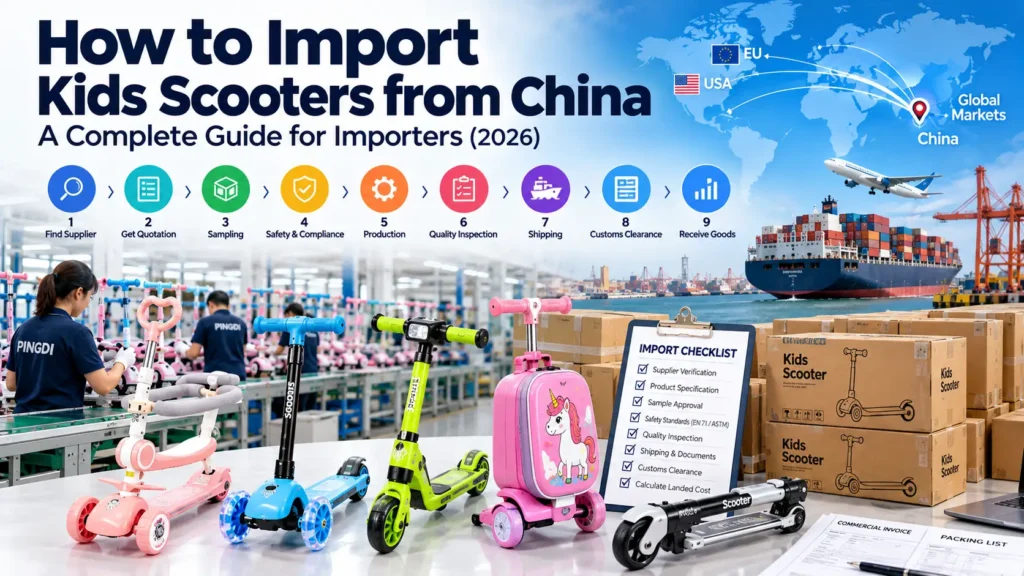
Importing kids scooters from China can be a practical way for distributors, wholesalers and private-label brands to expand their children’s mobility product ranges. However, a successful import project involves much more than finding a supplier and comparing FOB prices.
Buyers need to select suitable scooter models, verify manufacturing capabilities, understand minimum order quantities, confirm safety requirements, approve samples, manage production quality and arrange international shipping.
A low factory quotation does not necessarily mean a lower total import cost. Incorrect product specifications, inconsistent quality, unsuitable packaging or incomplete compliance documentation can create unexpected expenses.
For companies planning to import kids scooters from China, a structured sourcing process helps reduce these risks.
This guide explains the complete import process, from supplier selection and OEM customization to quality inspection, freight arrangements and customs clearance.
Guangzhou Pingdi Technology Co., Ltd. supports international importers, distributors, wholesalers and private-label brands through product sourcing, OEM/ODM project coordination, supplier communication, quality inspection and export support.
1. Understand the Kids Scooter Market Before Importing
The first step is to determine which scooter categories fit your target customers.
Children’s scooters are available in different designs, sizes, configurations and price segments.
3 Wheel Kids Scooters
Three-wheel scooters are commonly selected for younger children’s product ranges.
Depending on the model, features may include adjustable handlebars, wide decks, light-up wheels and different steering mechanisms.
For importers developing a toddler mobility collection, 3 wheel kids scooter wholesale products can be an important category.
Kids Scooters with Seats
Some models combine a standing scooter platform with a seat.
Depending on the design, the seat may be removable, adjustable or integrated into the structure.
These models can provide product differentiation compared with basic standing scooters.
Multifunction Kids Scooters
Multifunction scooters may include parent push handles, seats, guardrails, baskets or convertible configurations.
Importers should confirm the exact functional modes before marketing a product as 3-in-1, 4-in-1 or 5-in-1.
Foldable 2 Wheel Kids Scooters
Two-wheel kick scooters may be suitable for older children, depending on the product’s intended age range and specifications.
Buyers should compare folding mechanisms, wheel structures, handlebar adjustment systems and braking configurations.
Scooter Luggage
Scooter suitcases combine children’s luggage with a scooter structure.
This category can be relevant to distributors selling children’s travel accessories and mobility products.
Before requesting quotations, buyers should identify their preferred product categories, target retail prices and destination-market requirements.
2. How to Find a Kids Scooter Supplier in China
Finding a supplier is relatively easy. Identifying a reliable sourcing partner requires more evaluation.
Common supplier discovery channels include:
- Alibaba.com
- Made-in-China.com
- Global Sources
- Trade exhibitions
- Industry referrals
- Google searches
- Specialized sourcing companies
Useful search phrases include:
Kids scooter manufacturer China
Kids scooter supplier China
Wholesale kids scooters from China
Private label kids scooter supplier
However, buyers should not assume that every company describing itself as a manufacturer owns its production facilities.
Some suppliers operate their own factories, while others are trading companies or supply-chain management businesses.
Both models can support international purchasing when responsibilities and capabilities are transparent.
Manufacturer vs Trading Company
A direct manufacturer may provide closer access to its production facilities and technical team.
A professional trading or sourcing company may help buyers compare multiple manufacturing resources, coordinate different product categories and consolidate shipments.
The best option depends on the buyer’s requirements.
For example, a distributor sourcing three different scooter structures may need production resources with different specializations.
PINGDI operates as a China-based sourcing and OEM/ODM project management partner, coordinating suitable manufacturing resources according to product specifications, quantity and customization requirements.
3. Verify Your Kids Scooter Supplier
Before placing a bulk order, importers should complete a supplier verification process.
Important checks include:
Business Registration
Confirm the supplier’s legal company name and business registration information.
Manufacturing Relationship
Ask whether the supplier owns the factory or works with production partners.
Product Experience
Evaluate whether the supplier has experience with the required scooter category.
Technical Specifications
Request detailed specifications rather than relying only on product photographs.
Quality Management
Ask how production quality and product consistency are controlled.
Testing Documentation
Review available reports and determine whether they apply to the exact product configuration.
Production Capacity
For larger projects, confirm whether the selected production resources can meet the required order quantity and delivery schedule.
Export Experience
Evaluate the supplier’s ability to coordinate packaging, documentation and international shipping.
A reliable sourcing partner should explain its business model and provide appropriate evidence rather than making unsupported manufacturing claims.
4. Request Accurate Kids Scooter Wholesale Quotations
When importing kids scooters, a quotation should include more than a unit price.
Importers should provide a complete RFQ, or Request for Quotation.
A professional RFQ should include:
- Scooter type
- Product specifications
- Destination country
- Estimated order quantity
- Required colors
- Logo requirements
- Packaging requirements
- Testing requirements
- Preferred Incoterm
- Expected delivery date
Buyers should request confirmation of:
- Unit price
- MOQ
- Sample cost
- Customization cost
- Packaging specifications
- Production lead time
- Payment terms
- Incoterm and named place
- Quotation validity
For OEM projects, tooling or development charges should be identified separately where applicable.
This makes it easier to compare quotations from different suppliers.
5. What Is the MOQ for Wholesale Kids Scooters?
MOQ means Minimum Order Quantity.
There is no universal MOQ for kids scooters imported from China.
Minimum quantities vary according to the product, supplier and customization requirements.
Standard Models
Existing models using standard colors and packaging may offer more flexible order quantities.
Custom Logo Orders
Logo printing or labeling can introduce additional setup requirements.
Custom Colors
Special colors may require separate material preparation or production batches.
Private Label Packaging
Printed retail boxes, manuals and labels may have their own minimum quantities.
ODM Development
New tooling or structural development usually requires a separate commercial assessment.
For new importers, beginning with an established scooter platform may reduce development complexity.
PINGDI can help buyers evaluate different sourcing options based on expected order quantity, product requirements and customization needs.
6. Understand Kids Scooter Wholesale Prices
The factory cost of a kids scooter depends on several factors.
Product Structure
Basic three-wheel scooters, foldable two-wheel scooters and multifunction scooters have different component requirements.
Materials
Frame construction, plastic components, wheels, grips and other materials influence cost.
Functions
LED wheels, folding mechanisms, adjustable handlebars, seats and other features may affect the final quotation.
OEM Customization
Custom colors, logos, packaging and new tooling can increase development or production costs.
Order Quantity
Larger production volumes may improve purchasing efficiency, although savings depend on the product and supplier.
Quality Requirements
Inspection procedures, material specifications and testing requirements can affect project costs.
Importers should compare products according to approved specifications rather than photographs alone.
For a more detailed cost breakdown, see our guide to kids scooter wholesale prices and factory cost factors.
7. OEM and Private Label Kids Scooter Options
Many importers want to build their own children’s scooter brands instead of distributing generic products.
OEM customization can help create a more recognizable product range.
Depending on the model and production feasibility, customization may include:
- Brand logo
- Product colors
- Handle grip colors
- Wheel colors
- Deck graphics
- Product labels
- Instruction manuals
- Barcode labels
- Retail packaging
- Shipping carton marks
OEM vs ODM
OEM projects often use an existing product platform with agreed customization.
ODM projects may involve new designs, structural modifications or custom tooling.
For first-time importers, an existing platform with private-label packaging and branding may be more practical.
Established distributors may consider deeper product development when sales volume justifies the investment.
PINGDI supports OEM/ODM project coordination, including specification communication, sample approval, packaging development and production follow-up.
8. Confirm Kids Scooter Safety Requirements Before Ordering
Safety and compliance should be evaluated before mass production.
Different markets may have different requirements, and not every children’s scooter is classified in the same way.
European Union
Depending on product classification, applicable requirements may involve EU toy legislation and relevant EN 71 standards, or requirements applicable to certain sports-equipment scooters.
EN 14619 addresses a defined category of non-powered kick scooters.
Importers should not assume that every scooter automatically falls under EN 71 or EN 14619.
For products classified as toys, applicable EU conformity assessment, documentation and labeling requirements must be addressed.
The EU’s new Toy Safety Regulation, Regulation (EU) 2025/2509, also introduces future requirements, with its main provisions applying from August 1, 2030.
United States
The US Consumer Product Safety Commission distinguishes toys from non-powered scooters defined in ASTM F2264.
ASTM F963 should not automatically be treated as the applicable standard for every scooter.
Depending on the exact product and applicable regulations, importers may need testing, certification and supporting documentation.
As of 2026, importers should also review CPSC’s electronic certificate filing requirements where applicable.
Other Markets
Requirements for the UK, Mexico and other destinations should be assessed separately.
A report accepted for one market may not be sufficient for another.
Importers should confirm product classification, applicable regulations and required documentation before placing a bulk order.
PINGDI can coordinate relevant testing discussions with manufacturing partners and qualified third-party laboratories according to project requirements.
9. Order Samples Before Mass Production
Sample approval is one of the most important stages of importing kids scooters from China.
Buyers should not approve bulk production based only on catalog images.
A sample review should include:
Product Appearance
Check colors, surface finishing, printing and assembly quality.
Structural Components
Review frame construction, handlebar connections and relevant fasteners.
Wheels and Steering
Evaluate wheel installation, rotation and steering operation.
Braking
Check the intended braking system according to the approved specification.
Adjustable Components
Verify handlebar adjustment, folding mechanisms and other relevant functions.
OEM Branding
Confirm logo placement, colors and graphics.
Packaging
Review the packaging format, labels, manuals and shipping marks.
The approved sample should be supported by a written specification.
For repeat orders, maintaining an approved reference sample can help reduce differences between production batches.
10. Confirm the Purchase Order and Payment Terms
Once the product specification and commercial terms are agreed, buyers should issue a formal purchase order or sales contract.
Important information includes:
- Buyer and seller details
- Product description
- Model numbers
- Specifications
- Quantity
- Unit price
- Total value
- Packaging requirements
- Quality requirements
- Delivery schedule
- Incoterm and named place
- Payment terms
- Inspection arrangements
- Required documents
- Procedures for handling nonconforming goods
Payment structures vary by supplier, order value and commercial relationship.
Importers should verify beneficiary details carefully and use appropriate payment controls.
For larger or unfamiliar transactions, buyers may consider independent supplier verification and suitable trade-finance arrangements.
The agreed contract should clearly identify who is responsible for production, inspection, export documentation and shipment arrangements.
11. Manage Kids Scooter Production and Quality Control
After sample approval, the project enters mass production.
Importers should maintain communication with the supplier and monitor key milestones.
A practical production management process may include:
Pre-Production Confirmation
Confirm approved specifications, materials, colors, packaging and production schedule.
Production Follow-Up
Review progress against the agreed timeline.
In-Process Inspection
Where appropriate, check selected production-stage requirements.
Final Inspection
Evaluate finished products against the approved specification and inspection plan.
Kids Scooter Quality Inspection Checklist
Inspection points may include:
- Product appearance
- Frame assembly
- Handlebar installation
- Steering operation
- Wheel rotation
- Brake function
- Folding mechanism
- Seat and accessory installation
- Fasteners
- Logo placement
- Color consistency
- Labels
- Instructions
- Packaging
- Carton marks
- Quantity verification
Routine inspection does not replace laboratory testing or mandatory conformity assessment.
PINGDI can coordinate production follow-up and quality inspection according to the agreed sourcing project.
12. Choose the Right Shipping Method from China
International shipping affects both cost and delivery time.
The appropriate method depends on shipment size, urgency, destination and product packaging.
Sea Freight
Sea freight is commonly used for larger wholesale orders.
Importers may choose:
FCL – Full Container Load
Suitable for shipments requiring a dedicated container.
LCL – Less than Container Load
Suitable for smaller shipments that share container space.
Air Freight
Air freight may be considered for urgent samples or smaller high-priority shipments.
However, it can be significantly more expensive than sea freight.
Express Shipping
Courier services are often used for samples and small shipments.
Shipment Consolidation
Distributors purchasing multiple scooter models or other children’s mobility products may benefit from coordinated shipment consolidation.
For suitable projects, PINGDI can help coordinate products from different suppliers for combined shipping arrangements.
13. Understand FOB, CIF and DDP
Incoterms define important responsibilities between buyers and sellers.
Three terms commonly discussed during import sourcing are FOB, CIF and DDP.
FOB – Free on Board
Under FOB, the seller delivers the goods on board the vessel at the named port of shipment.
The buyer generally arranges the main carriage and takes responsibility for the relevant obligations under the agreed term.
FOB is intended for sea and inland waterway transport.
CIF – Cost, Insurance and Freight
Under CIF, the seller arranges and pays for the agreed carriage and minimum insurance to the named destination port.
However, risk transfers when the goods are loaded on board at the port of shipment.
Importers should not confuse the destination named in CIF with the point where risk transfers.
DDP – Delivered Duty Paid
Under DDP, the seller assumes extensive delivery responsibilities, including import clearance and applicable duties, subject to the agreed contract.
However, DDP can create practical difficulties where the seller cannot legally act as importer or complete the required customs procedures.
Buyers should verify the proposed arrangement before accepting DDP quotations.
For international B2B orders, the agreed Incoterm should include the relevant named place and edition, such as Incoterms 2020.
14. Prepare Customs Clearance Documents
Customs clearance requirements vary by destination country and product classification.
Common commercial shipping documents may include:
- Commercial invoice
- Packing list
- Bill of lading or air waybill
- Purchase order or sales contract
- Origin documentation where required
- Product specifications
- Applicable compliance documents
- Other destination-specific documents
Importers should work with a qualified customs broker to confirm local requirements.
What Is the HS Code for Kids Scooters?
The correct tariff classification depends on the product’s characteristics and the importing country’s tariff schedule.
Toy scooters and certain other scooters may fall under different tariff provisions.
For example, the US tariff schedule includes scooters within heading 9503 for relevant toy products, but this does not mean every scooter belongs in the same classification.
The importer should verify the exact classification before shipment.
Incorrect tariff classification can lead to duty errors, clearance delays or penalties.
Import Duties and Taxes
The total import cost may include:
- Customs duties
- Additional trade measures
- VAT or other import taxes
- Customs brokerage
- Port charges
- Inland transportation
- Other applicable fees
Duty rates can change and may depend on origin, classification and trade measures.
Importers should calculate landed cost using current official tariff information rather than relying on a supplier’s generic estimate.
15. Calculate the Total Landed Cost
Professional importers should evaluate total landed cost rather than factory price alone.
A simplified landed-cost calculation is:
Landed Cost = Product Cost + Packaging + Inspection + Freight + Insurance + Import Duties + Taxes + Customs and Local Charges
The actual calculation depends on the agreed Incoterm and which costs are already included in the supplier’s quotation.
For example, a scooter with a lower factory price may become more expensive if it requires larger packaging or produces higher freight costs.
Similarly, a slightly higher product price may be commercially reasonable when the specification, quality control and packaging are better aligned with the buyer’s requirements.
Importers should compare the full purchasing and logistics picture before confirming an order.
16. Common Mistakes When Importing Kids Scooters
Choosing Suppliers Only by Price
The cheapest quotation may exclude important specifications, packaging or quality requirements.
Ordering Without Samples
Catalog photographs cannot replace physical product evaluation.
Ignoring Product Classification
Different scooter categories may have different safety and regulatory requirements.
Assuming All Test Reports Are Valid
Reports should be checked against the exact product configuration and applicable requirements.
Failing to Confirm Packaging
Incorrect packaging can increase freight costs or create labeling problems.
Using an Incorrect HS Code
Tariff classification should be verified with the relevant customs authority or qualified broker.
Skipping Pre-Shipment Inspection
A final inspection can help identify nonconforming products before dispatch.
Failing to Plan Repeat Orders
Importers should maintain approved specifications and clear production records for future purchasing.
17. Why Importers Work with PINGDI
Guangzhou Pingdi Technology Co., Ltd. is a China-based children’s mobility product sourcing and OEM/ODM project management partner.
We primarily serve international importers, distributors, wholesalers and private-label brands.
Our business model focuses on coordinating suitable manufacturing resources rather than claiming ownership of every production facility.
Product Sourcing
We help buyers evaluate kids scooter models according to product requirements, target markets and commercial objectives.
Supplier Coordination
We coordinate suitable manufacturing resources for different scooter categories and project requirements.
OEM and Private Label Support
We support communication regarding logos, colors, graphics, packaging and selected product specifications.
Sample Management
We coordinate sample requirements and approval communication before bulk production.
Quality Control
Inspection requirements and production follow-up can be coordinated according to the agreed project scope.
Export and Shipping Support
We assist with packaging, shipment preparation and export-related coordination.
Multi-Category Procurement
Our sourcing range also includes:
- Baby strollers
- Kids balance bikes
- Kids bicycles
- Electric ride-on cars
- Scooter luggage
- Other selected children’s mobility products
For importers purchasing several product categories from China, consolidated sourcing may help simplify supplier communication and shipment planning.
18. Frequently Asked Questions
How do I import kids scooters from China?
Start by identifying your target scooter category and market requirements. Then evaluate suppliers, request quotations, approve samples, confirm compliance, arrange quality inspection and organize shipping and customs clearance.
What is the MOQ for kids scooters from China?
MOQ depends on the selected model, supplier, colors, branding, packaging and customization requirements. Standard products may offer more flexibility than fully customized projects.
Can I import private label kids scooters?
Yes. Suitable models can support custom logos, colors, graphics, labels and packaging, depending on production feasibility and order quantity.
Do kids scooters need safety testing?
Applicable testing requirements depend on the product’s design, intended use, age grading and destination market. Importers should confirm the relevant requirements for each model.
Is it better to buy directly from a factory?
Not necessarily. Direct factories and professional sourcing companies offer different advantages. Buyers should evaluate transparency, product capabilities, quality control and project management.
What documents are needed to import kids scooters?
Common documents include a commercial invoice, packing list and transport document. Additional customs and compliance documentation depends on the destination market and product.
Can different scooter models be shipped together?
For suitable orders, multiple models can be consolidated, subject to supplier schedules, packaging, customs requirements and logistics arrangements.
Can PINGDI help with OEM kids scooter sourcing?
Yes. PINGDI supports B2B sourcing, OEM/ODM coordination, sampling, quality inspection and export-related project management.
Conclusion: Build a Reliable Kids Scooter Import Supply Chain
Importing kids scooters from China requires a structured approach to product selection, supplier evaluation, OEM customization, quality control, shipping and customs clearance.
The most successful sourcing projects are not necessarily those with the lowest initial quotation.
They are projects where product specifications, responsibilities, compliance requirements, packaging and delivery arrangements are clearly established before production.
For importers and private-label brands, working with an experienced sourcing partner can help coordinate the different stages of international purchasing.
PINGDI supports international B2B buyers sourcing kids scooters and other children’s mobility products from China.
Whether you need three-wheel toddler scooters, foldable kick scooters, multifunction models or private-label products, our team can help coordinate suitable sourcing options.
Request a Wholesale Kids Scooter Quotation
Send us your destination country, required models, estimated quantity, branding requirements and preferred delivery schedule.