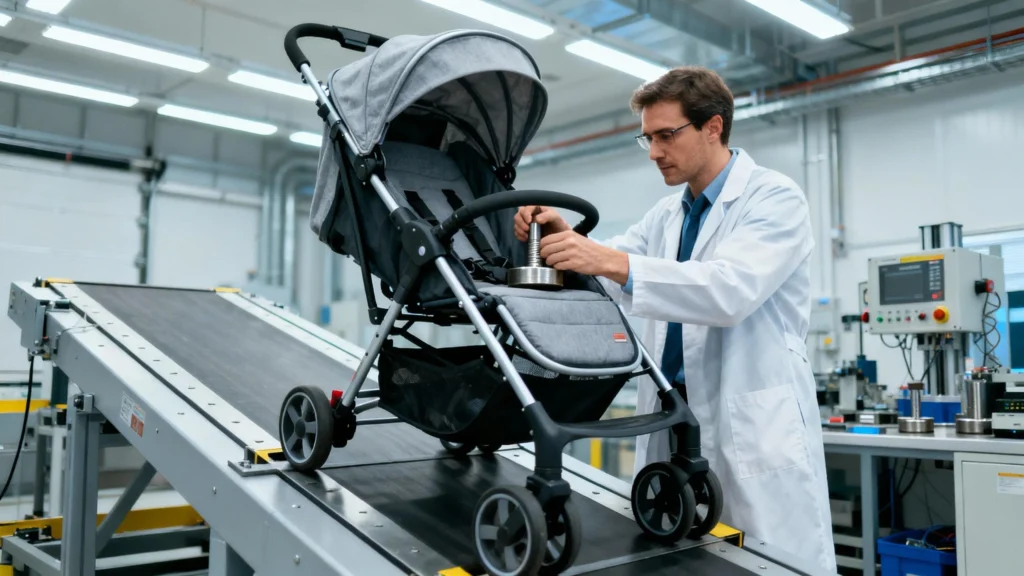
A practical verification guide for importers, wholesalers, distributors and private-label baby stroller brands.
Choosing a baby stroller manufacturer in China is not simply a matter of comparing product catalogs and FOB quotations.
A supplier may offer attractive designs, competitive pricing and professional factory photographs. However, these materials do not necessarily prove that the supplier operates the manufacturing facility, controls the production process or can deliver consistent quality across a bulk order.
For importers and private-label brands, supplier verification should begin before paying a deposit.
A 500-unit stroller order may involve multiple component suppliers, frame assembly, fabric production, safety testing, packaging approval and international shipping. Problems at any stage can affect delivery schedules, compliance and customer satisfaction.
This guide explains how to verify a baby stroller manufacturer in China before ordering, with practical methods for checking company registration, factory identity, production capacity, safety test reports, OEM capabilities and quality-control procedures.
It also explains how PINGDI helps international B2B buyers coordinate manufacturing partners, sourcing projects and quality inspections.
1. Verify the Supplier’s Legal Company Registration
The first step is to confirm that the Chinese supplier is a legally registered business.
Request a copy of the company’s Chinese business license and check the following information:
- Registered Chinese company name.
- Unified Social Credit Code.
- Legal representative.
- Registered address.
- Business registration status.
- Registered business scope.
- Company establishment date.
You can cross-check the information through China’s official National Enterprise Credit Information Publicity System.
Company verification checklist
| Document | What to Verify |
|---|---|
| Business license | Legal company identity |
| Unified Social Credit Code | Matches official registration |
| Registered address | Consistent with supplied details |
| Company bank account | Consistent with the contracting entity |
| Sales contract | Correct legal company name |
| Factory information | Actual production source |
A valid business license does not automatically prove that the company owns a factory.
It confirms registration information, which is only the first stage of supplier verification.
2. Identify the Actual Baby Stroller Manufacturing Facility
One of the most important questions is:
Who will actually manufacture the baby strollers?
Some suppliers operate their own production facilities. Others coordinate manufacturing through independent factories.
Both arrangements can be commercially workable.
However, importers should understand the actual supply structure.
Ask the supplier to provide:
- Manufacturing company’s legal name.
- Factory location.
- Relevant product categories.
- Production-line information.
- Main equipment.
- Available factory audit records.
- Quality-management procedures.
For larger orders, consider a live factory video inspection or independent factory audit.
Manufacturer versus sourcing partner
A direct manufacturer may offer close access to production equipment and factory management.
A sourcing partner may coordinate several manufacturing facilities and manage product selection, customization, quality inspection and export requirements.
The important distinction is not simply the company type.
It is whether the buyer can verify the manufacturing source and establish clear responsibility for product specifications, production quality and delivery.
3. Verify Whether the Factory Has Relevant Stroller Production Experience
Not every baby product factory has the same capabilities.
A factory experienced in lightweight umbrella strollers may not necessarily have the same manufacturing processes required for premium reversible-seat strollers or double strollers.
Before approving a supplier, ask which stroller categories it regularly produces.
Examples include:
- Lightweight baby strollers.
- Compact folding strollers.
- Reversible-seat strollers.
- Travel system strollers.
- Twin and double strollers.
- Jogging-style strollers.
Request evidence relevant to the actual product category.
A factory should be able to explain its production workflow, key components and quality-control procedures.
A product catalog alone is not enough.
4. Calculate Real Baby Stroller Production Capacity
Many suppliers advertise large monthly production capacities.
However, a capacity claim is only useful when supported by measurable production information.
Buyers should request:
- Number of relevant assembly lines.
- Actual daily output.
- Working days per month.
- Recent production records.
- Current order backlog.
- Available production capacity.
- Lead times for critical components.
Example production capacity calculation
Consider a hypothetical manufacturing facility:
| Parameter | Illustrative Value |
|---|---|
| Assembly lines | 2 |
| Daily output per line | 120 units |
| Working days per month | 22 |
| Theoretical monthly output | 5,280 units |
| Planning utilization | 75% |
| Illustrative planned output | 3,960 units |
The theoretical calculation is:
2 × 120 × 22 = 5,280 units per month
At an assumed utilization rate of 75%, planned output would be approximately 3,960 units.
These are illustrative figures, not verified PINGDI factory capacity.
Actual production depends on product complexity, staffing, component availability, existing orders and quality requirements.
Questions to ask
Can the factory provide recent output records?
How many production lines are suitable for the selected model?
Which components have the longest lead times?
How will the factory manage production delays?
What happens if an OEM component fails inspection?
Reliable answers are more useful than unsupported capacity claims.
5. Review the Baby Stroller Manufacturing Process
A professional stroller manufacturing process should have clearly defined stages and quality controls.
The exact workflow depends on the stroller design and manufacturing facility.
A typical project may involve:
Component sourcing → Incoming inspection → Frame preparation → Fabric preparation → Assembly → In-process checks → Final inspection → Packaging
Frame manufacturing
Verify the selected frame materials, construction methods and approved specifications.
Folding mechanism
Check the approved design, locking features and applicable safety requirements.
Wheel and brake systems
Confirm component specifications, assembly consistency and relevant functional testing.
Fabric and seating components
Review fabric specifications, stitching, seat construction and restraint-system installation.
Final assembly
The factory should follow documented assembly instructions and agreed inspection criteria.
Importers should request process information for the actual stroller model rather than rely on a generic factory presentation.
6. Verify ASTM F833 and U.S. Stroller Compliance
For importers targeting the United States, stroller safety compliance is a critical part of supplier verification.
Covered carriages and strollers are regulated under 16 CFR Part 1227, which incorporates the applicable CPSC-accepted version of ASTM F833.
Relevant requirements address issues such as:
- Stability.
- Parking brakes.
- Restraint systems.
- Folding and locking mechanisms.
- Structural performance.
- Wheel assemblies.
- Openings and entrapment hazards.
- Labeling and warnings.
Importers should confirm that test reports cover the actual product configuration and applicable regulatory requirements.
Children’s Product Certificate
For covered children’s products, the U.S. importer must issue a Children’s Product Certificate based on appropriate testing by a CPSC-accepted laboratory.
The certificate should identify the applicable rules and supporting test information.
From July 8, 2026, the CPSC’s certificate eFiling requirements also apply to covered imported consumer products, subject to the relevant effective-date provisions.
Importers should verify their current filing obligations before shipment.
Official resources:
CPSC Carriages and Strollers Business Guidance
CPSC Children’s Product Certificate Guidance
7. Verify EN 1888 and European Market Requirements
For European markets, importers should review the applicable stroller safety requirements, including relevant EN 1888 standards.
The exact requirements depend on the product design, intended use and applicable legislation.
Buyers should also assess obligations under the EU General Product Safety Regulation and other relevant rules.
Important verification areas
- Applicable product safety requirements.
- Test report identification.
- Manufacturer and importer information.
- Product traceability.
- Safety warnings.
- Instructions in required languages.
- Technical documentation.
- Correct product labeling.
A test report should identify the exact stroller model and relevant test standard.
Importers should not assume that a generic CE certificate proves compliance for every stroller. Whether CE marking is required depends on the legislation applicable to the particular product.
Official reference: European Commission Product Compliance Guidance
8. How to Verify a Baby Stroller Test Report
A supplier may provide a laboratory report containing a familiar testing-company name.
However, the document must be checked carefully.
Test report verification checklist
| Verification Item | Required Review |
|---|---|
| Laboratory | Confirm identity and relevant recognition |
| Report number | Verify where possible |
| Applicant | Identify the named company |
| Manufacturer | Check actual production source |
| Model number | Match the selected stroller |
| Product photographs | Match approved configuration |
| Test standard | Check applicable edition |
| Test date | Confirm relevance |
| Results | Review complete report |
| Design changes | Assess whether additional testing is needed |
A test report for one stroller model should not automatically be used for a different model.
If the supplier changes the frame, folding mechanism, wheels or other safety-related components, the effect on compliance should be assessed.
Where authenticity is uncertain, contact the issuing laboratory.
9. Verify OEM and Private-Label Manufacturing Capabilities
Many importers search for an OEM baby stroller manufacturer in China because they want customized products for their own brands.
However, OEM capability involves more than adding a logo.
Common customization options include:
- Fabric colors.
- Frame finishes.
- Brand logos.
- Packaging artwork.
- User manuals.
- Selected accessories.
- Product labeling.
- Approved component variations.
OEM customization review
| Customization | Verification Requirement |
|---|---|
| Logo | Artwork and placement approval |
| Fabric | Material and color confirmation |
| Frame finish | Approved appearance and process |
| Wheels | Compatibility and safety assessment |
| Packaging | Artwork and labeling approval |
| New folding mechanism | Engineering and testing review |
| Structural changes | Development and validation plan |
Before production, the buyer should approve a final sample and written product specification.
For complex projects, tooling ownership, design rights and change-control responsibilities should also be agreed.
10. Check the Factory’s Quality-Control System
A reliable manufacturer should have quality controls appropriate to the product and production process.
Incoming Quality Control
Incoming inspection checks relevant materials and components against approved specifications.
In-Process Quality Control
Production checks help identify assembly errors and component inconsistencies before products reach final inspection.
Final Quality Control
Finished products are checked against agreed product requirements.
Pre-Shipment Inspection
An independent inspection may be arranged before shipment.
Suggested inspection checklist
| Inspection Item | What to Check |
|---|---|
| Model | Matches purchase order |
| Frame | Approved material and construction |
| Folding system | Correct operation |
| Wheel assembly | Correct components |
| Brake | Correct operation |
| Restraint system | Approved configuration |
| Fabric | Material and workmanship |
| Labels | Required information |
| Instructions | Approved version |
| Packaging | Approved artwork |
| Carton quantity | Matches packing list |
General sampling inspections do not replace mandatory safety testing.
Safety-critical defects should be handled according to the applicable requirements and agreed rejection criteria.
11. Verify Component Suppliers and Product Traceability
Baby stroller production depends on several component categories.
These may include frames, wheels, brakes, fabrics, buckles, restraint components and packaging materials.
Importers should ask how the factory controls component sourcing.
Questions include:
- Are critical component suppliers approved?
- Are incoming components inspected?
- Are component substitutions documented?
- Can production batches be identified?
- Are nonconforming materials segregated?
- Can corrective actions be traced to the affected products?
A documented traceability process can help manage quality issues and potential product recalls.
12. Compare MOQ, Pricing and Production Lead Time
There is no universal minimum order quantity for all baby stroller manufacturers.
MOQ varies by product design, component requirements, materials, packaging and customization.
Illustrative purchasing scenarios
| Project | Example Quantity | Main Consideration |
|---|---|---|
| Market trial | 100 units | Supplier flexibility |
| Initial wholesale order | 500 units | Production planning |
| Private-label launch | 1,000 units | Custom components |
| Distributor replenishment | 2,000 units | Capacity and lead time |
These quantities are examples, not guaranteed supplier MOQs.
A professional quotation should identify:
- Product model.
- Technical specifications.
- Included accessories.
- MOQ.
- Unit price.
- Currency.
- Incoterm.
- Packaging.
- Sample charges.
- Tooling charges.
- Production lead time.
- Payment terms.
Buyers should compare equivalent specifications rather than choosing a supplier based only on the lowest quoted price.
13. Verify Packaging and Shipping Information
Packaging influences product protection and international freight costs.
Ask for final carton dimensions, packing quantity, gross weight and net weight.
Example CBM calculation
Suppose a hypothetical stroller carton measures:
55 × 45 × 25 cm
Carton volume:
0.55 × 0.45 × 0.25 = 0.061875 CBM
For 500 cartons:
500 × 0.061875 = approximately 30.94 CBM
This is a mathematical example, not an actual PINGDI product specification.
Container loading depends on carton dimensions, stacking limits, weight distribution and available container space.
The supplier should provide a loading plan based on the final approved packaging.
14. Use a Weighted Supplier Verification Scorecard
A structured scorecard helps buyers compare suppliers consistently.
The following scoring model is an illustrative procurement tool.
| Evaluation Area | Weight |
|---|---|
| Legal identity and transparency | 15% |
| Manufacturing capability | 20% |
| Safety compliance documentation | 25% |
| Quality management | 20% |
| OEM project execution | 10% |
| Delivery and communication | 10% |
| Total | 100% |
Score each category from 0 to 5.
Calculate the weighted result by dividing the category score by five and multiplying by its assigned weight.
For example, a score of 4 out of 5 in manufacturing capability produces 16 points out of 20.
A high total score should not override serious safety, documentation or legal concerns.
15. Red Flags Before Paying a Deposit
Importers should investigate suppliers that:
- Refuse to identify the actual factory.
- Provide inconsistent company information.
- Cannot explain production capabilities.
- Present test reports for unrelated models.
- Change specifications without approval.
- Make unsupported capacity claims.
- Refuse reasonable inspection arrangements.
- Provide unclear payment instructions.
- Cannot explain quality-control procedures.
- Promise unrealistic delivery schedules.
Each concern should be resolved before the buyer commits to a bulk order.
16. How PINGDI Supports Baby Stroller Supplier Verification
Guangzhou Pingdi Technology Co., Ltd. is a China-based B2B supply chain and OEM/ODM project management partner specializing in baby and children’s products.
Through our network of manufacturing partners, we support global importers, distributors, wholesalers and brands with product sourcing, supplier coordination, custom development, quality-control arrangements and international shipping coordination.
Our services include:
Manufacturing partner coordination
Helping buyers communicate with suitable manufacturing partners and request relevant factory information.
Product sourcing and specification review
Coordinating product model selection, technical requirements and approved specifications.
OEM/ODM project management
Supporting communication concerning custom colors, logos, packaging, sample development and production requirements.
Documentation follow-up
Coordinating requests for available test reports, product specifications and relevant compliance documents.
Quality inspection coordination
Assisting with agreed inspection arrangements and follow-up on identified issues.
Export project coordination
Supporting communication about packaging, production schedules and shipment preparation.
From initial product selection to bulk order delivery, PINGDI helps buyers manage sourcing projects with greater efficiency, transparency and confidence.
Final compliance and certification responsibilities remain with the relevant manufacturers, importers and other responsible economic operators.
17. Ten Steps to Verify a Manufacturer Before Ordering
Step 1 — Verify legal identity. Confirm the supplier’s registered company details.
Step 2 — Identify the factory. Establish where the selected stroller will be manufactured.
Step 3 — Review manufacturing capability. Check relevant equipment, processes and production records.
Step 4 — Confirm product specifications. Agree on the exact model, materials and features.
Step 5 — Verify test reports. Match documents to the actual product and applicable requirements.
Step 6 — Approve OEM details. Confirm customization, tooling and packaging.
Step 7 — Approve samples. Record the final accepted configuration.
Step 8 — Confirm commercial terms. Agree on price, MOQ, lead time and payment conditions.
Step 9 — Establish inspection requirements. Define quality criteria and inspection milestones.
Step 10 — Review shipment readiness. Confirm packaging, documents and logistics before release.
18. Frequently Asked Questions
How do I verify a baby stroller manufacturer in China?
Check the company’s legal registration, actual manufacturing facility, production capabilities, product specifications, safety documentation and quality-control procedures.
Is a trading company less reliable than a direct manufacturer?
Not necessarily. The important factors are transparency, supplier management, product knowledge, documentation and accountability.
How can I verify an ASTM F833 test report?
Confirm the laboratory, product model, applicable standard version, report scope and results. Contact the laboratory when authenticity is uncertain.
What documents should I request before ordering?
Relevant documents may include business registration details, factory information, product specifications, test reports, approved samples and agreed inspection requirements.
Can I arrange an independent factory audit?
Yes, subject to factory access and the agreed audit scope.
What is the MOQ for OEM baby strollers?
MOQ depends on the selected model, customization, components and manufacturing arrangements.
Can PINGDI assist with supplier verification?
PINGDI can help coordinate manufacturing partner information, sourcing communication, documentation requests, OEM projects and inspection arrangements.
Conclusion: Verify the Evidence Before You Order
A reliable baby stroller sourcing project starts with verifying the supplier’s legal identity, actual manufacturing arrangements and product capabilities.
Importers should also review safety documentation, production capacity, component controls, OEM requirements and quality-management procedures.
For private-label projects, approved samples and written specifications are particularly important.
The goal is not simply to find a supplier offering a low price.
It is to establish a transparent and manageable purchasing process supported by verifiable information.
Looking for a Baby Stroller Sourcing Partner in China?
PINGDI supports international B2B buyers with baby stroller sourcing, OEM/ODM coordination, manufacturing partner communication, documentation follow-up, quality inspection arrangements and export project management.
Explore Baby Stroller Sourcing Options
Contact PINGDI for a Wholesale or OEM Quotation
Share your destination market, stroller model, estimated quantity and customization requirements to discuss suitable sourcing options.
Guangzhou Pingdi Technology Co., Ltd.
Baby & Children’s Products Supply Chain Partner
China Sourcing · OEM/ODM · Quality Coordination · Global B2B Supply
Website: https://pingdifactory.com