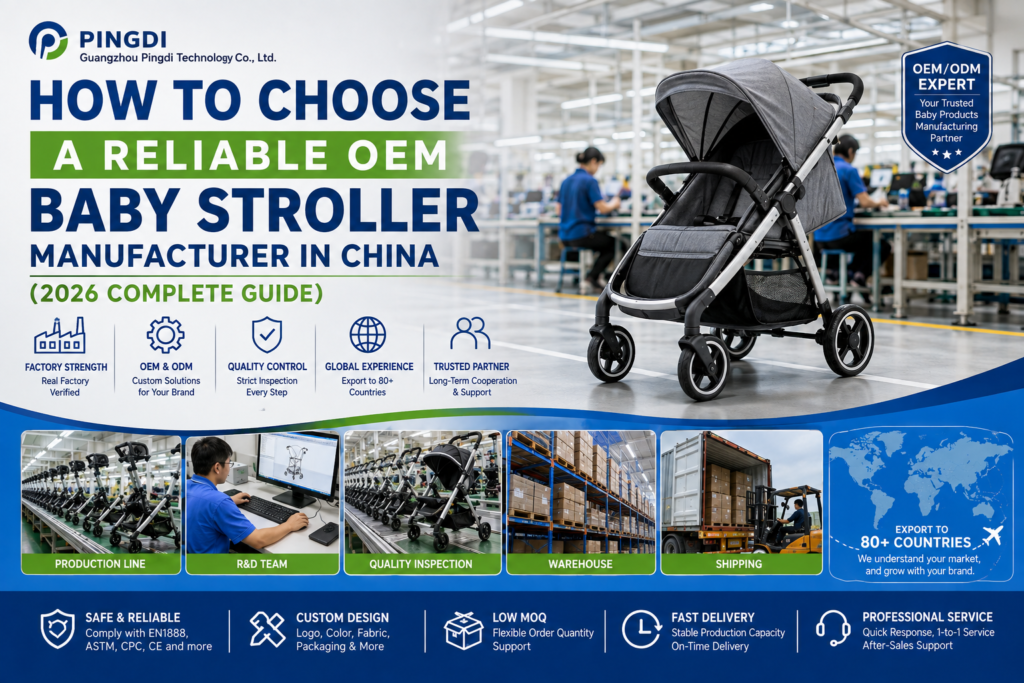
Global Market Trends, Why China Leads OEM Manufacturing, and What International Buyers Should Know
Category: Baby Products | OEM Manufacturing | Buying Guide
Published: August 2026
Introduction
The global baby stroller industry continues to evolve as parents increasingly prioritize safety, comfort, lightweight design, sustainability, and multifunctionality. At the same time, retailers, importers, and private-label brands are looking for manufacturing partners that can deliver consistent quality, competitive pricing, flexible customization, and reliable delivery.
China remains the world’s leading manufacturing hub for baby strollers, supplying products to Europe, North America, the Middle East, Latin America, Southeast Asia, and many other international markets.
However, not every manufacturer offers the same level of engineering expertise, quality control, or OEM capability. Choosing the wrong supplier may result in delayed production, quality issues, warranty claims, and damage to your brand reputation.
This complete 2026 guide explains how to identify a professional OEM Baby Stroller Manufacturer in China, understand current industry trends, and build a long-term manufacturing partnership that supports your business growth.
Why the Global Baby Stroller Market Continues to Grow
The baby care industry has become one of the fastest-growing consumer sectors worldwide. Parents today are more informed than ever before, and purchasing decisions are increasingly influenced by safety standards, product functionality, and brand reputation.
Several factors continue to drive demand for premium baby strollers.
Growing Demand for Premium Baby Products
Parents no longer purchase strollers based only on price. Instead, they compare:
- Safety features
- Lightweight construction
- Foldability
- Travel convenience
- Suspension systems
- Comfort
- Storage capacity
- Modern aesthetics
As a result, importers are seeking manufacturers capable of producing high-value products rather than basic low-cost models.
Popular Google search terms include:
- OEM Baby Stroller Manufacturer
- Baby Stroller Manufacturer China
- Lightweight Baby Stroller
- Travel Baby Stroller
- Baby Stroller Supplier
- Premium Baby Stroller
- Custom Baby Stroller
E-commerce Is Changing the Industry
Online sales continue to reshape the baby products market.
Retailers selling through platforms such as:
- Amazon
- Walmart Marketplace
- Mercado Libre
- Shopee
- Lazada
- Noon
need suppliers that provide:
- Stable product quality
- Attractive packaging
- Fast replenishment
- Private labeling
- Product differentiation
Unlike traditional wholesale, online sellers compete through branding and customer reviews. This has increased demand for OEM and ODM manufacturing.
Private Label Is Becoming the Preferred Business Model
Many distributors are moving away from selling generic products.
Instead, they build their own brands using:
- Custom logos
- Exclusive colors
- Retail packaging
- Product upgrades
- Local-language manuals
- Brand storytelling
A professional OEM manufacturer helps customers create products that cannot easily be compared with competitors.
Why China Remains the World’s Leading Baby Stroller Manufacturing Base
China has built one of the world’s most complete manufacturing ecosystems for baby products.
Instead of depending on suppliers located across different countries, manufacturers can source nearly every component locally.
Typical supporting industries include:
- Aluminum frame production
- Plastic injection molding
- Fabric manufacturing
- EVA wheel production
- Bearings
- Fasteners
- Packaging
- Carton printing
- Metal processing
- Surface coating
This integrated supply chain offers significant advantages.
Complete Supply Chain Integration
Because suppliers are located within the same manufacturing regions, factories can respond quickly to changing production schedules.
Benefits include:
- Faster material procurement
- Better production planning
- Reduced transportation costs
- Improved quality consistency
- More competitive pricing
This efficiency is one of the key reasons why international buyers continue to source from China.
Advanced Manufacturing Experience
China has accumulated decades of export experience in children’s products.
Professional factories are familiar with:
- International testing requirements
- Retail packaging standards
- OEM projects
- Large-scale production
- Export documentation
- Container loading optimization
This experience reduces communication barriers and improves project execution.
Continuous Product Innovation
Modern baby strollers are no longer simple transportation tools.
Manufacturers continue introducing features such as:
- One-hand folding systems
- Lightweight aluminum frames
- Shock absorption systems
- Reversible seats
- Large storage baskets
- Adjustable handlebars
- All-terrain wheels
- Compact travel designs
Importers increasingly prefer manufacturers with active R&D teams that can help launch new products instead of only producing existing models.
What International Buyers Expect from an OEM Manufacturer
The expectations of global buyers have changed significantly over the past few years.
Today, professional importers evaluate suppliers using much broader criteria than price.
They expect manufacturers to provide:
Stable Manufacturing Capacity
Large seasonal orders require reliable production planning.
Manufacturers should demonstrate the ability to:
- Manage multiple production lines
- Handle peak-season demand
- Maintain consistent lead times
- Deliver repeat orders without quality variation
Product Development Support
Many buyers seek engineering support before production begins.
A qualified manufacturer should assist with:
- Product optimization
- Material selection
- Structural improvements
- Cost reduction
- Packaging design
This collaborative approach shortens development cycles and improves final product performance.
Strong Export Experience
International business requires familiarity with:
- Commercial invoices
- Packing lists
- Certificates of origin
- Shipping marks
- Container loading
- Customs documentation
Experienced manufacturers help customers avoid delays caused by documentation errors.
Current Purchasing Trends in 2026
Based on current industry developments, several product categories continue attracting strong buyer interest.
Lightweight Baby Strollers
Urban families increasingly prefer compact, lightweight models that are easy to fold and transport.
These products are especially popular among:
- Travel retailers
- E-commerce sellers
- Airport stores
- Urban baby stores
Travel System Strollers
Travel systems combining:
- Stroller
- Car seat compatibility
- Easy folding
- Compact storage
continue to perform well across international markets.
Eco-Friendly Materials
Sustainability has become an important purchasing consideration.
Many buyers now ask manufacturers about:
- Recyclable packaging
- Durable materials
- Reduced plastic waste
- Responsible manufacturing practices
Factories capable of supporting environmental initiatives often gain a competitive advantage.
Smart Manufacturing
Modern buyers increasingly value manufacturing transparency.
Many factories now provide:
- Production videos
- Online factory tours
- Digital quality reports
- Real-time production updates
These services strengthen buyer confidence and improve communication throughout production.
Why Choosing the Right Manufacturer Matters
A baby stroller is a safety-related product used every day by families.
Selecting the right OEM partner affects far more than manufacturing costs.
A reliable supplier helps customers achieve:
- Better product quality
- Lower warranty costs
- Stronger brand reputation
- Faster product launches
- More stable supply chains
- Higher customer satisfaction
- Long-term business growth
For this reason, experienced buyers invest significant time in evaluating manufacturing partners before placing orders.
Conclusion
China continues to lead the global baby stroller manufacturing industry through its integrated supply chain, advanced production capabilities, engineering expertise, and strong export experience. As the market becomes more competitive, choosing a reliable OEM manufacturer is no longer simply about obtaining the lowest quotation—it is about finding a partner capable of supporting your brand’s long-term success.
In Part 2, we will explain how to evaluate an OEM Baby Stroller Manufacturer, including factory audits, R&D capabilities, production capacity, OEM/ODM services, engineering teams, and the critical factors that distinguish an outstanding manufacturing partner from an average supplier.
Factory Strength, OEM/ODM Capability & Production Excellence
After understanding why China remains the world’s leading manufacturing hub for baby strollers, the next question is:
How can you identify a truly reliable OEM Baby Stroller Manufacturer?
Many suppliers look similar on Alibaba, Google, or trade platforms. They may use comparable product photos, claim extensive export experience, and advertise competitive prices. However, their manufacturing capabilities, quality systems, engineering expertise, and customer support can differ significantly.
Experienced buyers focus on evaluating the factory itself rather than choosing solely based on quotation.
1. Verify Whether the Supplier Is a Real Manufacturer
The first step is determining whether you are working directly with a factory or with a trading company.
A genuine manufacturer generally offers:
- Dedicated production workshops
- Assembly lines
- Engineering department
- Quality inspection department
- Warehouse facilities
- Sample room
- Production management team
- Factory audit support
During discussions, ask for:
- Factory photos
- Production videos
- Workshop layout
- Manufacturing process
- Factory address
- Export history
If possible, arrange an online factory tour or an on-site visit before beginning long-term cooperation.
Working directly with a manufacturer often provides:
- Faster communication
- Better technical support
- Greater customization flexibility
- More stable pricing
- Better production control
2. Evaluate Factory Scale and Production Capacity
Factory size alone does not determine quality, but production capacity directly affects delivery reliability.
Ask questions such as:
- How many production lines are available?
- What is the monthly production capacity?
- How many workers are involved in assembly?
- Can the factory handle multiple OEM projects simultaneously?
- What happens during peak production seasons?
A professional Baby Stroller Factory should be capable of supporting:
- Trial orders
- Container orders
- Repeat production
- Seasonal demand
- Large retail programs
Stable capacity reduces delays during important sales periods such as Black Friday, Christmas, and promotional campaigns.
3. Assess Product Development and Engineering Capabilities
The baby stroller market changes rapidly.
Parents expect products that are:
- Lightweight
- Compact
- Stylish
- Safe
- Easy to fold
- Comfortable
- Travel-friendly
Factories with experienced engineering teams can respond to these market trends much faster.
A professional R&D department should support:
Product Appearance Design
Creating modern stroller designs that appeal to international consumers.
Structural Engineering
Optimizing:
- Folding mechanisms
- Frame strength
- Weight reduction
- Suspension systems
- Handle adjustment
- Seat structure
Prototype Development
Before mass production, engineers develop prototypes to verify:
- Dimensions
- User experience
- Stability
- Safety
- Production feasibility
Early testing reduces development risks and improves product quality.
4. Understand the Manufacturer’s OEM & ODM Capabilities
Not every factory provides the same level of customization.
A reliable OEM Baby Stroller Manufacturer should offer flexible solutions for different business models.
OEM Manufacturing
OEM services allow customers to build their own brand while using proven manufacturing processes.
Typical OEM services include:
- Logo printing
- Product color customization
- Packaging design
- User manual localization
- Carton artwork
- Barcode labels
- Shipping marks
- Hang tags
- Product labeling
This approach is ideal for distributors, retailers, and established brands.
ODM Manufacturing
ODM services are designed for customers who want to launch products quickly without starting from scratch.
Factories provide:
- Existing product platforms
- Appearance modifications
- Functional upgrades
- Material selection
- Packaging customization
ODM reduces development costs while maintaining a unique market identity.
5. Examine the Product Range
A manufacturer with a diverse product portfolio often demonstrates stronger engineering resources and broader production experience.
Typical product categories may include:
- Full-size baby strollers
- Lightweight travel strollers
- Umbrella strollers
- Compact cabin strollers
- Jogging strollers
- Twin strollers
- Reversible-seat strollers
- High landscape strollers
A wider product range allows customers to expand their business without changing suppliers.
6. Review Material Selection
Material quality directly influences product safety, durability, and customer satisfaction.
Professional manufacturers carefully select:
Aluminum Alloy Frames
Advantages include:
- Lightweight
- Corrosion resistance
- High strength
- Long service life
Premium Fabrics
Look for:
- Breathability
- Wear resistance
- Easy cleaning
- Comfortable texture
Wheels
Depending on market positioning:
- EVA wheels
- Rubber wheels
- PU wheels
- Suspension wheels
Different wheel configurations suit different customer needs.
7. Evaluate Production Management
A well-organized factory should have standardized production procedures.
Important production stages include:
- Material preparation
- Frame assembly
- Sewing
- Wheel installation
- Brake installation
- Folding system testing
- Packaging
- Final inspection
Efficient production management improves consistency and reduces manufacturing defects.
8. Review Export Experience
Manufacturing products is only part of the process.
Export experience is equally important.
An experienced supplier understands:
- International packaging standards
- Shipping documentation
- Container loading optimization
- Customs documentation
- Export compliance
- Buyer communication
This experience minimizes unnecessary delays and improves project efficiency.
9. Communication Is a Competitive Advantage
Excellent communication often distinguishes outstanding suppliers from average ones.
Professional manufacturers provide:
- Fast quotation response
- Engineering consultation
- Weekly production updates
- Production photos
- Video reports
- Inspection reports
- Shipment notifications
Transparent communication builds trust and helps customers manage projects remotely.
10. Factory Audit Checklist
Before selecting a manufacturing partner, consider reviewing the following areas during a factory audit:
Production
✔ Assembly lines
✔ Equipment maintenance
✔ Production workflow
✔ Material storage
Quality
✔ Incoming inspection
✔ Process inspection
✔ Final inspection
✔ Testing equipment
Engineering
✔ Design team
✔ Sample room
✔ Mold capability
✔ Product development
Warehouse
✔ Packaging area
✔ Finished goods storage
✔ Container loading
✔ Inventory management
Management
✔ Export documentation
✔ Project management
✔ Customer communication
✔ Continuous improvement
A structured audit provides valuable insight into a supplier’s long-term capabilities.
Why Long-Term Partnerships Matter
The most successful importers rarely change factories every year.
Instead, they build long-term relationships with manufacturers who understand their products, quality requirements, and business objectives.
Long-term cooperation offers advantages such as:
- More stable pricing
- Faster product development
- Priority production scheduling
- Better communication
- Improved quality consistency
- Stronger technical support
Rather than treating the manufacturer as only a supplier, many successful brands view the factory as an extension of their own business.
Conclusion
Choosing the right OEM Baby Stroller Manufacturer in China requires careful evaluation of production capability, engineering expertise, export experience, product development, communication, and long-term cooperation potential.
Price should never be the only decision factor. A dependable manufacturing partner helps reduce risks, improve product quality, shorten development cycles, and strengthen your brand in competitive international markets.
In Part 3, we will take a detailed look at quality control systems, EN1888 compliance, manufacturing processes, testing procedures, and practical strategies for avoiding common sourcing mistakes—essential knowledge for every importer planning to source baby strollers from China.
Quality Control, EN1888 Compliance, Manufacturing Process & Common Sourcing Mistakes
When sourcing baby strollers from China, many buyers focus on product design and pricing. However, experienced importers understand that quality management, regulatory compliance, and standardized manufacturing processes are what truly determine long-term business success.
A single quality issue can lead to customer complaints, product recalls, warranty claims, and damage to your brand reputation. This is why choosing a manufacturer with a mature quality management system is far more valuable than simply finding the lowest quotation.
In this section, we explain how professional OEM Baby Stroller Manufacturers manage quality, comply with international standards, and reduce sourcing risks.
Why Quality Control Is Critical for Baby Strollers
Unlike many consumer products, baby strollers are directly related to infant safety. Parents expect products that are durable, stable, comfortable, and easy to operate. Retailers and importers also face increasing pressure to comply with international regulations.
A professional factory should implement a complete quality management system covering every stage of production—from raw materials to final shipment.
Step 1: Incoming Quality Control (IQC)
Quality begins before production starts.
Every batch of raw materials and purchased components should be inspected before entering the production line.
Typical inspections include:
Frame Materials
- Aluminum tube thickness
- Steel strength
- Surface coating
- Welding consistency
Plastic Components
- Injection quality
- Color consistency
- Surface finish
- Dimensional accuracy
Fabric Inspection
- Fabric strength
- Stitching compatibility
- Color matching
- Abrasion resistance
Wheels & Bearings
- Rotation performance
- Wear resistance
- Noise level
- Load capacity
Accessories
- Buckles
- Safety belts
- Screws
- Handles
- Brake components
Only qualified materials proceed to production.
Step 2: In-Process Quality Control (IPQC)
Rather than waiting until production is complete, professional manufacturers inspect products continuously throughout assembly.
Typical checkpoints include:
Frame Assembly
Inspectors verify:
- Welding quality
- Structural alignment
- Dimensional accuracy
- Surface treatment
Fabric Installation
Quality inspectors confirm:
- Proper stitching
- Fabric tension
- Wrinkle-free installation
- Accurate logo placement
Folding Mechanism
The folding system is one of the most important parts of a baby stroller.
Factories should repeatedly test:
- Smooth folding
- Locking mechanism
- Automatic release
- Handle operation
Reliable folding systems improve both safety and customer satisfaction.
Step 3: Functional Testing
Each stroller should undergo comprehensive functional testing before packaging.
Typical tests include:
Brake Performance
The braking system should engage quickly and securely on different surfaces.
Steering Test
Front wheels should rotate smoothly without excessive resistance.
Wheel Durability
Factories often simulate repeated rolling to verify long-term performance.
Seat Adjustment
Backrest and footrest mechanisms should move smoothly while maintaining stability.
Canopy Function
The canopy should open and close easily while maintaining proper positioning.
Harness System
The five-point safety harness should operate correctly and securely.
Step 4: Final Quality Control (FQC)
Once assembly is complete, every finished stroller should undergo a comprehensive final inspection.
Typical inspection items include:
- Product appearance
- Color consistency
- Logo accuracy
- Folding operation
- Wheel alignment
- Brake system
- Fabric quality
- Accessories
- User manual
- Packaging
Products that fail inspection should be repaired or removed before shipment.
Step 5: Outgoing Quality Control (OQC)
Before loading containers, inspectors verify:
- Product quantity
- Carton labels
- Barcode accuracy
- Shipping marks
- Packaging condition
- Accessories included
- Pallet arrangement (if applicable)
This final inspection helps reduce shipping errors and ensures customers receive complete, correctly labeled shipments.
Understanding EN1888 Compliance
For buyers supplying Europe and many international markets, EN1888 is one of the most recognized stroller safety standards.
Although exact certification requirements depend on the destination market, manufacturers should understand how to design and test products with internationally accepted safety principles in mind.
Areas commonly evaluated include:
- Structural strength
- Stability
- Durability
- Locking mechanisms
- Parking brakes
- Restraint systems
- Small parts
- Sharp edges
- Folding safety
Factories familiar with EN1888 requirements are generally better prepared to support international customers.
Other Common International Compliance Requirements
Depending on the destination market, buyers may also request products designed to comply with standards such as:
- ASTM F833 (United States)
- CPSIA
- CE requirements
- REACH (material compliance where applicable)
- Phthalate testing
- Heavy metal testing
- Textile safety requirements
Before production, buyers should confirm applicable regulatory requirements with their local compliance specialists or testing agencies.
The Complete Manufacturing Process
Professional baby stroller manufacturing generally follows these stages:
Design Confirmation
Customer confirms:
- Product configuration
- Color
- Logo
- Packaging
- Accessories
Sample Production
Engineering develops prototypes for:
- Appearance verification
- Functional evaluation
- Structural testing
Material Procurement
Approved suppliers provide:
- Aluminum
- Fabrics
- Plastic parts
- Wheels
- Hardware
- Packaging
Component Manufacturing
Factories produce:
- Frame
- Plastic injection parts
- Fabric sewing
- Wheel assembly
Assembly
Production teams assemble all components according to standardized procedures.
Functional Testing
Each production batch undergoes:
- Folding test
- Brake test
- Wheel test
- Stability test
Quality Inspection
IQC
↓
IPQC
↓
FQC
↓
OQC
Every inspection stage contributes to consistent product quality.
Packaging & Shipment
Products are packed according to customer requirements before container loading and export.
Five Common Mistakes Buyers Should Avoid
Mistake 1: Choosing the Lowest Price
The cheapest quotation often results in:
- Lower material quality
- Poor workmanship
- Higher warranty costs
- Delivery risks
Total ownership cost is usually more important than unit price.
Mistake 2: Ignoring Factory Audits
Without verifying manufacturing capability, buyers cannot accurately assess:
- Production capacity
- Quality systems
- Engineering capability
- Export experience
Whenever possible, request a factory audit or virtual factory tour.
Mistake 3: Skipping Sample Evaluation
Always test samples before mass production.
Evaluate:
- Folding
- Stability
- Appearance
- Packaging
- User experience
Sample approval reduces production risks.
Mistake 4: Not Defining Product Specifications Clearly
Before production begins, confirm:
- Drawings
- Colors
- Logo position
- Packaging
- Accessories
- User manuals
Clear specifications reduce misunderstandings.
Mistake 5: No Third-Party Inspection
For larger orders, many buyers arrange independent inspections before shipment.
Third-party inspections provide additional confidence and help identify issues before products leave the factory.
Why Professional Quality Management Creates Long-Term Value
Quality management is not simply about passing inspections.
It helps customers achieve:
- Lower return rates
- Better online reviews
- Higher customer satisfaction
- Stronger brand reputation
- Reduced warranty costs
- Long-term business growth
For OEM projects, consistent quality often becomes the most valuable competitive advantage.
Conclusion
Professional quality management is the foundation of successful OEM baby stroller manufacturing. By implementing structured inspections, following recognized safety standards, and maintaining transparent production processes, reliable manufacturers help customers reduce sourcing risks and build stronger brands.
When evaluating an OEM Baby Stroller Manufacturer in China, buyers should look beyond price and focus on quality systems, engineering expertise, testing capability, and long-term cooperation potential.
In Part 4, we will introduce Why Choose Pingdi Factory, real OEM success stories, customer support services, FAQ, Meta information, and practical SEO recommendations that make this guide a valuable long-term resource for global buyers.
Why Choose Pingdi Factory, OEM Success Stories, FAQ & Contact Us
Choosing the right OEM Baby Stroller Manufacturer is not simply about finding a supplier—it is about selecting a long-term manufacturing partner who can support your brand, improve product quality, reduce sourcing risks, and help your business grow sustainably.
At Guangzhou Pingdi Technology Co., Ltd., we understand that every importer, distributor, retailer, and private-label brand has unique business goals. That is why we focus on delivering more than manufacturing—we provide complete OEM and ODM solutions backed by professional engineering, strict quality control, and responsive customer service.
Whether you are launching a new stroller collection or expanding an existing product line, Pingdi Factory is committed to helping you succeed in competitive international markets.
Why Choose Pingdi Factory?
Professional OEM & ODM Manufacturing
Pingdi Technology specializes in manufacturing a wide range of children’s products, including:
- Baby Strollers
- Balance Bikes
- Kids Ride On Cars
- Children’s Scooters
- Kids Bicycles
- Wiggle Cars
Our engineering and production teams support complete OEM and ODM services, allowing customers to develop products that reflect their own brand identity.
Our OEM capabilities include:
- Custom Logo Printing
- Private Label Manufacturing
- Customized Color Matching
- Packaging Design
- User Manual Localization
- Barcode & Shipping Mark Printing
- Carton Artwork
- Product Configuration Customization
For customers seeking new product opportunities, our ODM team also provides:
- Industrial Design
- Structural Engineering
- Mold Development
- Prototype Production
- Product Optimization
- Material Selection
- Cost Optimization
Our goal is to transform ideas into commercially successful products.
Modern Manufacturing Facilities
Our new factory expansion has significantly enhanced our manufacturing capabilities.
The upgraded facility includes:
- Modern assembly lines
- Sample development center
- Engineering office
- Quality inspection laboratory
- Finished goods warehouse
- Dedicated packaging area
- Container loading zone
By optimizing production workflow, we improve efficiency while maintaining consistent product quality.
This enables us to support:
- Trial Orders
- Container Orders
- Long-Term OEM Projects
- Seasonal Production
- Multi-Product Programs
Strict Quality Management
Children’s safety is our highest priority.
Every production order follows standardized quality procedures including:
Incoming Quality Inspection (IQC)
Inspection of:
- Aluminum frames
- Plastic parts
- Fabrics
- Wheels
- Hardware
- Packaging materials
In-Process Inspection (IPQC)
Monitoring:
- Frame assembly
- Folding mechanism
- Fabric installation
- Brake system
- Wheel installation
- Component alignment
Final Inspection (FQC)
Testing includes:
- Appearance
- Functionality
- Folding operation
- Brake performance
- Wheel alignment
- Safety harness
- Packaging
Pre-Shipment Inspection (OQC)
Before shipment, we verify:
- Product quantity
- Carton labels
- Accessories
- Shipping marks
- Packaging quality
This structured approach helps minimize quality risks and ensures products meet customer expectations.
OEM Success Story
Supporting a European Baby Brand
A European customer approached Pingdi Technology seeking a manufacturing partner capable of producing a premium lightweight baby stroller under its own private label.
Customer Objectives
The customer required:
- Lightweight aluminum frame
- Modern design
- Private-label branding
- Retail-ready packaging
- Consistent product quality
- Reliable production schedule
Our Solution
Our engineering team worked closely with the customer to optimize:
- Product appearance
- Folding mechanism
- Packaging layout
- Material selection
- User manual
- Brand presentation
Throughout production we provided:
- Sample confirmation
- Weekly production updates
- Factory photos
- Inspection reports
- Packaging verification
Result
The project was completed according to the agreed production schedule.
The customer successfully introduced the stroller to its market with:
- Improved product consistency
- Professional packaging
- Enhanced brand presentation
- Stable long-term cooperation
This project reflects our commitment to transparency, quality, and customer-focused manufacturing.
What Makes Pingdi Different?
Many factories manufacture products.
We focus on building partnerships.
Our customers value us because we provide:
✔ Professional engineering support
✔ Transparent communication
✔ Flexible OEM solutions
✔ Stable production capacity
✔ Continuous product improvement
✔ Reliable quality management
✔ International export experience
✔ Long-term cooperation mindset
We believe that our success is closely linked to the success of our customers.
Our Vision
As global demand for baby products continues to grow, Pingdi Technology will continue investing in:
- Advanced manufacturing equipment
- Product innovation
- Intelligent production management
- Sustainable manufacturing
- International market expansion
- Customer service excellence
Our objective is to become one of China’s most trusted OEM manufacturers for baby and children’s products.
Ready to Develop Your Next Baby Stroller?
Whether you are:
- An importer
- A distributor
- A retail chain
- An Amazon seller
- A baby brand
- A private-label company
Pingdi Technology is ready to help you bring your ideas to market.
We invite you to contact our team to discuss:
- OEM Manufacturing
- ODM Product Development
- Product Customization
- Factory Audits
- Sample Requests
- Quality Standards
- Production Planning
- Shipping Solutions
We look forward to building a successful long-term partnership with you.
Frequently Asked Questions (FAQ)
1. Do you provide OEM services?
Yes. We support complete OEM manufacturing, including logo printing, customized colors, packaging design, manuals, and private-label production.
2. Can you develop completely new stroller designs?
Yes. Our ODM team supports industrial design, structural engineering, prototype development, and mold manufacturing.
3. Do you provide samples before mass production?
Yes. Samples are available for evaluation before production begins to help customers verify product quality, functionality, and appearance.
4. How do you control product quality?
Our quality management system includes IQC, IPQC, FQC, and OQC inspections throughout the manufacturing process. We also cooperate with third-party inspection agencies when requested.
5. Which markets do you export to?
We work with customers across Europe, North America, Latin America, the Middle East, Southeast Asia, and other international markets.
6. Can you support long-term cooperation?
Absolutely. Many of our customers work with us on repeat OEM projects because they value stable quality, reliable delivery, and responsive communication.
Contact Us
Guangzhou Pingdi Technology Co., Ltd.
OEM Baby Products Manufacturer in China
Contact us today to receive:
- Latest Product Catalog
- OEM & ODM Consultation
- Product Quotations
- Sample Information
- Factory Introduction
- Production Lead Time
- Packaging Solutions
- Shipping Recommendations
Let’s build your next successful baby stroller project together.