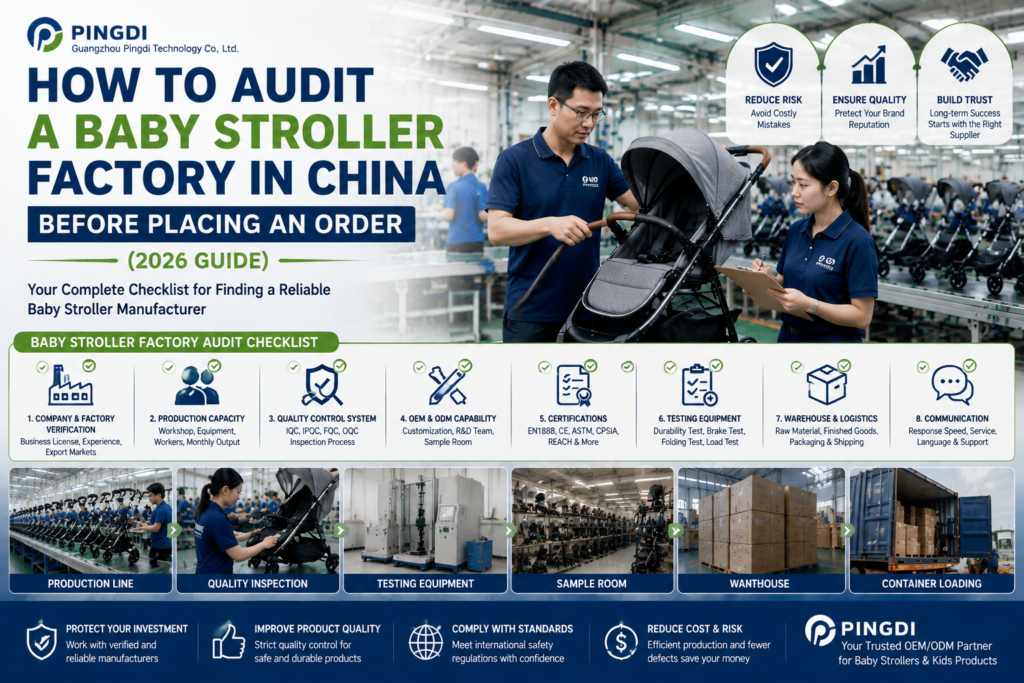
Introduction: Why Factory Audit Matters Before Importing Baby Strollers from China
Choosing the right Baby Stroller Manufacturer China is one of the most important decisions for international buyers.
China has become the world’s leading manufacturing hub for baby products, offering:
- Competitive production costs
- Complete supply chains
- Flexible OEM services
- Advanced manufacturing capabilities
- Large-scale production capacity
However, not every supplier can provide the same level of quality, reliability, and service.
Many buyers make the mistake of choosing suppliers only based on:
- Lowest price
- Product photos
- Alibaba rankings
- Sales promises
This approach often creates problems later:
- Product quality issues
- Delayed shipments
- Failed inspections
- High return rates
- Customer complaints
A professional factory audit helps buyers understand the real manufacturing capability behind the quotation.
Before placing an order with a Baby Stroller Factory in China, importers should evaluate production facilities, quality systems, engineering capabilities, certifications, and export experience.
What Is a Baby Stroller Factory Audit?
A factory audit is a systematic evaluation of a supplier’s:
- Manufacturing capability
- Production process
- Quality management
- Factory management
- Product development ability
- Compliance systems
The purpose is to determine whether the supplier can consistently produce products that meet your requirements.
For baby stroller buyers, a factory audit helps answer:
- Is this a real manufacturer?
- Can they handle my order volume?
- Do they have proper quality control?
- Can they support OEM customization?
- Can they deliver products safely and on time?
1. Verify the Factory’s Basic Information
The first step of auditing a supplier is confirming basic company information.
Buyers should check:
Company History
Ask:
- How many years have you manufactured baby strollers?
- Which countries do you export to?
- What types of customers do you serve?
Experienced suppliers usually have better knowledge of:
- International standards
- Export requirements
- Customer expectations
Factory Location
Understanding the factory location helps evaluate:
- Supply chain advantages
- Transportation efficiency
- Production resources
China’s major baby product manufacturing regions have mature supplier networks for:
- Aluminum frames
- Fabrics
- Plastic components
- Wheels
- Hardware accessories
2. Check If It Is a Real Baby Stroller Manufacturer
Many buyers worry about working with trading companies instead of factories.
A real OEM Baby Stroller Factory should have:
Production Workshop
Check:
- Assembly lines
- Sewing areas
- Frame processing areas
- Packaging sections
Sample Room
A professional factory should have:
- Existing product samples
- New product prototypes
- Custom development examples
Engineering Department
Strong manufacturers usually have:
- Product engineers
- Structural designers
- R&D capability
This allows them to support:
- Custom baby stroller development
- Product improvement
- Cost optimization
3. Evaluate Production Capacity
Production capacity directly affects delivery reliability.
During an audit, buyers should review:
Production Lines
Questions:
- How many assembly lines are available?
- How many workers are involved?
- What is monthly production capacity?
Warehouse Management
Check:
- Raw material storage
- Finished product warehouse
- Inventory management
A well-managed warehouse reduces:
- Material shortages
- Production delays
- Shipment problems
4. Review Quality Control System
Quality control is the most important part of a baby stroller factory audit.
A professional manufacturer should have a complete QC process.
Incoming Quality Control (IQC)
Inspection of:
- Aluminum tubes
- Fabrics
- Wheels
- Plastic parts
- Hardware components
Production Quality Control (IPQC)
Monitoring:
- Frame assembly
- Sewing quality
- Folding mechanism
- Brake installation
- Wheel alignment
Final Quality Control (FQC)
Testing:
- Product appearance
- Function performance
- Safety components
- Packaging
Outgoing Quality Control (OQC)
Before shipment:
- Quantity confirmation
- Carton inspection
- Shipping mark verification
- Final product check
5. Check OEM and ODM Capability
For modern baby product brands, OEM capability is essential.
A reliable supplier should support:
Private Label Baby Stroller
Including:
- Logo customization
- Brand packaging
- Product labeling
Custom Baby Stroller Development
Including:
- Color customization
- Fabric selection
- Functional improvements
- New designs
ODM Services
Professional manufacturers can help with:
- Product concept
- Engineering design
- Prototype production
- Market-oriented improvements
A factory with strong OEM/ODM capability can become a long-term business partner rather than only a supplier.
6. Verify Testing and Certification Capability
Baby strollers are safety-related products.
During an audit, buyers should ask:
- What safety standards do you follow?
- Which testing reports can you provide?
- How do you control product safety?
Common standards include:
- EN1888 Baby Stroller Standard
- ASTM F833
- CE
- CPSIA
- REACH
A professional manufacturer should understand how different markets have different compliance requirements.
7. Inspect Production Equipment and Testing Facilities
Factory equipment reflects manufacturing capability.
Important areas include:
Frame Processing Equipment
Evaluate:
- Cutting equipment
- Welding process
- Surface treatment
Sewing Equipment
Check:
- Stitching quality
- Production efficiency
- Fabric handling
Testing Equipment
Look for:
- Durability testing
- Brake testing
- Folding cycle testing
- Load testing
Professional testing capability reduces product risks.
8. Evaluate Communication and Project Management
A factory audit is not only about equipment.
Communication ability is equally important.
A reliable supplier should provide:
- Fast quotation response
- Technical support
- Production updates
- Quality reports
- Shipping information
Good communication reduces mistakes during:
- Product development
- Mass production
- Shipment preparation
9. Request Factory Audit Documents
Professional buyers may request:
- Factory introduction
- Production videos
- Quality system documents
- Certification reports
- Customer references
- Previous project experience
Transparent factories are usually more confident in showing their capabilities.
10. Final Baby Stroller Factory Audit Checklist
Before placing an order, buyers should confirm:
✅ Real manufacturing facility
✅ Experienced production team
✅ Stable production capacity
✅ Strong OEM capability
✅ Quality inspection system
✅ International certification knowledge
✅ Export experience
✅ Transparent communication
✅ Reliable after-sales support
Why Choose Pingdi Factory?
Guangzhou Pingdi Technology specializes in OEM and ODM children’s products, including:
- Baby Strollers
- Balance Bikes
- Kids Ride On Cars
- Children’s Scooters
- Kids Bicycles
Our manufacturing advantages include:
✔ Professional production experience
✔ Complete OEM/ODM services
✔ Strict quality control
✔ Product customization
✔ Factory transparency
✔ International export experience
We welcome global importers, distributors, retailers, and baby product brands to visit or audit our factory.
Conclusion
A factory audit is one of the most effective ways to reduce sourcing risks when importing baby strollers from China.
Choosing a supplier should not be based only on price. Buyers should evaluate:
- Manufacturing capability
- Quality systems
- OEM experience
- Testing ability
- Communication efficiency
A reliable Baby Stroller Manufacturer China can help brands achieve better quality, stronger market reputation, and long-term business growth.
Before placing your next order, take the time to understand the factory behind the product.
The right manufacturing partner can make the difference between a successful product launch and costly supply chain problems.