A baby stroller can look perfect in a product photo and still create serious problems after shipment.
Loose wheels, inconsistent brakes, poorly fitted folding locks, missing accessories, scratched frames, incorrect warning labels or weak cartons may not appear during quotation or sample approval.
They often appear during mass production.
For importers, distributors and private-label brands, this creates an important question:
How do you know the 500 or 2,000 strollers being shipped are consistent with the sample you originally approved?
The answer is not another product photo.
It is a structured baby stroller quality control process.
A professional pre-shipment inspection should verify the actual production batch against the approved product specification, golden sample, packaging requirements and purchase order.
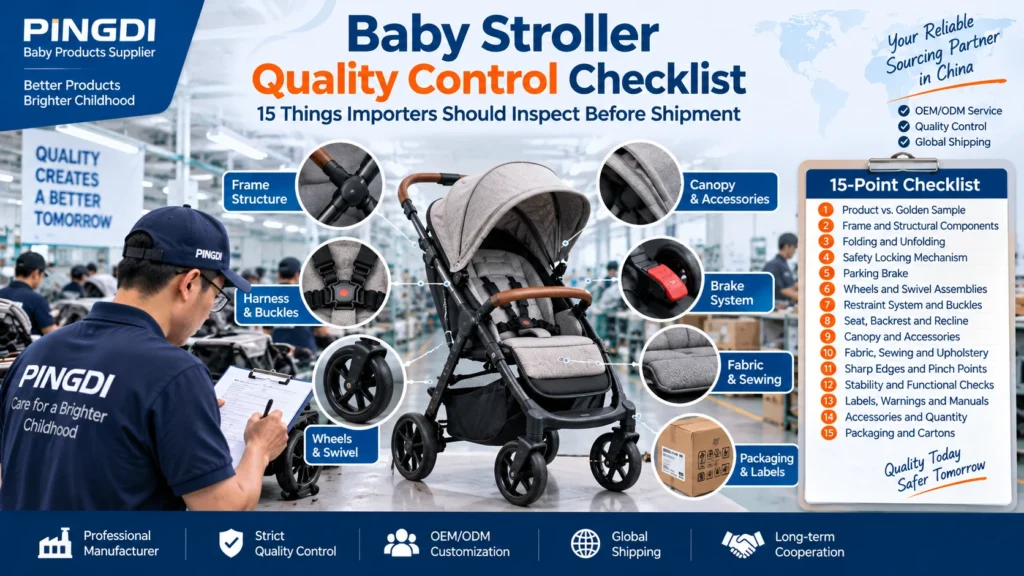
This guide provides a practical 15-point baby stroller inspection checklist that importers can use before authorizing shipment.
Why Baby Stroller Pre-Shipment Inspection Matters
Laboratory testing and production inspection serve different purposes.
A test report can help demonstrate that a tested product meets applicable requirements. It does not automatically prove that every unit in a later mass-production batch is correctly assembled or identical to the tested configuration.
A stroller pre-shipment inspection, on the other hand, evaluates the actual goods prepared for shipment.
This matters because production problems can include:
- Incorrect components
- Loose fasteners
- Cosmetic defects
- Assembly inconsistency
- Missing accessories
- Incorrect labels
- Wrong colors
- Packaging errors
- Component substitutions
For U.S.-market strollers, CPSC requirements address hazards including stability, brakes, restraint systems, latches and folding mechanisms, structural integrity, wheels and other areas. The U.S. mandatory stroller rule is found in 16 CFR Part 1227 and incorporates ASTM F833 requirements.
That makes many of these areas important not only for product quality but also for safety management.
1. Verify the Product Against the Approved Golden Sample
The first QC step should happen before inspecting individual components.
Put the mass-production stroller next to the approved sample.
Compare:
- Frame structure
- Overall dimensions
- Fabric
- Color
- Wheels
- Handle
- Canopy
- Basket
- Buckles
- Accessories
- Logo
- Labels
For an OEM baby stroller manufacturer project, this is especially important because customized products may involve several component changes.
A factory may consider a replacement wheel or slightly different fabric “equivalent.”
The importer may not.
PINGDI therefore recommends establishing an approved sample and final specification sheet before mass production.
The question during QC should be:
Does production match what the buyer approved?
Not simply:
“Does the stroller look acceptable?”
2. Inspect the Frame and Structural Components
The frame is one of the most important areas in any baby stroller quality inspection.
Inspect:
- Frame tubes
- Welding points
- Rivets
- Screws
- Joints
- Connections
- Plastic structural components
- Frame alignment
Look for visible cracks, deformation, poor welding, loose connections or inconsistent assembly.
For painted or coated frames, also inspect surface finishing.
A stroller may function correctly when first unfolded but develop problems after repeated loading if structural components or connections are inconsistent.
This is why frame inspection should never be reduced to a cosmetic check.
3. Check Folding and Unfolding
Folding is one of the most frequently operated functions of a stroller.
Every sampled unit should fold and unfold correctly according to the approved design.
Inspect:
- Folding button operation
- Secondary locks
- Automatic locking
- Frame engagement
- Folding resistance
- Unfolding movement
- Abnormal noise
Perform the operation repeatedly rather than testing it once.
The U.S. stroller safety framework specifically addresses latches and folding mechanisms among the hazards covered by the standard.
A mechanism that works once but becomes unreliable after several cycles deserves investigation before shipment.
4. Inspect the Safety Lock
A stroller should not unintentionally fold during normal use.
Inspect the locking system to confirm:
- It engages completely
- Locking indicators work if applicable
- It cannot easily disengage accidentally
- Left/right mechanisms operate consistently
- Components are installed correctly
This is particularly important when an OEM modification affects the handle, frame or folding system.
Structural modifications should be reviewed during development rather than first discovered during final inspection.
5. Test the Parking Brake
The brake is another critical inspection point.
The inspector should check:
- Brake engagement
- Brake release
- Left/right synchronization where applicable
- Wheel holding
- Pedal operation
- Abnormal looseness
The U.S. CPSC stroller requirements specifically include parking-brake performance.
For importers, however, the QC objective is broader than merely checking whether the brake “works.”
The operation should also be consistent across sampled production units.
If one unit requires very little force while another is extremely difficult to engage, there may be an assembly or component-control issue.
6. Check Wheels and Swivel Assemblies
Wheel problems can quickly turn into customer complaints.
Inspect:
- Front wheels
- Rear wheels
- Axles
- Bearings
- Swivel function
- Wheel locks
- Wheel retention
- Tire/wheel material
- Alignment
Push the stroller on a suitable surface.
It should track and steer consistently according to its design.
Listen for abnormal noise and check for excessive wheel movement.
Wheel and swivel assembly detachment is also specifically addressed within the U.S. stroller safety requirements.
For baby stroller wholesale orders, wheel consistency across the production batch deserves particular attention.
7. Inspect the Restraint System and Buckles
The harness should match the approved configuration and operate correctly.
Check:
- Buckle engagement
- Buckle release
- Strap installation
- Adjustment
- Stitching
- Attachment points
- Missing components
- Twisted straps
The restraint system should not be evaluated only visually.
Actually fasten, adjust and release it.
CPSC identifies restraining-system performance as part of the applicable stroller requirements in the United States.
8. Check Seat, Backrest and Reclining Functions
If the stroller has an adjustable backrest, test every intended position.
Inspect:
- Reclining adjustment
- Left/right alignment
- Locking
- Seat attachment
- Fabric tension
- Padding
- Stitching
- Backrest stability
For twin or double strollers, inspect both seating positions independently.
One seat functioning correctly does not prove the second has been assembled correctly.
This is particularly important for the twin baby stroller wholesale projects you are developing.
9. Inspect the Canopy and Moving Accessories
Open and close the canopy several times.
Check:
- Movement
- Support structure
- Fabric tension
- Stitching
- Attachment
- Symmetry
- Windows if applicable
- Zippers if applicable
Then inspect other moving accessories such as:
- Footrests
- Bumper bars
- Trays
- Cup holders
- Adjustable handles
A component may appear attractive in photos while being frustrating to use because of excessive resistance or poor alignment.
QC should evaluate function as well as appearance.
10. Check Fabric, Sewing and Upholstery
Fabric quality strongly affects the buyer’s perception of the finished stroller.
Inspect:
- Color consistency
- Stains
- Holes
- Loose threads
- Uneven stitching
- Fabric tension
- Incorrect fabric
- Wrinkles
- Logo embroidery/printing
For private-label orders, compare color against the approved reference rather than relying on memory or photographs.
Material changes can also have compliance implications.
If a supplier substitutes fabric, coating or plastic material after the product was tested, the importer should determine whether the change affects applicable testing or documentation.
11. Inspect Sharp Edges, Pinch Points and Accessible Components
Run a structured visual and functional inspection around areas accessible during normal use.
Pay particular attention to:
- Frame joints
- Folding points
- Plastic edges
- Exposed hardware
- Screws
- Springs
- Moving components
The CPSC stroller framework addresses issues including scissoring, shearing, pinching, exposed coil springs and protective components.
A production inspector should not claim that a visual QC check replaces formal safety testing.
Instead, the objective is to detect obvious production deviations or workmanship problems before shipment.
12. Perform Stability and Functional Checks
A finished stroller should operate consistently under its intended configuration.
Inspection can include appropriate checks of:
- Stability
- Steering
- Parking
- Folding
- Reclining
- Wheel movement
- Handle operation
- Load behavior
Formal compliance tests should follow the applicable standard and laboratory procedures rather than improvised factory methods.
For U.S. products, CPSC lists stability and static-load performance among the requirements addressed by the mandatory stroller standard.
For European projects, buyers should separately confirm applicable EN 1888 requirements for their particular stroller and destination.
13. Verify Labels, Warnings and Manuals
This is one of the easiest areas to overlook.
Inspect:
- Product label
- Model number
- Batch information
- Warning labels
- Age/weight information where applicable
- Importer information where required
- Instruction manual
- Language
- Barcode
- Carton marks
For the United States, CPSC guidance specifies durable infant/toddler product marking requirements that include manufacturer/importer information and model identification, among other requirements.
For other destinations, requirements differ.
Therefore, never copy a U.S. label directly onto an EU product or vice versa without reviewing the destination-market requirements.
14. Check Accessories and Quantity
Imagine receiving 1,000 strollers and discovering that 80 rain covers are missing.
The stroller itself may be perfect, but the order is still incomplete.
Before shipment, verify all contracted accessories:
- Rain cover
- Mosquito net
- Foot cover
- Cup holder
- Bumper bar
- Adapter
- Carrycot
- Additional seat
- Spare parts
- Manuals
Compare them against:
Purchase Order + Packing List + Approved Specification
For an OEM project, also check customized packaging and branded accessories.
This simple step prevents many avoidable claims.
15. Inspect Packaging Before Authorizing Shipment
The final checkpoint is the carton.
A high-quality stroller inside weak export packaging can still arrive damaged.
Check:
- Carton dimensions
- Carton strength
- Product protection
- Plastic bags
- Foam/protective materials
- Wheel protection
- Handle protection
- Carton sealing
- Shipping marks
- Barcode
- Model/color identification
Then verify carton quantity and loading information.
Packaging is particularly important for:
- Twin strollers
- Travel systems
- Large-wheel strollers
- High-value aluminum strollers
because shipping volume and vulnerable protruding components can increase logistics risk.
What Should a Baby Stroller PSI Report Include?
A professional stroller pre-shipment inspection should leave the importer with evidence, not just a WhatsApp message saying:
“Quality is good.”
The report should clearly identify the order and inspected product and document:
PO/model → inspection quantity → sampling → defects → measurements → functional checks → packaging → photos → conclusion
Photos should show both compliant products and discovered defects.
If a problem is identified, the next question is:
Can the factory rework the affected goods before shipment?
That is the main reason PSI should happen before the balance payment/shipping authorization where commercially agreed, rather than after the container has already left China.
Lab Testing vs Factory QC vs Pre-Shipment Inspection
These three activities should not be confused.
Laboratory Testing
Answers:
Does the tested product meet specified test requirements?
Production QC
Answers:
Is the factory producing the product according to the approved specification?
Pre-Shipment Inspection
Answers:
Does the finished production batch meet the agreed quality and order requirements before shipment?
Professional importers use these processes together.
One does not automatically replace another.
How PINGDI Manages Baby Stroller Quality Control
PINGDI works with importers, distributors, wholesalers and private-label brands sourcing baby and children’s mobility products from China.
Because we manage projects as a supply-chain and OEM/ODM partner rather than presenting ourselves as the owner of every production facility, our role is to help the buyer control the project across the selected supplier network.
For baby stroller projects, the workflow can include:
Supplier Evaluation
We evaluate suitable production resources according to product type, target market, quantity and customization requirements.
Specification Confirmation
Critical product details are documented before mass production.
Sample Management
The approved sample becomes an important reference for production.
OEM/ODM Coordination
We coordinate color, logo, fabrics, accessories, packaging and other agreed customization.
Production Follow-Up
Key production milestones are followed to identify issues earlier.
Quality Inspection
Finished goods can be checked against the approved sample, specification and PO before shipment.
Compliance Coordination
We help organize product information and coordinate appropriate third-party testing when required. Final regulatory applicability should be confirmed for the exact product and destination market.
Consolidation & Shipping Coordination
For buyers sourcing strollers together with balance bikes, kids scooters, ride-on cars or other children’s products, we can coordinate multiple suppliers and consolidated shipments where appropriate.
The objective is simple:
Identify problems in China before they become problems in the destination market.
A Better QC Process Starts Before Production
The biggest lesson for importers is that quality control does not start on inspection day.
It starts when the purchase order is written.
A good sourcing workflow should look like:
RFQ → Specification → Sample → Compliance Review → Golden Sample → Production → QC → PSI → Shipment
If specifications are unclear at the beginning, the inspector may have nothing objective to inspect against at the end.
For example, “high-quality wheels” is subjective.
But:
approved wheel model + material + diameter + color + supplier/reference sample
is inspectable.
The more precise the purchasing specification, the more effective your QC system becomes.
Final Baby Stroller Quality Control Checklist
Before approving shipment, make sure your inspection has covered these 15 areas:
- Product vs approved golden sample
- Frame and structural components
- Folding and unfolding
- Safety locking mechanism
- Parking brake
- Wheels and swivel assemblies
- Harness and buckles
- Seat, backrest and recline
- Canopy and accessories
- Fabric and sewing
- Sharp edges, pinch points and accessible components
- Stability and functional performance
- Labels, warnings and manuals
- Accessories and order quantity
- Export packaging
If several of these checks are missing from your current inspection process, improving the checklist before your next shipment may be considerably cheaper than dealing with returns, claims or rework after arrival.
Conclusion
For professional importers, baby stroller quality control is not simply checking whether a stroller looks good.
It is a structured process for confirming that mass production matches what was ordered and approved.
A reliable baby stroller supplier China project should connect:
Product specification + compliance + production control + final inspection + documentation
rather than treating them as unrelated tasks.
If you are sourcing OEM baby strollers, twin strollers, lightweight strollers or private-label stroller products from China, send PINGDI your product specifications, target market, quantity and QC requirements.
We can help coordinate supplier selection, sampling, OEM/ODM development, production follow-up, quality inspection and shipment consolidation.
Request a Baby Stroller OEM / Quality Control Consultation →