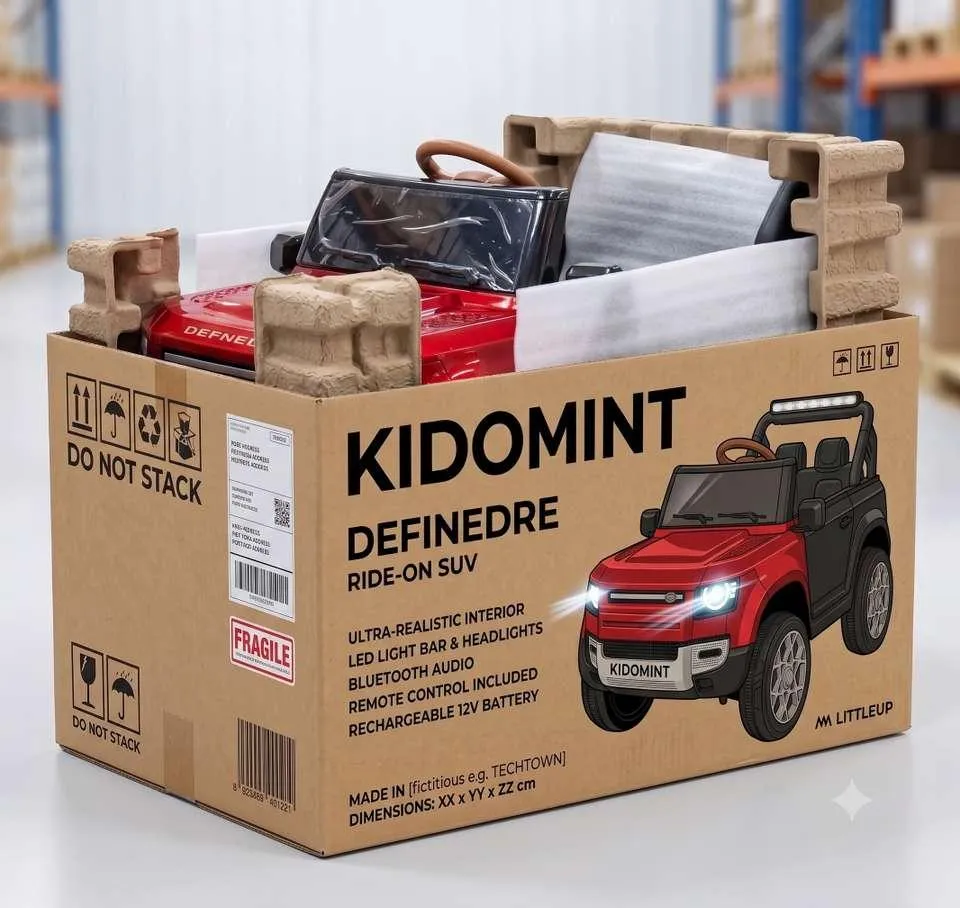
A practical B2B guide to battery selection, transport documentation, dangerous goods classification, export packaging and shipping electric ride-on toys from China.
Importing kids electric ride-on cars from China involves more than selecting a popular model and negotiating a competitive wholesale price.
For importers, distributors and private-label brands, the battery can significantly affect product specifications, freight arrangements, documentation, warehouse handling and landed costs.
A supplier may offer 12V and 24V ride-on cars with different battery technologies. The product price may appear attractive, but the buyer still needs to establish whether the battery is suitable for the destination market, which transport rules apply and whether the proposed shipping method is available.
In 2026, international transport requirements for certain battery-powered vehicles have also changed, making accurate classification increasingly important.
This guide explains the main kids electric ride-on car battery and shipping requirements importers should review before approving bulk orders.
It covers battery types, UN38.3 documentation, transport classification, packaging, container planning, OEM customization and supplier verification.
1. Why Battery Specifications Matter for Wholesale Ride-On Cars
The battery is a key component of an electric ride-on car.
It affects product performance, charging arrangements, product weight, maintenance requirements and transportation planning.
Importers should not evaluate battery options using voltage alone.
A 12V battery does not automatically provide the same operating time, capacity or performance as another 12V battery.
Similarly, a higher-voltage system does not necessarily mean a longer runtime.
Important specifications include:
- Battery chemistry.
- Nominal voltage.
- Rated capacity.
- Watt-hour rating.
- Battery weight.
- Charging method.
- Battery protection system.
- Product compatibility.
- Battery installation and accessibility.
- Applicable testing and transport documentation.
These details should be confirmed before comparing quotations.
2. Common Battery Types Used in Kids Electric Ride-On Cars
Two battery categories commonly encountered in children’s electric ride-on products are sealed lead-acid batteries and rechargeable lithium-ion batteries.
Actual product availability depends on the model and manufacturing partner.
Sealed lead-acid batteries
Sealed lead-acid batteries are used in various traditional ride-on toy designs.
Their commercial advantages may include established sourcing channels and familiar charging systems.
However, they can add considerable product weight.
Importers must confirm the exact battery construction and transport classification. The term “sealed” does not automatically establish that every shipment qualifies for a transport exception.
Lithium-ion batteries
Lithium-ion batteries may provide advantages in weight and energy density, depending on the selected design.
However, they require careful attention to cell and pack specifications, battery protection, charging compatibility and applicable transport requirements.
Buyers should confirm the exact chemistry rather than accept the generic description “lithium battery.”
Battery comparison
| Factor | Sealed Lead-Acid | Lithium-Ion |
|---|---|---|
| Weight | Generally heavier for comparable energy | Generally lighter |
| Energy density | Generally lower | Generally higher |
| Initial battery cost | Often lower | Often higher |
| Charging system | Battery-specific | Battery-specific |
| Transport assessment | Depends on construction and classification | Requires lithium-specific assessment |
| Required documentation | Depends on applicable rules | UN38.3 evidence and other applicable documents |
| Suitable projects | Model-dependent | Model-dependent |
Neither battery type is automatically the best choice for every market.
The decision should consider product design, cost, intended use, safety requirements and logistics.
3. Understand 6V, 12V and 24V Ride-On Car Batteries
Wholesale buyers frequently compare 6V, 12V and 24V ride-on cars.
Voltage describes one electrical characteristic of the system, but it does not establish the battery’s total energy capacity.
To estimate nominal battery energy:
Watt-hours (Wh) = Nominal Voltage (V) × Capacity (Ah)
For example:
| Illustrative Battery | Calculation | Nominal Energy |
|---|---|---|
| 6V 7Ah | 6 × 7 | 42Wh |
| 12V 7Ah | 12 × 7 | 84Wh |
| 12V 10Ah | 12 × 10 | 120Wh |
| 24V 7Ah | 24 × 7 | 168Wh |
These examples are mathematical illustrations, not specifications for PINGDI products.
Actual operating time depends on motor load, terrain, rider weight, controller behavior, battery condition and other factors.
For lithium battery transport, the accurate rated watt-hour value must be confirmed from the battery manufacturer’s documentation.
4. Why Battery Shipping Classification Must Be Confirmed Before Ordering
One of the most common sourcing mistakes is assuming that all electric ride-on cars can be shipped as ordinary toys.
Battery-powered products may be subject to dangerous goods requirements depending on their configuration and transport classification.
The correct classification can depend on:
- Battery chemistry.
- Whether the battery is installed, packed with or shipped separately.
- Product design and intended function.
- Applicable UN classification.
- Transport mode.
- Applicable special provisions or exceptions.
- Carrier acceptance conditions.
For example, lithium-ion batteries shipped separately may be classified differently from lithium-ion batteries installed in certain equipment or vehicles.
Importers should never assign a UN number based only on a product’s marketing name.
The shipper should obtain a defensible classification from appropriately trained dangerous goods personnel before booking transportation.
5. Important 2026 IMDG Changes for Battery-Powered Vehicles
The International Maritime Dangerous Goods Code establishes requirements for transporting dangerous goods by sea.
Amendment 42-24 became mandatory on January 1, 2026.
For products meeting the relevant battery-powered vehicle classification, important entries include:
| UN Number | Proper Shipping Name |
|---|---|
| UN 3171 | Battery-powered vehicle, where applicable to relevant non-lithium battery types |
| UN 3556 | Vehicle, lithium-ion battery powered |
| UN 3557 | Vehicle, lithium metal battery powered |
| UN 3558 | Vehicle, sodium ion battery powered |
Under the amended requirements, lithium-ion and sodium-ion powered vehicles within the relevant scope should not continue to be declared under the former generic UN 3171 classification.
However, a children’s ride-on toy must first be assessed to determine which transport classification applies.
A toy containing a lithium-ion battery should not automatically be declared as UN 3556 without that assessment.
Importers should confirm the applicable entry, packaging requirements, marks, labels and documentation with the dangerous goods specialist and carrier.
Official reference: IMO IMDG Code
Carrier guidance: Maersk Battery-Powered Vehicle Classification Update
6. What Is UN38.3 and Why Does It Matter?
UN38.3 refers to the lithium cell and battery testing requirements in the United Nations Manual of Tests and Criteria.
The tests address conditions relevant to transport safety, such as vibration, shock, thermal exposure and other specified hazards.
For lithium batteries subject to these requirements, the battery design must satisfy the applicable testing criteria.
Importers should request the relevant UN38.3 test summary and confirm that it relates to the actual battery type being purchased.
Battery documentation review
| Item | Verification |
|---|---|
| Battery manufacturer | Identified |
| Battery model | Matches product specification |
| Chemistry | Confirmed |
| Voltage | Confirmed |
| Rated capacity | Confirmed |
| Watt-hour rating | Confirmed where relevant |
| UN38.3 test summary | Available where required |
| Test identification | Matches relevant battery type |
| Product configuration | Consistent with transport declaration |
A test summary for one battery model should not automatically be used for a different battery design.
Official resource: PHMSA Lithium Battery Test Summaries
7. MSDS, SDS and Battery Test Reports: What Is the Difference?
Importers often receive several battery-related documents.
Understanding their purpose helps avoid incomplete shipping preparations.
Safety Data Sheet
A Safety Data Sheet, often called SDS or MSDS, provides information about the material or product, including relevant hazards, handling and emergency considerations.
It can support transport assessment but does not independently prove that a battery has passed UN38.3 testing.
UN38.3 test summary
Provides prescribed information concerning the tested lithium battery design.
Battery specification sheet
Identifies technical characteristics such as chemistry, voltage, capacity, dimensions and other relevant parameters.
Dangerous goods transport declaration
Where required, the shipper prepares the applicable dangerous goods documentation based on the correct transport classification.
Product compliance documentation
Product safety testing and market-entry documentation are separate from dangerous goods transport documentation.
A complete purchasing review must distinguish product compliance from transport compliance.
8. Shipping Lithium Batteries Installed in Ride-On Cars
The transport requirements for a battery installed in a ride-on car may differ from those for batteries shipped separately.
Buyers should confirm whether the proposed shipment includes:
- Fully assembled ride-on cars with installed batteries.
- Partially assembled products with installed batteries.
- Batteries packed alongside the vehicles.
- Spare batteries in separate cartons.
- Mixed shipments containing different battery configurations.
Each arrangement may require a different assessment.
For installed batteries, important questions include whether the battery is adequately secured, whether accidental activation is prevented and whether the product is protected against damage.
For separate batteries, terminal protection, packaging and other applicable conditions may be important.
The applicable rules must be established for the actual shipment.
9. Air Freight vs Sea Freight for Electric Ride-On Cars
Air and sea transport have different regulatory frameworks and commercial considerations.
Sea freight
Sea freight is commonly evaluated for bulk orders because ride-on cars can be bulky.
However, dangerous goods classification may affect carrier acceptance, booking procedures, container requirements and freight costs.
Air freight
Air freight may be considered for urgent samples or smaller shipments.
Lithium battery shipments are subject to detailed air transport requirements, including restrictions that depend on classification, battery rating and configuration.
For certain battery-powered vehicles covered by IATA Packing Instruction 952, the 2026 guidance includes state-of-charge restrictions.
These should not be generalized to every ride-on toy without confirming the relevant classification.
Official resource: IATA 2026 Lithium and Sodium-Ion Battery Guidance
Freight comparison
| Factor | Sea Freight | Air Freight |
|---|---|---|
| Typical bulk-order suitability | Often favorable | Often less economical |
| Transit time | Generally longer | Generally shorter |
| Battery requirements | IMDG Code | ICAO/IATA framework |
| Carrier acceptance | Must be confirmed | Must be confirmed |
| Dangerous goods charges | May apply | May apply |
| Best use | Planned wholesale shipments | Selected urgent shipments |
Freight availability and costs should be confirmed before finalizing the purchase order.
10. Battery Packaging and Export Carton Requirements
Suitable packaging is essential for product protection and transport safety.
The correct requirements depend on the product, battery configuration and applicable dangerous goods classification.
For ride-on cars, buyers should review both product protection and battery-related risks.
Packaging checklist
| Area | What to Verify |
|---|---|
| Battery installation | Correctly secured |
| Accidental activation | Prevented where required |
| Electrical connections | Properly protected |
| Product movement | Adequately restrained |
| Carton strength | Suitable for handling |
| Internal protection | Prevents avoidable damage |
| Shipping marks | Correct where required |
| Dangerous goods labels | Applied where required |
| Carton information | Matches packing list |
| Documentation | Matches actual configuration |
Do not assume that a standard printed retail carton is sufficient for every dangerous goods shipment.
The packaging method should be confirmed with the responsible logistics and dangerous goods specialists.
11. How Battery Choice Affects Container Loading and Freight Costs
Battery selection can affect both product weight and shipping arrangements.
However, the largest freight cost difference for ride-on cars may come from the finished product’s carton dimensions.
Importers should request accurate packaging information for every SKU.
Calculate carton volume
CBM = Length (m) × Width (m) × Height (m)
Suppose a hypothetical ride-on car carton measures:
1.10 × 0.65 × 0.45 meters.
Its volume is approximately:
0.322 CBM per carton
For 200 cartons:
200 × 0.32175 = 64.35 CBM
This is an illustrative calculation.
It does not mean that 200 cartons will fit into a particular container.
Actual loading depends on carton arrangement, weight distribution, stacking limitations, container dimensions and dangerous goods requirements.
Importers should request a loading plan based on final packaging specifications.
12. How to Calculate the Real Landed Cost
The purchase price is only one component of the total import cost.
A useful landed-cost calculation includes:
Landed Cost = Product Cost + Export and Freight Charges + Insurance + Import Duties and Taxes + Destination Charges + Other Applicable Costs
Depending on the shipment, additional costs may include:
- Battery-related testing.
- Dangerous goods documentation.
- Specialized packaging.
- Carrier surcharges.
- Terminal handling.
- Customs brokerage.
- Storage and delivery.
The exact allocation of charges depends on the agreed Incoterm and contract.
A supplier offering a lower FOB unit price may not provide the lowest landed cost if the shipment requires more expensive logistics arrangements.
For meaningful comparisons, buyers should request quotations based on equivalent specifications and shipping assumptions.
13. Verify Battery Quality Before Bulk Production
Battery documentation is important, but product quality control should also be addressed.
Importers should establish inspection criteria based on the approved product specification.
Battery and electrical inspection areas
- Battery model and rating.
- Correct installation.
- Wiring and connectors.
- Charger compatibility.
- Relevant protection functions.
- Charging operation.
- Motor and controller operation.
- Product labeling.
- Approved component consistency.
- Packaging condition.
Safety-related performance should be evaluated against applicable product standards and agreed test criteria.
Routine factory inspection does not replace laboratory testing where required.
14. Check Destination-Market Product Compliance
Transport acceptance does not mean a ride-on car is legally compliant for sale in the destination market.
These are separate obligations.
United States
Children’s electric ride-on toys may be subject to applicable CPSC toy safety requirements, including 16 CFR Part 1250 and other relevant rules.
Depending on the product, requirements may include third-party testing, certification, tracking labels and other safety obligations.
Official resource: CPSC Toy Safety Guidance
European Union
Electric ride-on toys classified as toys must be assessed against the applicable EU toy safety framework and other relevant legislation.
Electrical components, batteries, chemicals, labeling and waste-related obligations may also require consideration.
Importers should determine the applicable requirements based on the product and date of placing on the market.
Official resource: European Commission Product Compliance Guidance
Other markets
Mexico, South Africa, Southeast Asian markets and other destinations may have different import, labeling, electrical or battery-related requirements.
Buyers should confirm local obligations before approving packaging and production.
15. OEM and Private-Label Ride-On Car Battery Projects
OEM ride-on car projects may involve custom colors, logos, packaging, accessories and electrical configurations.
Some buyers also request different battery capacities or charging arrangements.
However, battery customization can affect:
- Product performance.
- Charger compatibility.
- Electrical protection.
- Product safety testing.
- Transport documentation.
- Freight classification.
- Production cost.
- MOQ.
A battery substitution should never be treated as a purely cosmetic change.
Recommended OEM approval process
Product selection → Battery specification review → Technical assessment → Compliance review → Sample approval → Transport documentation review → Bulk production
Buyers should ensure that the final battery model matches the approved specification and relevant supporting documents.
16. How PINGDI Supports Electric Ride-On Car Importers
Guangzhou Pingdi Technology Co., Ltd. is a China-based B2B sourcing and OEM/ODM project management partner serving importers, wholesalers, distributors and private-label brands.
PINGDI works with suitable manufacturing partners rather than claiming ownership of every production facility involved in a project.
Our services can include:
Product sourcing: Coordinating suitable electric ride-on car models and specifications.
Battery specification confirmation: Helping buyers obtain and compare available battery information from manufacturing partners.
OEM/ODM coordination: Managing communication regarding product customization, approved samples and production specifications.
Documentation follow-up: Coordinating requests for available battery test summaries, specifications and other relevant documents.
Third-party testing coordination: Assisting with communication and sample arrangements where additional testing is required.
Quality inspection coordination: Supporting agreed inspection arrangements before shipment.
Logistics coordination: Helping communicate product and battery details to freight partners for classification, booking and shipment planning.
Final dangerous goods classification, declarations and regulatory compliance decisions must be made by the responsible parties with appropriately qualified specialists.
Our goal is to help buyers develop a more transparent and organized purchasing process.
17. Pre-Shipment Checklist for Kids Electric Ride-On Cars
Before shipment, importers should confirm the following:
| Verification Item | Status |
|---|---|
| Final ride-on car model approved | Pending / Complete |
| Battery chemistry confirmed | Pending / Complete |
| Battery model and capacity verified | Pending / Complete |
| Relevant UN38.3 evidence reviewed | Pending / Complete / N/A |
| SDS and other requested information collected | Pending / Complete / N/A |
| Dangerous goods classification confirmed | Pending / Complete |
| Carrier acceptance confirmed | Pending / Complete |
| Packaging requirements confirmed | Pending / Complete |
| Product compliance evidence reviewed | Pending / Complete |
| Pre-shipment inspection completed | Pending / Complete |
| Packing list and invoice checked | Pending / Complete |
| Shipping documentation approved | Pending / Complete |
The checklist should be adapted to the actual product, battery and destination.
18. Frequently Asked Questions
Can kids electric ride-on cars with lithium batteries be shipped by sea?
Potentially, yes, provided the shipment satisfies applicable classification, documentation, packaging and carrier acceptance requirements.
Do all lithium battery ride-on cars use UN 3556?
No. The appropriate classification depends on whether the product falls within the relevant battery-powered vehicle provisions or another applicable transport entry.
Is an MSDS enough to ship lithium batteries?
No. An SDS does not replace required testing evidence, classification, declarations or other applicable transport requirements.
What is a UN38.3 test summary?
It is a prescribed summary of testing information for a lithium cell or battery design under the applicable transport framework.
Are lead-acid batteries always non-dangerous goods?
No. Their classification and any available exceptions depend on the actual battery construction and applicable transport requirements.
Can I mix different ride-on car models in one container?
Potentially, but the logistics provider must evaluate the actual products, batteries, packing arrangements and applicable transport rules.
Can PINGDI help coordinate battery documentation and shipping?
PINGDI can assist with obtaining available supplier information and coordinating communication with suitable testing and logistics providers.
Conclusion: Battery Compliance Is Part of Professional Ride-On Car Sourcing
Successful electric ride-on car importing requires more than choosing a popular model and negotiating a low unit price.
Importers should confirm battery chemistry, technical specifications, product compliance, transport classification, packaging and carrier acceptance before approving bulk orders.
The 2026 transport changes make accurate documentation and classification especially important for applicable battery-powered vehicle shipments.
For OEM and private-label projects, battery changes should also be assessed for their effects on testing, performance and shipping requirements.
A well-managed purchasing project connects product selection, battery verification, quality control and freight planning before production begins.
Planning a Wholesale Electric Ride-On Car Order?
PINGDI supports international B2B buyers with electric ride-on car sourcing, OEM/ODM coordination, battery documentation follow-up, inspection arrangements and export shipment coordination.
Contact PINGDI for a Wholesale Quotation
Share your destination market, preferred ride-on car models, estimated quantity, battery requirements and shipping destination so our team can discuss suitable sourcing options.