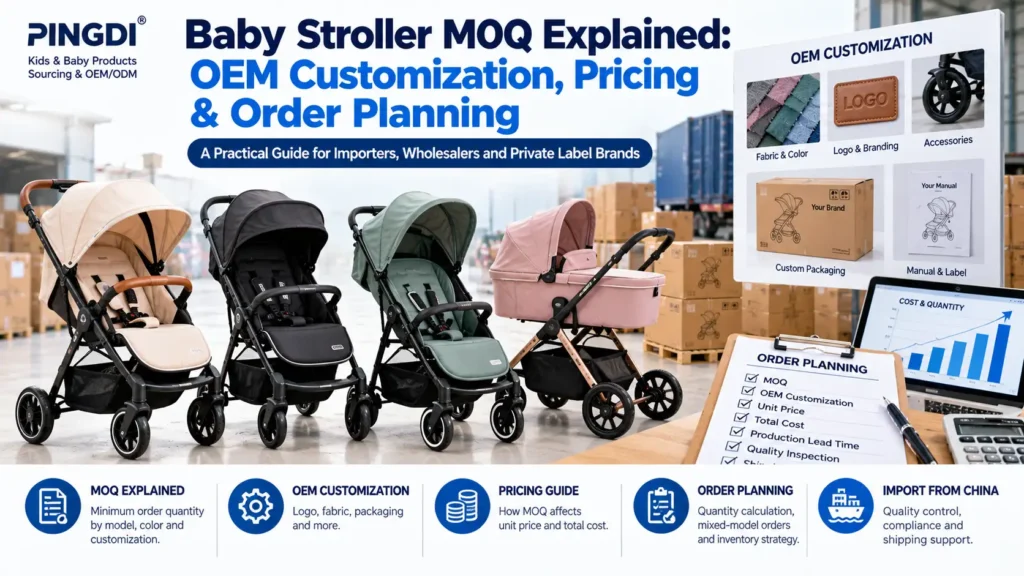
A practical sourcing guide for importers, wholesalers, distributors and private-label brands purchasing baby strollers from China.
An importer planning to launch a private-label baby stroller collection may receive several quotations with different minimum order quantities.
One supplier may offer an existing stroller model with standard fabrics and packaging. Another may propose customized colors, embroidered logos and branded retail boxes. A third may quote a completely new stroller design requiring tooling and engineering development.
Although all three quotations concern baby strollers, their production requirements and commercial risks are very different.
For professional buyers, baby stroller MOQ is not simply the smallest number of units a supplier will accept. It is a purchasing decision that affects OEM customization, wholesale pricing, inventory investment, quality control and delivery planning.
This guide explains how minimum order quantities work, why they change between projects and how importers can plan commercially realistic stroller orders from China.
1. What Does MOQ Mean in Baby Stroller Wholesale?
MOQ stands for Minimum Order Quantity. It represents the minimum quantity a supplier is willing to produce or supply under agreed conditions.
However, baby stroller wholesale MOQ may apply at several levels.
| MOQ Type | Meaning | Buyer Consideration |
|---|---|---|
| Order MOQ | Minimum quantity or value for an entire order | Can multiple models be combined? |
| Model MOQ | Minimum quantity for each stroller design | How many models can be included? |
| Color MOQ | Minimum quantity for each color combination | Can different fabric colors share one order? |
| Fabric MOQ | Minimum quantity for customized textile materials | Is a special fabric production batch required? |
| OEM MOQ | Minimum quantity for branded or customized products | Which changes affect production? |
| Packaging MOQ | Minimum quantity for printed retail boxes | Does custom packaging increase the order commitment? |
| Component MOQ | Minimum quantity for customized wheels, frames or fittings | Are upstream component minimums involved? |
A buyer ordering 500 strollers across five colors may meet the overall order requirement but fail to satisfy the minimum quantity for one custom fabric color.
The first step is therefore to request a model-by-model and color-by-color MOQ breakdown.
2. Why Do Baby Stroller Suppliers Have Different MOQs?
There is no universal MOQ for baby strollers manufactured or sourced from China.
Minimum quantities depend on several operational factors.
Existing designs and tooling
A standard stroller model may use established molds, frame components and assembly processes.
A new frame design or folding mechanism may require engineering work, tooling and additional product validation.
Fabric and color requirements
Customized fabrics may require separate material purchasing or production batches.
A standard fabric color may be available through an existing supply arrangement, while an exclusive color may introduce an additional minimum.
Component purchasing
Strollers contain frames, wheels, brakes, restraint systems, fabrics, buckles, hinges and other components.
Some components may have independent supplier minimums.
Production scheduling
Small batches can require additional setup and coordination relative to the quantity produced.
Packaging and branding
Custom retail boxes, manuals, labels and accessories can create separate minimum quantities.
Importer recommendation: Ask suppliers to explain which specific requirement determines the quoted MOQ. This is more useful than negotiating an arbitrary lower quantity without understanding the underlying constraint.
3. Standard Wholesale, OEM and ODM: How MOQ Changes
Different purchasing models involve different commitments.
Standard wholesale baby strollers
The buyer selects an existing stroller model with established specifications.
Standard products may offer more flexible sourcing arrangements, depending on supplier availability and production schedules.
This approach can be useful for distributors testing a new product category.
OEM baby strollers
OEM projects generally involve manufacturing an agreed product with buyer-specific requirements.
Possible changes include:
- Brand logos
- Fabric colors
- Seat materials
- Packaging artwork
- Instruction manuals
- Selected accessories
- Approved component configurations
Each customization should be evaluated separately.
For example, adding a logo to an existing approved design may be less complex than developing a new folding system.
ODM stroller development
ODM projects may involve new structural designs, engineering work, tooling, prototypes and additional validation.
These projects require a different commercial assessment from purchasing existing products.
Importers should compare standard wholesale, basic private-label and advanced product development quotations separately.
4. How OEM Customization Affects Baby Stroller Pricing
Customization does not increase cost in only one way.
It may affect the unit price, development expenses, packaging cost and minimum purchasing commitment.
Common OEM cost categories
| Customization | Potential Cost Impact |
|---|---|
| Logo printing | Artwork preparation and application cost |
| Custom fabric color | Material sourcing and possible fabric MOQ |
| Embroidery | Additional processing cost |
| Custom wheels | Component sourcing or tooling |
| Custom retail box | Artwork, printing and packaging MOQ |
| Branded manuals | Translation, layout and printing |
| Structural modification | Engineering, tooling and validation |
| New accessories | Components, assembly and testing |
Not every customization creates every cost listed above.
Buyers should request an itemized quotation identifying one-time development charges separately from recurring production costs.
This helps determine whether the project remains economical at the proposed order quantity.
5. How to Compare Baby Stroller Wholesale Prices
A lower unit price does not necessarily indicate a better purchasing arrangement.
Two suppliers may quote different prices because their products use different frames, fabrics, wheels, packaging or quality specifications.
Before comparing prices, confirm that the quotations cover equivalent requirements.
Recommended quotation comparison
| Item | Supplier A | Supplier B |
|---|---|---|
| Stroller model | Confirm | Confirm |
| Frame specification | Confirm | Confirm |
| Fabric specification | Confirm | Confirm |
| Wheels and brakes | Confirm | Confirm |
| Accessories | Confirm | Confirm |
| Packaging | Confirm | Confirm |
| MOQ | Confirm | Confirm |
| Sample approval | Confirm | Confirm |
| Inspection requirements | Confirm | Confirm |
| Trade term | Confirm | Confirm |
| Lead time | Confirm | Confirm |
A meaningful comparison should also identify whether the quotation includes tooling, sample development, testing or packaging charges.
For additional background, buyers can consult PINGDI’s existing article on baby stroller manufacturing costs.
6. Example: How MOQ Changes the Total Order Investment
Consider a hypothetical comparison between two purchasing options.
| Item | Option A | Option B |
|---|---|---|
| Order quantity | 300 units | 600 units |
| Unit price | US$38 | US$35 |
| Product value | US$11,400 | US$21,000 |
| One-time customization | US$600 | US$600 |
| Total before freight and other costs | US$12,000 | US$21,600 |
| Effective cost per unit | US$40 | US$36 |
All quantities and prices are illustrative, not actual PINGDI quotations.
Option B has a lower effective unit cost but requires US$9,600 more in upfront purchasing expenditure.
For an established distributor with predictable demand, that investment may be justified.
For a new private-label brand, the additional inventory may create unnecessary financial pressure.
The correct decision depends on expected sales, available capital, storage costs and replenishment requirements.
7. How to Calculate the Right Baby Stroller Order Quantity
Importers should begin with realistic demand forecasts rather than supplier MOQ alone.
A basic planning formula is:
Target Order Quantity = Forecast Sales During Replenishment Period + Safety Stock − Available Inventory − Confirmed Incoming Inventory
For a new product without sales history, forecasts should be treated cautiously.
Example order plan
Suppose a distributor expects to sell 80 strollers per month.
Assume:
- Planning period: 4 months
- Expected sales: 320 units
- Safety stock: 40 units
- Available inventory: 0
- Confirmed incoming inventory: 0
The preliminary target order quantity is:
320 + 40 = 360 units
If the supplier’s MOQ is 500 units, the buyer faces a 140-unit gap.
Possible responses include selecting another standard model, adjusting the sales plan, evaluating another manufacturing partner or accepting the larger inventory commitment.
The buyer should not automatically order 500 units without assessing the financial implications.
8. How MOQ Affects Inventory and Cash Flow
Baby strollers can require substantial storage space compared with smaller children’s products.
Large orders may therefore increase both inventory investment and warehousing requirements.
Before approving a higher MOQ, importers should evaluate:
- Forecast monthly sales
- Gross margin
- Available working capital
- Warehouse capacity
- Product seasonality
- Replenishment lead time
- Potential product changes
- Unsold inventory risk
A practical measure is:
Inventory Coverage (Months) = Available Units ÷ Forecast Monthly Sales
For example, 600 units divided by expected sales of 80 units per month equals 7.5 months of coverage.
That may be appropriate for some distributors but excessive for others.
The objective is to balance purchasing efficiency with realistic market demand.
9. Can Importers Combine Different Baby Stroller Models?
Mixed-model orders can help buyers develop a broader product assortment.
However, combining models into one purchase order does not automatically remove individual supplier MOQs.
Consider a hypothetical 500-unit order.
| Stroller Type | Planned Quantity |
|---|---|
| Compact travel stroller | 200 |
| Standard stroller | 150 |
| Twin stroller | 100 |
| Premium stroller | 50 |
| Total | 500 |
Illustrative quantities only.
The importer must confirm whether each model is available at the requested quantity.
Different designs may require separate manufacturing batches, components or packaging.
A sourcing partner may help coordinate the purchasing project across suitable manufacturing partners, but feasibility must be evaluated individually.
10. How to Reduce MOQ Without Creating Quality Risks
Some purchasing arrangements may provide more flexibility than others.
Select existing models
Using established designs may avoid the additional commitments associated with new tooling.
Limit color variations
Reducing unnecessary fabric and frame color combinations can simplify purchasing.
Start with basic branding
A standard product with approved logo or packaging changes may be more practical than extensive structural customization.
Evaluate packaging alternatives
Standard packaging with compliant labeling may be suitable for some wholesale programs.
Discuss phased purchasing
Where commercially feasible, buyers can discuss production schedules and delivery arrangements.
However, suppliers should not be assumed to accept staged orders or inventory holding without agreement.
Reducing MOQ must never involve skipping required testing, weakening safety-critical components or accepting unapproved product substitutions.
11. Baby Stroller Quality Control Before Bulk Production
Baby strollers are safety-sensitive products.
Importers should not treat a low MOQ or competitive price as a substitute for adequate quality and compliance verification.
Inspection should be based on the approved product specification and applicable requirements.
Recommended inspection checkpoints
| Inspection Area | Verification |
|---|---|
| Frame | Construction and workmanship |
| Folding system | Correct operation and locking |
| Brakes | Operation against applicable criteria |
| Wheels | Installation, function and retention |
| Restraint system | Approved components and operation |
| Seat and recline | Correct configuration and function |
| Fabric | Approved materials and workmanship |
| Fasteners | Correct assembly and security |
| Labels | Required identification and warnings |
| Packaging | Correct protection and information |
| Quantity | Correct model, color and units |
Buyers should establish an agreed inspection plan before production.
For OEM projects, the approved sample and technical specification should form the reference for manufacturing and quality checks.
12. Compliance Requirements for Baby Stroller Importers
Importers must determine the applicable requirements for their destination markets.
For the United States, the CPSC identifies 16 CFR Part 1227 as the mandatory federal safety standard for carriages and strollers, incorporating the applicable Commission-accepted version of ASTM F833.
The CPSC guidance also addresses labeling, registration forms and Children’s Product Certificate requirements.
For European markets, buyers should review the applicable stroller standard, commonly EN 1888 for products within its scope, together with relevant product safety, chemical, labeling and traceability obligations.
Compliance requirements can differ according to the product configuration and destination.
Before placing a bulk order, importers should verify:
- Applicable regulations and standards
- Product classification
- Required test reports
- Certification obligations
- Warning labels and instructions
- Traceability information
- Whether reports cover the actual product configuration
A report for one stroller model should not automatically be assumed to cover every customized variation.
13. How Packaging and Shipping Affect MOQ Decisions
Stroller packaging influences freight costs and storage requirements.
A compact travel stroller may use a different carton size from a twin stroller or full-size travel system.
Buyers should request:
- Final carton dimensions
- Units per carton
- Net and gross weights
- Total carton quantity
- Packaging specifications
- Production completion date
Carton volume can be calculated as:
CBM = Length (m) × Width (m) × Height (m)
For example, a carton measuring 0.85 × 0.50 × 0.35 meters occupies approximately 0.149 CBM.
This is an illustrative calculation.
Actual container loading depends on carton arrangement, stacking limitations, weight distribution and other operational constraints.
For meaningful landed-cost comparisons, buyers should obtain freight quotations based on the final approved packaging.
14. How PINGDI Supports Baby Stroller OEM and Wholesale Projects
Guangzhou Pingdi Technology Co., Ltd. is a China-based B2B sourcing and OEM/ODM project management partner serving international importers, distributors, wholesalers and baby product brands.
PINGDI works with suitable manufacturing partners rather than claiming ownership of every production facility involved in a project.
Our services can include:
Product sourcing and model selection
We help buyers evaluate stroller designs according to their target markets, purchasing quantities and product requirements.
MOQ evaluation
We coordinate discussions with manufacturing partners regarding minimum quantities, color combinations, components and packaging requirements.
OEM/ODM coordination
We support communication on fabrics, logos, accessories, packaging, samples and agreed product specifications.
Production follow-up
We help buyers track agreed production milestones and communicate issues with relevant manufacturing partners.
Quality inspection coordination
We can help arrange inspection checkpoints and third-party inspection services according to the project requirements.
Shipment preparation
We assist with packaging information, order coordination and export-related communication with relevant partners.
Our objective is to help importers develop a purchasing plan that balances commercial feasibility, product quality, customization requirements and long-term supply stability.
15. What Should Importers Include in a Baby Stroller RFQ?
A detailed request for quotation allows sourcing teams to evaluate the project more accurately.
| Required Information | Example |
|---|---|
| Buyer type | Importer, Distributor or Brand |
| Destination market | United States, EU, Mexico or Other |
| Stroller type | Travel, Standard, Twin or Other |
| Estimated quantity | Units per model and color |
| Customization | Standard, Logo, Fabric or OEM |
| Packaging | Standard or Private Label |
| Compliance | Applicable market requirements |
| Target delivery | Preferred shipment period |
| Trade term | EXW, FOB or Another Agreed Term |
Buyers should also provide reference photographs or technical specifications where available.
A clear RFQ helps identify MOQ constraints before quotation and sample development.
16. Frequently Asked Questions
What is the typical MOQ for baby strollers from China?
There is no universal MOQ. Requirements vary by model, manufacturing partner, components, colors, packaging and customization.
Is MOQ higher for OEM baby strollers?
It can be. Customized fabrics, components, packaging and structural changes may introduce additional minimum quantities.
Can I order several stroller models together?
Potentially, yes. Mixed-model purchasing can be coordinated, but individual model and supplier MOQs may still apply.
Does a larger order always provide better pricing?
Not necessarily. A larger order may reduce unit cost but increase inventory investment and storage requirements.
Can I start with a trial order?
Trial-order feasibility depends on the selected model, supplier arrangements, available stock and customization requirements.
Can PINGDI help coordinate OEM baby stroller orders?
PINGDI can coordinate sourcing, customization discussions, production follow-up, inspection arrangements and shipment preparation with suitable manufacturing partners.
Conclusion: Plan Baby Stroller MOQ Around Commercial Reality
A successful baby stroller purchasing strategy is not simply about securing the lowest MOQ or the cheapest unit price.
Importers should evaluate model-specific production requirements, OEM customization, total purchasing costs, inventory exposure, compliance and delivery planning.
The right order quantity is one that supports realistic sales expectations while meeting the technical and commercial requirements of the selected product.
By confirming MOQ details, comparing equivalent quotations and establishing clear quality requirements, buyers can make more informed sourcing decisions.
Planning a Baby Stroller Wholesale or OEM Order?
PINGDI supports international B2B buyers with baby stroller sourcing, OEM/ODM coordination, MOQ evaluation, quality inspection arrangements and export preparation.
Explore Baby Stroller Products
Contact PINGDI for a Wholesale Quotation
Please share your destination market, preferred stroller models, estimated quantities and customization requirements.