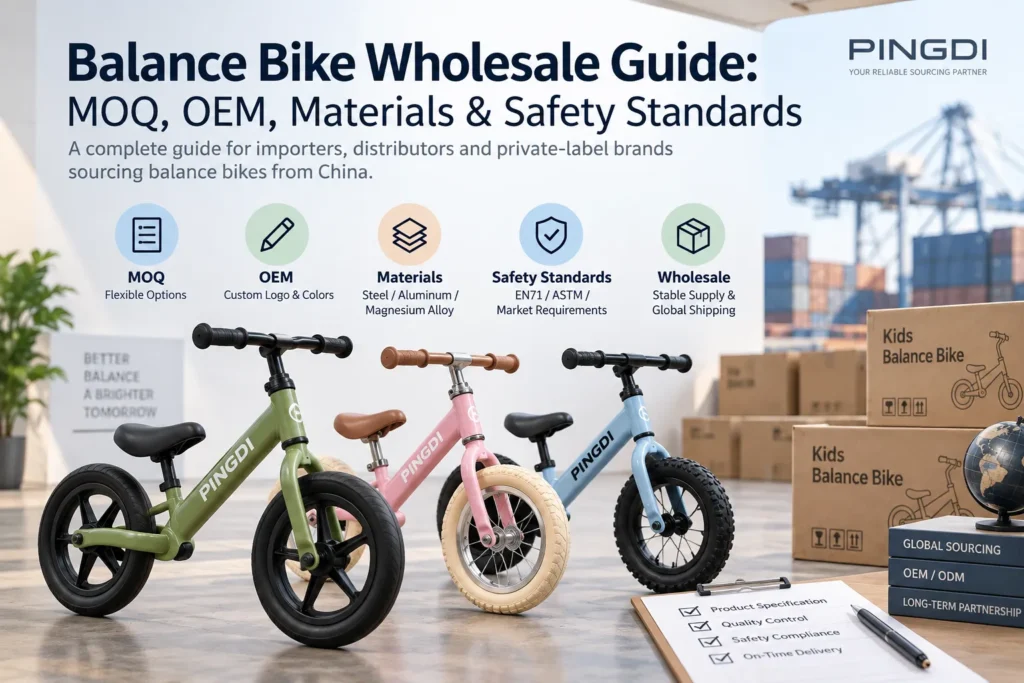
Sourcing balance bikes from China is not simply a matter of finding the lowest FOB price.
For importers, distributors and private-label brands, the real purchasing decision involves MOQ, frame material, wheel configuration, OEM requirements, packaging, quality consistency, safety requirements and supplier capability.
Two balance bikes may look almost identical in supplier photos while having very different frame materials, components, product weight, packaging and production costs.
This guide explains the key points professional buyers should evaluate when sourcing balance bikes wholesale from China, from MOQ and OEM customization to materials, quality control and destination-market requirements.
1. What Should Buyers Confirm Before Requesting a Balance Bike Quotation?
Before asking ten suppliers for a price, prepare a basic purchasing specification.
At minimum, a professional RFQ should include:
- Destination country
- Estimated order quantity
- Target age group
- Wheel size
- Frame material
- Wheel/tire type
- Seat and handlebar requirements
- Target price range
- Logo requirements
- Packaging requirements
- Required testing or documentation
- Expected delivery schedule
This is particularly important when comparing a balance bike manufacturer in China because quotations based on different specifications cannot be compared accurately.
A $12 product and a $20 product may appear similar in photos while using different frames, wheels, bearings, surface finishes and packaging.
At PINGDI, we prefer to establish a comparable specification before evaluating supplier quotations. This helps buyers understand what they are actually paying for rather than selecting a supplier from a price spreadsheet alone.
2. What Is the Typical MOQ for Balance Bike Wholesale Orders?
There is no universal balance bike MOQ.
Current Chinese B2B listings show anything from very small trial quantities to several hundred pieces, while customized models commonly move toward higher production quantities. For example, current supplier listings include 50-, 100-, 200-, 300- and 500-piece MOQs depending on model and supplier. Alibaba
For professional sourcing, it is better to think about MOQ in three levels.
Existing Model Without Customization
If you select an existing production model and standard color, suppliers may accept a relatively lower MOQ.
This can be suitable for:
- Market testing
- New distributors
- Initial sample orders
- Small regional wholesalers
Existing Model With OEM Branding
Adding a logo, custom carton, manual or labels normally introduces additional production requirements.
The product MOQ may remain manageable, but packaging suppliers can have their own printing MOQ.
Custom Color or Product Configuration
Custom frame colors, components, molded parts or more substantial modifications usually require a higher commitment.
Therefore, importers should ask:
“What is the MOQ for this exact configuration?”
rather than simply:
“What is your MOQ?”
That small difference produces a much more useful answer.
3. Steel vs Aluminum vs Magnesium Alloy Balance Bikes
Frame material is one of the most important variables when sourcing kids balance bikes wholesale.
There is no single material that is best for every market.
Steel Frame Balance Bikes
Steel remains common in value-oriented children’s mobility products.
Advantages can include established production processes, broad supplier availability and competitive cost.
For importers targeting price-sensitive retail channels, steel-frame models may offer a practical balance between cost and product positioning.
However, buyers should evaluate:
- Product weight
- Welding quality
- Surface treatment
- Coating consistency
- Corrosion protection
- Frame geometry
Do not compare a steel-frame quotation directly with an aluminum or magnesium model without considering the different construction and positioning.
Aluminum Balance Bikes
Aluminum frames are often considered for lighter-weight product ranges.
Reduced weight can be commercially attractive because parents frequently consider portability when choosing children’s mobility products.
For B2B buyers, aluminum models can support a more premium retail position, but the complete product specification still matters.
A lightweight frame does not automatically mean that every component is high quality.
Evaluate the fork, wheels, bearings, seat, handlebar and other components together.
Magnesium Alloy Balance Bikes
Magnesium alloy models are increasingly visible in higher-positioned balance bike ranges, especially designs using integrated or distinctive frame shapes. Current B2B sourcing pages prominently feature magnesium-alloy options alongside steel and aluminum products. Alibaba.com Seller Central
They can provide strong visual differentiation for brands seeking a more distinctive product.
However, buyers should evaluate:
- Actual frame construction
- Product weight
- Surface finish
- Tooling requirements
- MOQ
- Color options
- Replacement-component availability
- Total landed cost
Material should therefore be selected according to target customer, retail positioning and landed-cost objective, rather than simply choosing whichever material sounds more premium.
4. EVA Wheels vs Pneumatic Tires
Wheel configuration can significantly change product cost, weight, maintenance requirements and riding characteristics.
EVA Wheels
EVA wheels are popular because they are lightweight and require little maintenance.
For distributors focused on simple assembly, low maintenance and competitive pricing, EVA can be practical.
Pneumatic Tires
Air-filled tires can provide different riding characteristics and are often used on more bicycle-like models.
However, they also introduce considerations such as inflation, tubes/valves, maintenance and replacement parts.
Before confirming an order, specify:
- Wheel diameter
- Wheel material
- Rim material
- Bearing configuration
- Tire type
- Required spare parts
Avoid approving a bulk order based solely on appearance.
5. OEM Balance Bike Options for Private-Label Brands
For many importers, OEM balance bike sourcing does not mean developing an entirely new product.
Most private-label projects begin with an existing platform and customize selected elements.
Common OEM options include:
Logo
Brand logos can potentially be applied to the frame, fork or other suitable areas depending on product design.
Custom Colors
Frame, fork, wheels, grips and saddle colors may be customized subject to production MOQ.
Labels
Product labels, warning labels, barcode labels and carton labels can be prepared according to buyer requirements.
Instruction Manual
Manuals can be customized with the buyer’s brand, language and required product information.
Private-Label Packaging
For private label balance bike programs, packaging can include customized artwork, brand information, product specifications and shipping marks.
Selected Components
Depending on the model and factory capability, buyers may also select different seats, grips, wheels or accessories.
At PINGDI, we recommend creating an OEM confirmation sheet before mass production.
The document should clearly identify:
Product model → Color → Logo → Components → Labels → Manual → Packaging → Carton marks.
This is far safer than confirming important OEM details across dozens of WhatsApp or email messages.
6. How Does OEM Affect Balance Bike MOQ and Cost?
Customization affects more than the unit price.
For example, a custom color may require a minimum production batch. A printed carton may have a separate packaging MOQ. A custom molded component may require tooling.
When evaluating an OEM balance bike supplier, ask suppliers to separate costs into:
Product cost
OEM cost
Packaging cost
Tooling cost, if applicable
Testing cost, if applicable
Sample cost
This makes quotations easier to compare.
It also prevents an apparently inexpensive quotation from becoming much more expensive after artwork and customization are confirmed.
7. Safety Standards: What Importers Need to Understand
This is one of the most misunderstood parts of balance bike sourcing.
Importers sometimes ask:
“Does this balance bike have EN71 and ASTM?”
That question alone is not sufficient.
Applicable requirements depend on the specific product design, intended age, product classification and destination market.
For the United States, CPSC distinguishes requirements covering toys and bicycles, and ASTM F963 is the mandatory toy safety framework for products that fall within its scope. Children’s products may also be subject to other applicable CPSC requirements. U.S. Consumer Product Safety Commission
Therefore, a supplier should not simply place an “ASTM” or “CPC” logo on a quotation and treat the compliance question as finished.
Professional importers should confirm:
- Exact product model tested
- Applicable market
- Applicable regulation/standard
- Test report number and date
- Whether the report matches the production model
- Whether additional requirements apply
- Whether required third-party testing is from an appropriate laboratory
For U.S. children’s toys subject to ASTM F963, CPSC states that applicable third-party testing must use a CPSC-accepted laboratory. U.S. Consumer Product Safety Commission
For other markets, requirements need to be evaluated according to the applicable product and jurisdiction.
Do not assume one test report makes a balance bike compliant worldwide.
8. How to Verify a Balance Bike Test Report
Before accepting a supplier’s test report, compare it with the actual product you intend to purchase.
Check:
Product Name — Does it describe the same type of product?
Model Number — Is your model included?
Applicant / Manufacturer — Who submitted the product?
Photos — Does the tested product visually correspond to your product?
Standard / Regulation — What exactly was tested?
Issue Date — Is the document current enough for the project?
Laboratory — Is the laboratory appropriate for the required testing?
A PDF titled “EN71 Test Report” is not automatically evidence that every balance bike in a supplier’s catalog has been tested.
This verification step is especially important when a supplier sells dozens or hundreds of models.
9. Balance Bike Quality Control Checklist
Safety documentation does not replace production quality control.
For balance bike wholesale orders, inspection should compare mass-produced goods against the approved sample and confirmed specification.
PINGDI typically recommends checking areas such as:
Frame & Fork
Check assembly, alignment, finish, welding or relevant structural workmanship.
Steering
Check movement, assembly and applicable steering limitations according to the product specification.
Wheels
Check wheel installation, rotation, tire condition and applicable bearings.
Seat & Handlebar
Check adjustment, fastening and dimensions against the confirmed specification.
Fasteners
Check assembly and visible fastening consistency.
Surface Finish
Check coating, scratches, color differences, printing and visible defects.
OEM Elements
Verify logos, labels, manuals, barcodes and packaging against approved artwork.
Packaging
Confirm accessories, quantity, packing method, carton condition and shipping marks.
The inspection standard should be defined before production, not after a problem is discovered.
10. How to Compare Balance Bike Suppliers
A professional balance bike supplier in China should be evaluated across more than price.
Importers should compare:
Specification transparency
Can the supplier clearly explain materials and components?
Sample consistency
Can production follow the approved sample?
OEM management
Are colors, logos and packaging controlled systematically?
Quality control
Is there a documented inspection process?
Testing support
Can applicable documentation be provided or testing coordinated?
Communication
Are specification changes recorded clearly?
Production capability
Can the selected production resource handle the required quantity and schedule?
Export support
Can packaging, consolidation and shipment requirements be coordinated?
A quotation that is $1 cheaper is not necessarily cheaper if it creates rework, claims, delays or inconsistent production.
11. Why Work With PINGDI for Balance Bike Sourcing?
PINGDI works with international importers, distributors, wholesalers and brands sourcing children’s mobility products from China.
We are not limited to sending buyers a catalog and asking them to choose a model.
Our role can include:
Product Matching
Identify suitable models based on market, specification and target positioning.
Supplier Evaluation
Evaluate appropriate production resources for the project.
Quotation Comparison
Help buyers compare equivalent specifications instead of misleading headline prices.
OEM/ODM Coordination
Coordinate colors, logos, labels, packaging and approved specifications.
Sample Management
Arrange and confirm samples before production where required.
Production Follow-Up
Track confirmed specifications and project requirements during production.
Quality Control
Coordinate inspection against the approved sample and purchase requirements.
Consolidation & Shipping
For suitable projects, coordinate multiple products, packaging and export shipment.
This approach is particularly useful for buyers who want a China balance bike sourcing partner rather than simply another online product listing.
12. Frequently Asked Questions
What is the MOQ for wholesale balance bikes?
MOQ depends on the model, frame material, color, components and OEM requirements. Existing models generally provide more flexibility than heavily customized projects.
Can I put my own logo on a balance bike?
Yes, depending on the model and quantity. Private-label options may include logos, colors, labels, manuals and customized packaging.
Which frame material is better: steel, aluminum or magnesium?
There is no universal best material. Steel can suit cost-sensitive ranges, while aluminum and magnesium can support lightweight or differentiated product positioning. Buyers should compare the complete product specification and landed cost.
Can I mix several balance bike models in one shipment?
For suitable projects, multiple models can be coordinated. MOQ and consolidation feasibility depend on the factories, quantities and packaging.
Can you arrange samples?
Yes. Samples can be coordinated for specification and quality evaluation before bulk production.
Can PINGDI help with product testing?
Where required, we can help coordinate available supplier documentation and third-party testing arrangements. Applicable requirements should first be confirmed according to the exact product and destination market.
Request a Balance Bike Wholesale Quote
Looking for a reliable balance bike supplier in China?
Send PINGDI your destination market, expected quantity, preferred frame material, wheel configuration, target price range and OEM requirements.
We can help you evaluate suitable products, compare production options, coordinate samples, manage OEM/private-label requirements, follow production, arrange quality control and support international shipment.