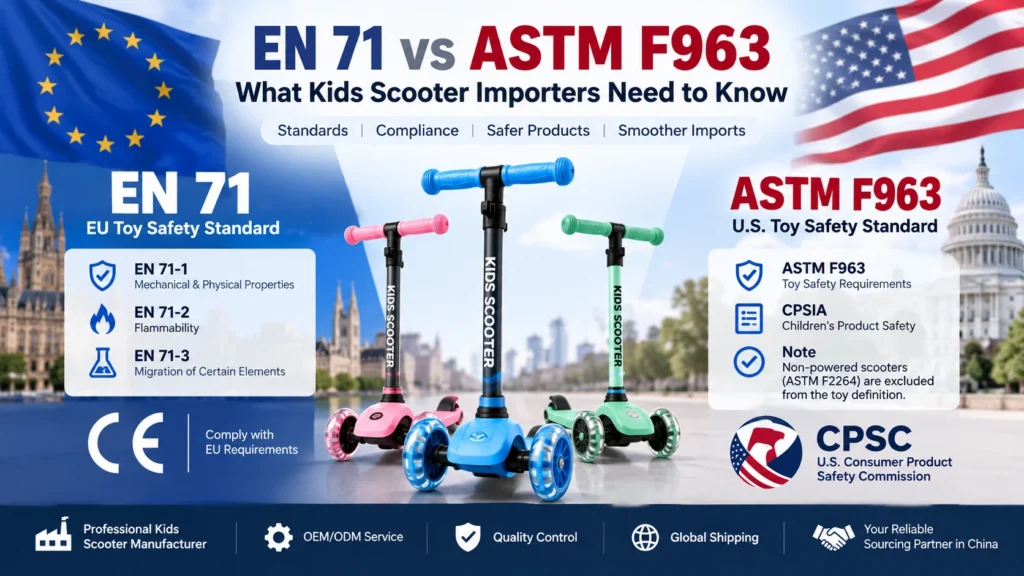
If you import kids scooters from China, one of the first questions you may ask a supplier is:
“Does this scooter comply with EN 71 or ASTM F963?”
Unfortunately, the answer is often more complicated than a simple “yes.”
A supplier may send an EN 71 test report, another may advertise “CE + ASTM,” while a third may claim that the same report can be used for Europe and the United States.
For importers, distributors and private-label brands, this creates a significant sourcing risk.
The most important question is not:
“Do you have EN 71 or ASTM?”
It is:
“What regulations and standards actually apply to this specific scooter in my destination market?”
EN 71 and ASTM F963 are both associated with children’s product safety, but they belong to different regulatory systems and are not interchangeable.
More importantly, certain non-powered scooters in the United States are expressly excluded from ASTM F963’s definition of toys and are instead addressed through other requirements.
Understanding this distinction before confirming an OEM order can prevent incorrect testing, labeling problems, shipment delays and unnecessary compliance costs.
1. What Is EN 71?
EN 71 is a family of European standards addressing the safety of toys.
For importers of products classified as toys in the European Union, EN 71 can form an important part of demonstrating conformity with EU toy-safety requirements.
Different parts address different types of hazards.
Common examples include:
EN 71-1 — Mechanical and Physical Properties
This is particularly relevant to toy scooters because it covers mechanical and physical hazards.
EN 71-2 — Flammability
This addresses flammability requirements for toys.
EN 71-3 — Migration of Certain Elements
This addresses migration limits for specified elements from toy materials.
However, buyers should not treat “EN71 certified” as a complete compliance statement.
The applicable requirements depend on the product itself, its materials, intended age, construction and market classification.
For toy scooters specifically, European Commission guidance explains that EN 71-1 distinguishes between toy scooters intended for children with body mass of 20 kg or less and those intended for children with body mass of 50 kg or less.
That is why PINGDI asks buyers to confirm the intended user, maximum user weight and destination market during the product-specification stage rather than waiting until the shipment is ready.
2. What Is ASTM F963?
ASTM F963 is the widely recognized U.S. toy safety standard.
Under U.S. law, the applicable version of ASTM F963 has been incorporated into the mandatory federal toy-safety framework through 16 CFR Part 1250.
The current CPSC-accepted version for applicable children’s toys manufactured after April 20, 2024 is ASTM F963-23.
ASTM F963 addresses numerous potential toy hazards, although the applicable sections depend on the particular product.
For children’s toys subject to the rule and intended primarily for children 12 years old or younger, third-party testing by a CPSC-accepted laboratory and certification requirements can apply.
This leads to a very common sourcing misunderstanding.
A supplier may say:
“This is a children’s product, therefore ASTM F963 applies.”
That conclusion should not automatically be accepted for a scooter.
3. Does ASTM F963 Apply to Every Kids Scooter?
No.
This is probably the most important point in this entire guide.
The U.S. Consumer Product Safety Commission states that the definition of a toy for purposes of ASTM F963 does not include:
non-powered scooters as defined in ASTM F2264.
The exclusion also covers recreational powered scooters and pocket bikes as defined in ASTM F2641.
Therefore, an importer should not automatically request an ASTM F963 report simply because the product is marketed for children.
The actual product must first be classified correctly.
For example, depending on the product design and intended use, questions may include:
- Is this product legally classified as a toy?
- Is it a non-powered scooter within ASTM F2264?
- What age group is it intended for?
- Are there additional children’s product requirements?
- Which component/material requirements apply?
- What certification and labeling obligations apply?
This is where experienced sourcing and compliance coordination becomes important.
A test report is useful only when the correct standard has been applied to the correct product.
4. EN 71 vs ASTM F963: The Key Differences
For purchasing teams, the easiest way to understand the difference is to stop thinking of EN 71 and ASTM F963 as two versions of the same certificate.
They belong to different compliance frameworks.
| Area | European Union | United States |
|---|---|---|
| Common toy standard | EN 71 series | ASTM F963 |
| Regulatory framework | EU toy-safety legislation | CPSIA / CPSC rules including 16 CFR Part 1250 |
| Market marking | CE marking for toys | No equivalent CE mark |
| Importer obligations | Yes | Yes |
| Product classification matters | Yes | Yes |
| All scooters automatically covered? | No | No |
| Non-powered scooter issue | Toy-scooter classification must be established | ASTM F2264-defined non-powered scooters excluded from ASTM F963 toy definition |
This table is deliberately simplified.
It should not be used as a substitute for a compliance assessment of a particular SKU.
That distinction is important for importers because two scooters that look almost identical may have different intended ages, user-weight limits, structures or functions.
Those differences can affect the compliance route.
5. EN 71 Requirements for Toy Scooters
EN 71-1 contains specific provisions for toy scooters.
European Commission guidance explains that toy scooters are separated according to intended body mass, including the 20 kg and 50 kg groups. It also explains that the lower-weight category corresponds to products intended for very young children and can trigger additional provisions.
Depending on the product, evaluation can involve issues such as:
Mechanical strength
The scooter needs to withstand the applicable mechanical stresses without creating unacceptable hazards.
Steering system
The handlebar and steering structure are important safety components.
Folding mechanisms
For foldable models, locking and folding structures require particular attention.
Wheels and axles
Wheel retention, structural integrity and moving components can affect product safety.
Accessible edges and points
The finished product should not introduce prohibited hazardous edges or points.
Warnings and instructions
Warnings need to match the product’s intended user and applicable requirements.
For a 3 wheel kids scooter manufacturer, therefore, compliance should influence engineering and material selection from the beginning of development.
It should not be treated as paperwork added after production.
6. What Does CE Mean for a Kids Scooter?
Another frequent question from buyers is:
“Does the scooter have CE?”
This question is understandable, but technically incomplete.
CE is not simply a certificate that a Chinese factory purchases.
For toys placed on the EU market, manufacturers must carry out the appropriate conformity assessment, prepare the required technical documentation and meet applicable safety requirements. Importers also have specific obligations, including checking that conformity assessment and documentation have been addressed and that required markings are present.
For a toy, documentation can include, as applicable:
- Product identification
- Technical specifications
- Risk/safety assessment
- Test reports
- Declaration of Conformity
- Traceability information
- Warnings
- User instructions
- Product/packaging markings
The European Commission states that only toys bearing CE marking can be placed on the EU market and outlines responsibilities for manufacturers and importers.
Therefore:
CE mark ≠ test report ≠ Declaration of Conformity.
These elements are related, but they are not the same thing.
7. Important EU Change Importers Should Know in 2026
European toy legislation is also changing.
Regulation (EU) 2025/2509 on toy safety entered into force on January 1, 2026 and is scheduled to apply from August 1, 2030, replacing the current Toy Safety Directive framework after the transition period.
One particularly important development is the future requirement for a Digital Product Passport for toys.
The European Commission says the new framework also strengthens restrictions concerning hazardous chemicals and uses digital product information to improve enforcement.
For buyers developing product lines with multi-year life cycles, this is worth considering now.
A professional supplier should therefore not simply keep sending the same historical “EN71 certificate” year after year without checking whether:
- the product has changed,
- materials have changed,
- standards have changed,
- regulations have changed,
- or the destination-market requirements have changed.
8. What About U.S. Requirements Beyond ASTM F963?
Another common mistake is assuming:
“If ASTM is okay, the product is completely compliant.”
U.S. children’s products can be subject to additional requirements depending on the product.
For example, CPSC identifies requirements concerning lead content and lead in surface coatings among common children’s-product compliance issues.
Therefore, when developing a scooter for the United States, the buyer and supplier should identify the complete set of applicable requirements rather than purchasing a generic report labeled “ASTM.”
For applicable children’s products, issues may include:
- Lead in accessible components
- Lead in paint/surface coatings
- Phthalate requirements where applicable
- Tracking information
- Applicable mechanical safety standard
- Appropriate warnings
- Certification requirements
The precise requirements depend on the product.
For this reason, PINGDI recommends confirming the test plan with a qualified, appropriately accredited or CPSC-accepted laboratory where required before mass production.
9. Why Existing Supplier Test Reports Need to Be Checked Carefully
Imagine a supplier sends you a 30-page EN 71 report.
Should you approve the order?
Not yet.
Importers should check at least five things.
Is the report for the same model?
A report for Scooter A does not automatically cover Scooter B.
Does the tested construction match your product?
Changing wheels, deck materials, plastic components, coatings or accessories may affect compliance.
Are the colors/materials covered?
This can be particularly important for chemical testing.
Is the report still relevant?
Check the test date, referenced standards and subsequent product changes.
Is the laboratory appropriate?
The identity and competence/accreditation scope of the testing laboratory matter.
This is why a professional kids scooter supplier China project should connect:
Specification → Sample → Testing → Mass Production → QC
instead of treating each as a separate task.
10. Compliance Should Begin Before the OEM Sample
For an OEM kids scooter project, we recommend defining compliance requirements before finalizing the sample.
A practical workflow looks like this:
Step 1 — Confirm destination market
EU? United States? UK? Multiple markets?
Step 2 — Define intended user
Age, body mass and product positioning.
Step 3 — Confirm product classification
Do not assume every children’s scooter falls into exactly the same category.
Step 4 — Define specifications
Materials, deck, wheels, steering system, folding system, maximum user weight and packaging.
Step 5 — Establish testing plan
Confirm applicable standards and tests with the appropriate compliance specialist/laboratory.
Step 6 — Approve sample
Maintain an approved golden sample.
Step 7 — Mass production
Production should follow the tested/approved specification.
Step 8 — Quality control
Verify that mass production has not deviated materially from the approved product.
This sequence can save considerably more money than discovering a compliance problem after 5,000 scooters have already been produced.
11. Questions to Ask a Kids Scooter Manufacturer
When evaluating a kids scooter manufacturer in China, do not ask only:
“Do you have EN71?”
Instead ask:
Which exact model was tested?
Which version of the standard appears on the report?
Can you provide the complete report rather than only the first page?
Does the report cover the materials and colors in my order?
Have any materials or components changed since testing?
Which markets are your existing customers importing this model into?
Can you support third-party testing for my customized version?
How do you ensure mass production matches the approved sample?
These questions immediately separate a supplier who merely collects certificates from a team that actually understands compliance management.
12. OEM Changes Can Affect Compliance
This is particularly important for private label kids scooter projects.
Suppose an existing scooter has already been tested.
You then request:
- New plastic color
- New painted metal component
- Different wheel
- New grip material
- Different deck
- Added LED components
- Modified folding mechanism
It may no longer be appropriate to assume that the original test evidence covers the modified product.
This does not mean every logo or packaging change automatically requires complete retesting.
It means that changes should be reviewed for their potential compliance impact.
At PINGDI, our preferred approach is therefore:
Change → Risk Review → Determine Testing Impact → Approve → Production
rather than:
Change → Produce → Hope the old report still works.
13. Why Compliance Matters for Importers, Not Just Factories
Importers sometimes assume product compliance is entirely the manufacturer’s responsibility.
That is dangerous.
In the EU, the European Commission explicitly assigns obligations to importers, including ensuring that the manufacturer has carried out appropriate conformity assessment and prepared technical documentation, and checking CE marking and related requirements.
In the United States, manufacturers and importers also have certification responsibilities for children’s products subject to CPSC-enforced rules.
Therefore, choosing the right supplier is not simply about finding a factory willing to say:
“Yes, we can make it.”
A professional buyer needs a supply-chain partner capable of supporting documentation, testing coordination, production consistency and traceability.
14. How PINGDI Supports Kids Scooter Importers
PINGDI works with importers, distributors, wholesalers and private-label brands sourcing children’s mobility products from China.
Our role is not simply to forward a supplier’s existing test report.
For qualified projects, our support can include:
We help define the product configuration before final quotation and sampling.
Supplier & Production Coordination
We coordinate suitable manufacturing resources according to product and project requirements.
Including colors, logos, packaging, components and product customization.
Compliance Coordination
We help organize product information and coordinate testing requirements with the buyer and appropriate third-party laboratories. Final legal applicability should be confirmed for the specific product and destination market.
Golden Sample Management
Approved samples provide a reference for subsequent production.
Quality Control
Production and finished goods can be checked against agreed specifications and approved samples.
Documentation Coordination
We help organize relevant test reports, product information and shipping documentation required for the project.
Multi-Product Procurement
For buyers purchasing scooters together with balance bikes, ride-on cars, bicycles or other children’s products, we can also coordinate sourcing and shipment consolidation.
This allows buyers to manage China-side sourcing through one project-management point rather than coordinating every supplier independently.
15. EN 71 or ASTM F963: What Should an Importer Request?
The answer should not start with a certificate name.
Start with four pieces of information:
What is the exact product?
Who is the intended user?
Where will it be sold?
How is the product legally classified?
Only then should the applicable standards, testing and documentation be determined.
For an EU toy scooter, EN 71 may be central to the conformity process.
For a U.S. non-powered scooter falling within ASTM F2264, assuming ASTM F963 applies simply because it is used by children would be incorrect.
That distinction can determine whether your compliance program is based on the right requirements from the beginning.
Conclusion: Test the Product, Not the Certificate Name
For professional kids scooter importers, safety compliance should never be reduced to three letters printed on a quotation.
EN 71, ASTM F963, CE, CPSIA and other terms describe different standards, regulations, markings or compliance concepts.
They are not interchangeable.
The safest sourcing process is:
Market → Product Classification → Specification → Applicable Requirements → Sample → Testing → Production → QC → Documentation
This is especially important for wholesale kids scooters and private-label projects where materials, colors, components or structures are customized.
If you are planning a new kids scooter project in China, send PINGDI your:
- Product photo or drawing
- Target market
- Expected quantity
- Intended age/user weight
- OEM requirements
- Packaging requirements
- Existing compliance requirements
Our team can help evaluate the sourcing project, coordinate the product specification, OEM process, quality control and appropriate compliance workflow before mass production.
Request a Kids Scooter OEM / Wholesale Quote →