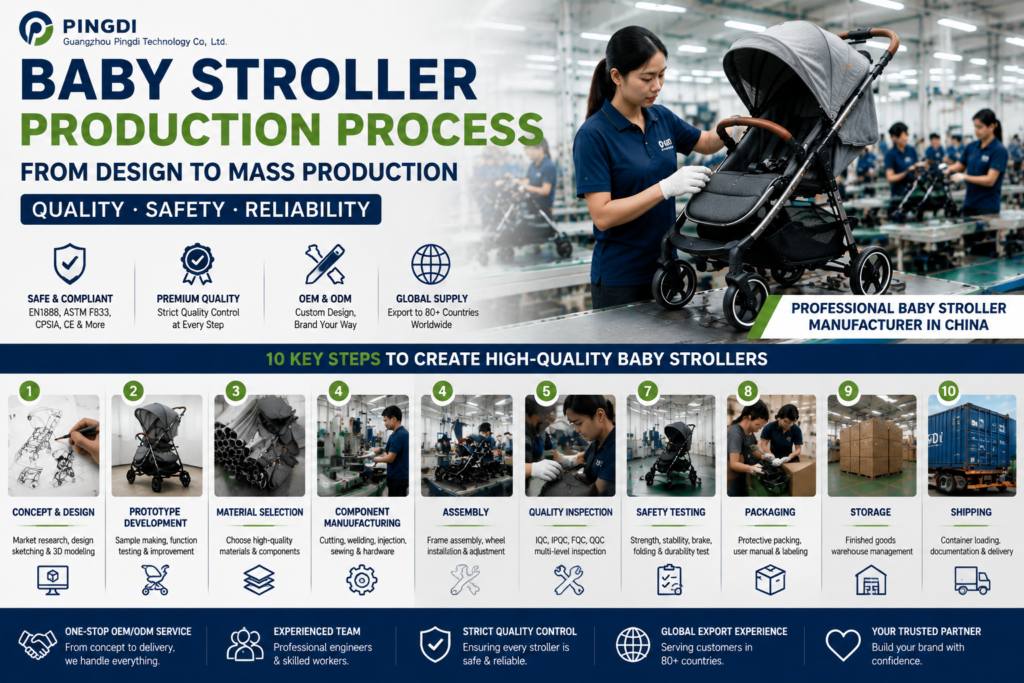
Introduction: How Are Baby Strollers Manufactured?
When international buyers purchase baby strollers from China, many focus on:
- Product price
- MOQ
- Delivery time
- Supplier quotation
However, professional buyers understand that the real difference between suppliers is hidden inside the manufacturing process.
A reliable OEM Baby Stroller Manufacturer China does not simply assemble products. A professional factory manages the entire process, including:
- Product concept development
- Industrial design
- Engineering optimization
- Prototype production
- Material selection
- Component manufacturing
- Assembly
- Quality inspection
- Mass production
- Export preparation
Understanding the complete baby stroller production process helps importers evaluate whether a manufacturer has the capability to deliver safe, reliable, and market-ready products.
This guide explains how professional baby stroller factories transform an idea into a finished product.
1. Product Concept and Market Research
Every successful baby stroller starts with market research.
Before developing a new product, manufacturers analyze:
- Target market requirements
- Consumer preferences
- Safety regulations
- Competitor products
- Price positioning
Different markets have different expectations.
For example:
European Market
Customers often focus on:
- Safety standards
- Lightweight design
- Compact folding
- Premium appearance
North American Market
Buyers usually prefer:
- Durability
- Larger storage
- Comfortable seating
- Multi-function design
Latin American Market
Important factors include:
- Cost efficiency
- Durability
- Easy maintenance
- Practical design
A professional Baby Stroller Manufacturer China develops products based on market demand rather than simply copying existing models.
2. Industrial Design and Product Development
After confirming the product concept, engineers begin the design process.
The design stage includes:
Appearance Design
Designers develop:
- Product shape
- Color combinations
- Fabric style
- Brand appearance
The goal is to create products that are attractive to consumers.
Structural Design
Engineers focus on:
- Frame structure
- Folding mechanism
- Wheel system
- Seat support
- Handle adjustment
A good structural design improves:
- Safety
- Durability
- User experience
Engineering Optimization
Before production, engineers evaluate:
- Manufacturing difficulty
- Material cost
- Assembly efficiency
- Product reliability
This stage helps balance:
Design + Quality + Cost
3. Prototype Development
Before mass production, professional factories create prototypes.
Prototype development allows manufacturers and customers to evaluate:
- Product appearance
- Functionality
- Comfort
- Safety
- Assembly process
During prototype testing, engineers check:
Folding System
Testing:
- Folding smoothness
- Locking function
- Durability
Wheel Performance
Checking:
- Steering flexibility
- Stability
- Noise level
Frame Strength
Testing:
- Load capacity
- Structural stability
- Long-term durability
4. Material Selection and Component Preparation
Material quality directly affects the final product.
A professional baby stroller factory carefully selects:
Frame Materials
Common materials include:
- Aluminum alloy
- Steel
- Reinforced materials
High-quality frames provide:
- Strength
- Lightweight performance
- Longer service life
Fabric Materials
Important factors include:
- Comfort
- Breathability
- Durability
- Easy cleaning
Wheels and Hardware
Components include:
- Wheels
- Bearings
- Brakes
- Buckles
- Screws
Each component must meet product requirements.
5. Component Manufacturing
Before final assembly, different parts are manufactured separately.
Main production processes include:
Metal Processing
Including:
- Cutting
- Welding
- Polishing
- Surface treatment
Plastic Injection
Plastic components include:
- Handles
- Connectors
- Safety parts
Injection molding ensures:
- Consistent size
- Stable quality
- Efficient production
Fabric Sewing
Professional sewing teams produce:
- Seat covers
- Canopies
- Storage baskets
- Safety belt covers
Precision sewing improves product appearance and durability.
6. Baby Stroller Assembly Process
After all components are prepared, products enter the assembly line.
The assembly process usually includes:
Step 1: Frame Assembly
Workers install:
- Main frame
- Folding structure
- Handle system
Step 2: Wheel Installation
Including:
- Front wheels
- Rear wheels
- Brake system
Workers check wheel rotation and alignment.
Step 3: Seat Installation
Including:
- Seat frame
- Fabric cover
- Harness system
Step 4: Functional Adjustment
Workers adjust:
- Folding mechanism
- Brake performance
- Seat position
7. Quality Control During Production
Quality control is one of the most important parts of baby stroller manufacturing.
Professional factories use multiple inspection stages.
IQC: Incoming Quality Control
Before production:
Inspect:
- Aluminum tubes
- Fabrics
- Plastic parts
- Wheels
- Hardware
Only approved materials enter production.
IPQC: In-Process Quality Control
During assembly:
Inspect:
- Component installation
- Welding quality
- Sewing quality
- Folding system
Problems are identified early.
FQC: Final Quality Control
Before packaging:
Test:
- Appearance
- Function
- Safety
- Stability
OQC: Shipment Inspection
Before loading:
Confirm:
- Quantity
- Packaging
- Labels
- Accessories
8. Safety Testing and Compliance
Baby strollers are safety-related products.
Professional manufacturers consider international requirements such as:
- EN1888
- ASTM F833
- CE requirements
- CPSIA requirements
Testing commonly evaluates:
- Structural strength
- Brake system
- Stability
- Folding safety
- Harness performance
A reliable factory integrates safety requirements into product development from the beginning.
9. Packaging and Mass Production
After approval, the factory begins mass production.
Mass production includes:
- Production scheduling
- Material preparation
- Assembly management
- Quality monitoring
- Packaging
Professional manufacturers optimize packaging to:
- Protect products
- Reduce shipping damage
- Improve container loading efficiency
10. Shipment Preparation
Before shipment, factories prepare:
- Commercial invoice
- Packing list
- Shipping marks
- Export documents
Products are loaded into containers and shipped worldwide.
A professional manufacturer supports buyers throughout the entire process.
Why Choose an Experienced OEM Baby Stroller Manufacturer?
The production process determines:
- Product quality
- Delivery reliability
- Customer satisfaction
- Brand reputation
An experienced factory can help buyers:
✔ Reduce production risks
✔ Improve product quality
✔ Launch products faster
✔ Control manufacturing costs
✔ Build long-term supply chains
Why Choose Pingdi Factory?
Guangzhou Pingdi Technology specializes in OEM and ODM children’s products, including:
- Baby Strollers
- Balance Bikes
- Kids Ride On Cars
- Children’s Scooters
- Kids Bicycles
Our capabilities include:
✔ Product Design Support
✔ OEM & ODM Manufacturing
✔ Quality Control System
✔ Production Management
✔ Customized Packaging
✔ Export Support
From initial concept to final shipment, Pingdi Factory provides complete manufacturing solutions for global baby product brands.
Frequently Asked Questions (FAQ)
1. How long does baby stroller production take?
Production time depends on product complexity, customization requirements, and order quantity.
2. Can I customize my own baby stroller design?
Yes. Professional OEM manufacturers support:
- Custom colors
- Logos
- Packaging
- Product modifications
3. What is the MOQ for OEM baby strollers?
MOQ depends on:
- Product model
- Customization level
- Packaging requirements
4. Do Chinese factories provide safety testing?
Yes. Experienced manufacturers can support testing requirements according to target markets.
5. How do I choose a reliable baby stroller factory?
Evaluate:
- Production capability
- Quality system
- OEM experience
- Factory audit results
- Export experience
Conclusion
The journey from a baby stroller concept to mass production requires professional design, engineering expertise, strict quality control, and experienced manufacturing management.
Choosing the right OEM Baby Stroller Manufacturer China allows brands and importers to create reliable products while reducing supply chain risks.
A professional factory is not only a supplier—it is a manufacturing partner that supports your brand growth.
At Pingdi Factory, we help global customers transform ideas into high-quality baby products through professional OEM and ODM solutions.
Planning a Baby Stroller Sourcing Project?
Tell us your target market, preferred stroller type, estimated order quantity and customization requirements. Our team can review your request and discuss the next steps for your project.
Looking for a Reliable Baby Stroller Sourcing Partner in China?
Guangzhou Pingdi Technology Co., Ltd. supports importers, distributors and private-label brands with supplier coordination, OEM/ODM project management, quality inspection and shipment arrangements.