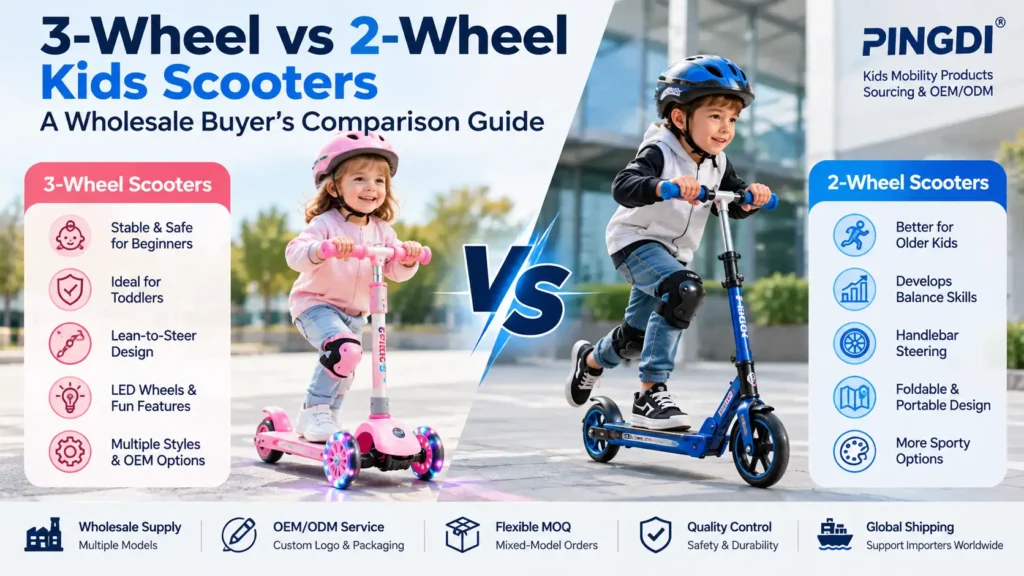
How importers, distributors and private-label brands can select the right kids scooter models, compare technical specifications and build a profitable wholesale product range.
For importers sourcing kids scooters from China, choosing between a 3-wheel scooter and a 2-wheel scooter is more than a product design decision.
The wheel configuration influences steering behavior, rider experience, product positioning, component selection, packaging requirements and quality inspection.
A three-wheel toddler scooter may be suitable for a beginner-focused product range, while a two-wheel kick scooter may appeal to customers seeking a different riding experience.
However, buyers should not assume that all three-wheel scooters are designed for younger children or that every two-wheel scooter is intended for older riders.
The correct choice depends on the actual product design, intended user, applicable safety requirements and target market.
This wholesale buying guide compares 3-wheel vs 2-wheel kids scooters from a professional sourcing perspective, helping importers evaluate product specifications, OEM customization, minimum order quantities and total purchasing costs.
1. What Is the Difference Between 3-Wheel and 2-Wheel Kids Scooters?
The most obvious difference is the number and arrangement of wheels.
However, wheel configuration alone does not determine how a scooter performs.
Three-wheel kids scooters
Many three-wheel children’s scooters use two front wheels and one rear wheel.
This configuration provides a broader support arrangement when the scooter is stationary or moving slowly.
Some models use a lean-to-steer mechanism, allowing the rider to change direction by shifting body weight.
Other designs may use different steering structures.
Three-wheel scooters are commonly found in toddler and beginner-oriented product ranges, although suitability must be evaluated for each specific model.
Two-wheel kids scooters
Two-wheel kick scooters typically use one front wheel and one rear wheel.
Many models use handlebar steering and require the rider to manage balance differently from a typical three-wheel scooter.
Depending on the design, two-wheel scooters may feature folding mechanisms, adjustable handlebars, larger wheels or other accessories.
They are often considered for children’s mobility ranges targeting riders with more developed balancing and coordination skills.
Quick comparison
| Feature | 3-Wheel Kids Scooter | 2-Wheel Kids Scooter |
|---|---|---|
| Wheel arrangement | Commonly two front, one rear | One front, one rear |
| Typical positioning | Toddler and beginner-oriented ranges | Children with different balance and riding needs |
| Steering | Often lean-to-steer; varies by model | Often handlebar steering; varies by model |
| Stationary support | Generally broader wheel support | Requires more active balancing |
| Product variations | LED wheels, seats, adjustable bars | Folding designs, adjustable bars, different wheel sizes |
| Key QC concerns | Steering linkage, wheel alignment, deck and brake | Steering, folding lock, wheel alignment and brake |
| OEM possibilities | Colors, logos, packaging, selected components | Colors, logos, packaging, selected components |
This table describes common product configurations, not universal performance or safety guarantees.
2. Which Scooter Is Better for Different Age Groups?
One of the most common questions from wholesale buyers is whether three-wheel scooters are better for toddlers and two-wheel scooters are better for older children.
Age positioning is important, but the answer requires more than counting wheels.
Three-wheel scooters for beginner-oriented ranges
Many importers include three-wheel scooters in product collections intended for younger riders.
Common features may include:
- Wide decks
- Adjustable handlebars
- Lean-to-steer mechanisms
- Multiple wheel configurations
- Optional LED wheels
- Selected models with seats
These features can support different product positioning strategies.
However, the intended age range should be established through product design assessment and applicable requirements, not marketing assumptions.
Two-wheel scooters for developing riding skills
Two-wheel scooters are often included in product ranges aimed at children who can manage the balance and steering characteristics of the selected model.
Depending on the product, buyers may evaluate:
- Handlebar height
- Deck dimensions
- Wheel diameter
- Folding mechanism
- Brake operation
- Weight and portability
What importers should verify
Before selecting a scooter for a particular age segment, request the manufacturer’s intended age grading, technical specifications, applicable test documentation and user instructions.
Do not assign an age recommendation solely because a scooter has two or three wheels.
This is particularly important for private-label brands responsible for product positioning and consumer-facing information.
3. Steering Systems: Lean-to-Steer vs Handlebar Steering
Steering design is one of the most important differences buyers should examine.
Lean-to-steer systems
Many three-wheel scooters use a mechanism that changes direction when the rider leans or shifts weight.
The actual steering response depends on the mechanical design, geometry and component quality.
Buyers should evaluate:
- Steering movement
- Return behavior, where applicable
- Component fit
- Smoothness of operation
- Wheel alignment
- Consistency between samples
A steering system that feels acceptable on one sample must also be reproduced consistently during mass production.
Handlebar steering
Many two-wheel scooters use direct handlebar steering.
Buyers should check the steering range, assembly fit, movement and stability of the handlebar system.
Why this matters for wholesale buyers
Different steering systems may require different components and inspection procedures.
When comparing suppliers, importers should not simply ask whether a scooter has a steering function.
They should request the exact steering design and test the product under its intended operating conditions.
For OEM programs, steering specifications should be documented before approving the production sample.
4. Stability, Balance and Rider Experience
Three-wheel scooters are often marketed as more stable than two-wheel scooters.
However, stability is influenced by several design factors.
These include:
- Wheel arrangement
- Wheelbase
- Track width
- Deck dimensions
- Center of gravity
- Steering geometry
- Rider weight and posture
- Surface conditions
A three-wheel arrangement may provide broader support when stationary, but that does not automatically make every three-wheel model safer than every two-wheel model.
Similarly, two-wheel scooters may provide a different riding experience, but their suitability depends on the intended rider and product design.
Practical recommendation for importers
Request physical samples and evaluate the complete product rather than relying only on supplier photographs.
Where possible, compare models under the same documented evaluation conditions.
A product’s advertised features should be supported by its actual design and relevant testing.
5. Comparing Product Specifications Before Requesting Prices
Professional importers should compare equivalent specifications before comparing quotations.
A lower-priced scooter may use different materials, wheels, bearings or packaging.
Recommended specification comparison
| Specification | What Buyers Should Check |
|---|---|
| Frame material | Material type and approved construction |
| Deck | Dimensions, surface and structure |
| Wheels | Diameter, material and configuration |
| Bearings | Specification and performance requirements |
| Handlebar | Height adjustment and locking mechanism |
| Steering | Mechanical design and function |
| Brake | Design and operation |
| Folding system | Locking mechanism, if applicable |
| Seat | Attachment and locking, if applicable |
| Lighting | LED configuration, if applicable |
| Product weight | Verified product specification |
| Packaging | Dimensions, weight and protection |
For example, two scooters with similar appearance may have different wheel materials, deck construction and steering components.
These differences can influence manufacturing cost, durability and customer experience.
A meaningful wholesale price comparison requires a consistent technical specification.
6. Which Scooter Type Has a Lower Wholesale Price?
There is no reliable universal rule that three-wheel scooters are cheaper or more expensive than two-wheel scooters.
The number of wheels is only one cost factor.
A basic three-wheel scooter may cost less than a premium foldable two-wheel model.
A multifunction three-wheel scooter with a seat, lighting and additional components may cost more than a simple two-wheel design.
Major wholesale price factors
Materials: Frame and deck construction influence material costs.
Wheel specifications: Wheel size, material, bearings and lighting features affect component costs.
Steering systems: Different mechanisms involve different components and assembly requirements.
Additional functions: Folding systems, seats and accessories may increase production complexity.
Customization: Exclusive colors, logos, packaging and structural changes may affect pricing.
Order quantity: Supplier MOQ and production arrangements influence commercial terms.
Importers should therefore request quotations based on the same agreed specifications and trade terms.
For a more complete purchasing evaluation, compare unit price together with packaging, freight and expected after-sales costs.
7. MOQ Differences Between 3-Wheel and 2-Wheel Scooters
Minimum order quantity is another important purchasing consideration.
However, MOQ depends more on the supplier, product platform and customization requirements than on wheel count alone.
Standard products may offer different purchasing flexibility from fully customized OEM designs.
Common MOQ considerations
| Purchasing Requirement | Potential MOQ Impact |
|---|---|
| Existing standard model | Depends on supplier and stock availability |
| Custom product color | May require separate component production |
| Custom logo | Depends on printing method and production arrangement |
| Private-label packaging | May involve separate printing MOQ |
| Modified components | May require additional development or tooling |
| Mixed-model order | Individual model MOQs may still apply |
For importers planning a mixed assortment, it is important to confirm the MOQ for each model and configuration.
For detailed guidance, read our article on Kids Scooter Wholesale MOQ and Mixed-Model Order Planning.
8. OEM and Private-Label Customization Options
Both three-wheel and two-wheel scooters can be considered for OEM or private-label programs, subject to the selected model and manufacturing partner.
Possible customization options include:
- Product colors
- Brand logos
- Deck graphics
- Handlebar details
- Wheel configurations
- Retail packaging
- Instruction manuals
- Product labels
- Shipping carton markings
Not every customization is available for every model.
Standard customization
Basic branding and packaging adjustments may be suitable for buyers using existing product platforms.
Advanced OEM development
Structural changes, exclusive components or new molds require additional evaluation.
Importers should discuss tooling ownership, sample approval, technical specifications, development costs and expected production quantities before starting such projects.
PINGDI can coordinate these requirements with suitable manufacturing partners according to the buyer’s project specifications.
9. Packaging and Container Loading Considerations
For wholesale buyers, the product’s shipping dimensions can be as important as its unit price.
Three-wheel and two-wheel scooters may have different carton dimensions because of their structures and accessories.
However, packaging efficiency depends on the specific design rather than wheel count alone.
Important packaging information
Request the following details for each model:
- Individual packaging dimensions
- Master carton dimensions
- Units per carton
- Net weight
- Gross weight
- Total carton quantity
- Carton volume
- Loading restrictions
CBM calculation
Carton volume can be calculated using:
CBM = Length (m) × Width (m) × Height (m)
For example, a carton measuring 0.75 × 0.35 × 0.40 meters occupies approximately 0.105 CBM.
This is an illustrative calculation.
Actual loading quantities depend on carton arrangement, weight limits and product protection requirements.
Why packaging matters
A scooter with a lower factory price may have a higher landed cost if its packaging uses substantially more shipping space.
Importers should compare the total purchasing and logistics cost before deciding which product offers better commercial value.
10. Quality Control Differences Between 3-Wheel and 2-Wheel Scooters
Quality inspection should be based on the product’s actual structure and approved specifications.
Three-wheel scooter inspection
Important checkpoints may include:
- Front wheel alignment
- Steering mechanism
- Wheel rotation
- Deck construction
- Handlebar adjustment
- Rear brake function
- Seat attachment, where applicable
- Fastener security
- Surface finish
Two-wheel scooter inspection
Important checkpoints may include:
- Front and rear wheel alignment
- Steering operation
- Handlebar assembly
- Folding lock, where applicable
- Deck construction
- Brake function
- Fastener security
- Wheel rotation
- Surface finish
Inspection comparison
| Inspection Area | 3-Wheel Scooter | 2-Wheel Scooter |
|---|---|---|
| Wheel alignment | Check all wheel positions | Check front and rear alignment |
| Steering | Verify actual steering mechanism | Verify actual steering mechanism |
| Deck | Inspect structure and finish | Inspect structure and finish |
| Folding | If applicable | If applicable |
| Seat mechanism | If applicable | If applicable |
| Brake | Verify approved design | Verify approved design |
| Packaging | Check labels and protection | Check labels and protection |
Both product types require appropriate inspection planning.
A successful sample evaluation does not guarantee that every production unit will match the approved specification.
For bulk orders, importers should agree on inspection criteria, sampling arrangements and corrective-action procedures before shipment.
11. Safety Standards and Import Compliance
Importers should not assume that three-wheel and two-wheel scooters automatically fall under the same regulatory classification.
Applicable requirements depend on intended use, age grading, product design and destination market.
For example, toy scooters and sports scooters may be subject to different requirements.
Relevant standards and regulations may include EN 71, EN 14619, ASTM F963 and other market-specific requirements, depending on the product.
These standards have different scopes and should not be treated as interchangeable.
Before ordering, buyers should confirm:
- Intended market and age group.
- Product classification.
- Applicable safety requirements.
- Required testing and documentation.
- Warning labels and instructions.
- Traceability information.
- Whether available reports match the actual model.
A test report for one scooter should not automatically be assumed to cover another design or configuration.
For private-label importers, product compliance should be reviewed before bulk production rather than after shipment.
12. Which Scooter Type Is Better for Different Distribution Channels?
The best product mix depends on the buyer’s target customers and sales channels.
Children’s specialty retailers
Retailers focused on toddler mobility products may consider three-wheel scooters and selected multifunction designs.
Product suitability, age positioning and available retail space should guide assortment decisions.
General sporting goods distributors
Distributors serving a broader age range may consider both two-wheel and three-wheel scooters.
Product differentiation and price positioning can help create a more complete range.
E-commerce brands
Online sellers should pay particular attention to packaging protection, assembly instructions, product dimensions and after-sales support.
A product that performs well in a showroom may still generate complaints if its packaging or assembly instructions are inadequate.
Private-label brands
Brands developing a coordinated scooter collection may select both configurations to cover different customer needs.
However, the assortment should remain manageable in terms of SKU count, MOQ, inventory and quality control.
The objective is not to stock every available scooter model, but to select products that fit the buyer’s actual market.
13. How to Build a Balanced Wholesale Scooter Collection
A practical purchasing strategy is to divide the product range into core, supporting and trial products.
Consider the following hypothetical order.
| Product Type | Planned Quantity | Role |
|---|---|---|
| Standard 3-wheel scooters | 400 | Core product |
| LED 3-wheel scooters | 250 | Feature-based variation |
| Foldable 2-wheel scooters | 250 | Supporting product |
| Premium scooter models | 100 | Trial assortment |
| Total | 1,000 | Mixed product range |
Illustrative planning example only. These are not confirmed PINGDI minimum order quantities.
Before placing the order, buyers should confirm the MOQ and packaging requirements for every SKU.
They should also evaluate expected sales velocity, available capital and reorder lead times.
A balanced assortment can reduce dependence on one product design, but excessive SKU variation can increase purchasing and inventory complexity.
14. How PINGDI Supports Kids Scooter Importers
Guangzhou Pingdi Technology Co., Ltd. is a China-based B2B sourcing and OEM/ODM project management partner specializing in children’s mobility products.
We work with suitable manufacturing partners to support international importers, wholesalers, distributors and private-label brands.
PINGDI does not present itself as the owner of every manufacturing facility involved in a sourcing project.
Our role is to help buyers coordinate the purchasing process according to their specifications and commercial requirements.
Product sourcing and model comparison
We help buyers evaluate different scooter configurations according to their target market, intended user and product requirements.
Supplier and specification coordination
We coordinate communication with manufacturing partners regarding materials, components, product functions and commercial terms.
OEM/ODM project management
We support discussions involving product colors, logos, packaging, samples and agreed customization requirements.
Quality inspection coordination
We help organize agreed inspection checkpoints and communicate quality issues with manufacturing partners.
Packaging and export coordination
We can assist with packaging information, shipment planning and export-related communication according to the project requirements.
Mixed-model sourcing
For buyers purchasing several scooter types, we can evaluate suitable sourcing arrangements and coordinate selected products from different manufacturing resources.
Our objective is to help buyers establish a sourcing program that balances product suitability, commercial feasibility, quality consistency and long-term supply requirements.
15. What Information Should Buyers Include in a Scooter RFQ?
Before requesting a wholesale quotation, importers should prepare the following information.
| RFQ Information | Example |
|---|---|
| Buyer type | Importer / Distributor / Private-label brand |
| Destination market | United States / EU / Mexico / Other |
| Scooter configuration | 3-wheel / 2-wheel / Mixed |
| Intended users | Defined age and product positioning |
| Estimated quantity | Units per model and color |
| Required specifications | Wheels, deck, steering, folding and accessories |
| Branding | Standard / Logo / OEM |
| Packaging | Standard / Private-label |
| Compliance | Applicable destination-market requirements |
| Delivery schedule | Preferred shipment period |
Providing detailed requirements helps sourcing teams evaluate suitable models and prepare more accurate quotations.
16. Frequently Asked Questions
Are 3-wheel scooters better than 2-wheel scooters for toddlers?
Many three-wheel scooters are designed for beginner-oriented product ranges, but suitability depends on the specific product’s design, intended age grading and applicable safety requirements.
Are 2-wheel scooters cheaper to manufacture?
Not necessarily. Manufacturing cost depends on materials, wheel specifications, steering systems, accessories, production quantities and customization requirements.
Can importers order both 3-wheel and 2-wheel scooters together?
Potentially, yes. Mixed-model orders can be coordinated, subject to individual supplier MOQs, product availability and shipping arrangements.
Can both scooter types support OEM customization?
Yes, selected models may support colors, logos, packaging and other customization. Available options depend on the specific product and manufacturing partner.
Which scooter type is better for private-label brands?
The choice depends on the brand’s target users, sales channels, product positioning and expected purchasing volume.
Can PINGDI help compare different scooter models?
PINGDI can help importers evaluate suitable models, coordinate specifications and discuss OEM/ODM and sourcing requirements with manufacturing partners.
Conclusion: Choose the Right Scooter Mix for Your Market
When comparing 3-wheel vs 2-wheel kids scooters, wholesale buyers should evaluate more than wheel configuration.
The most important factors include intended users, steering systems, product specifications, safety requirements, OEM options, quality control, packaging and total landed cost.
Three-wheel scooters and two-wheel scooters can serve different positions within a children’s mobility product range.
For importers and distributors, the most effective purchasing strategy is to select models that match actual market demand and establish clear sourcing specifications before placing bulk orders.
Looking for a Kids Scooter Wholesale Supplier in China?
PINGDI supports international B2B buyers with kids scooter sourcing, OEM/ODM coordination, product specification management, quality inspection arrangements and export support.
Explore Our Wholesale Kids Scooter Collection
View Our 3-Wheel Kids Scooter Product
Contact PINGDI for an OEM/Wholesale Quotation
Please share your destination market, preferred scooter configurations, estimated order quantities and customization requirements.