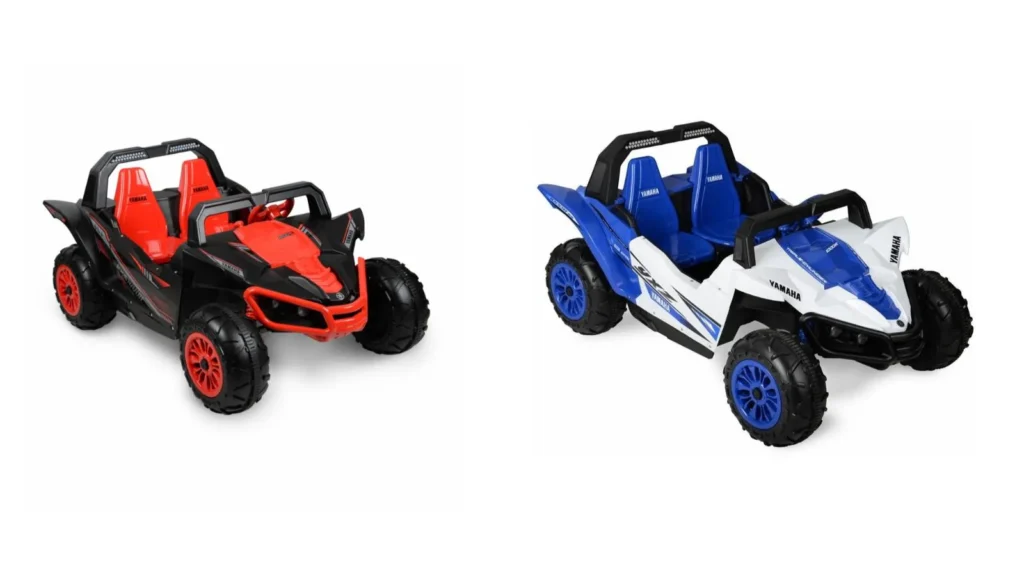
A practical sourcing guide for importers, distributors, wholesalers and private-label brands buying electric ride-on cars from China.
For importers and distributors, choosing between 12V and 24V kids ride-on cars is more than a battery specification decision.
The voltage affects how a vehicle’s electrical system is designed, but wholesale buyers must also consider motor output, battery capacity, speed control, product weight, safety compliance, packaging volume, after-sales support and target retail positioning.
A low-priced 12V electric ride-on car may be suitable for an entry-level product range. A larger 24V ride-on UTV may offer an attractive premium product opportunity, but it can also introduce higher purchasing costs, larger shipping cartons and more demanding component requirements.
So which configuration should a wholesaler import?
This guide compares 12V and 24V ride-on cars from a B2B purchasing perspective and explains how to evaluate suppliers, technical specifications, OEM customization, quality inspection and export documentation.
1. What Is the Difference Between 12V and 24V Kids Ride-On Cars?
The main difference is the nominal voltage of the electrical power system.
A 12V ride-on car uses a nominal 12-volt battery system, while a 24V model uses a nominal 24-volt system.
However, voltage alone does not determine vehicle performance.
Actual driving performance depends on several connected factors:
- Battery voltage and capacity.
- Motor rated power and efficiency.
- Number of drive motors.
- Motor controller design.
- Gear ratio and drivetrain efficiency.
- Vehicle weight and passenger load.
- Wheel diameter and tire construction.
- Terrain and operating conditions.
For example, a 24V vehicle with a low-power motor and conservative speed controller may operate more slowly than a differently designed 12V model.
Importers should therefore compare complete product specifications instead of treating voltage as a universal performance rating.
12V vs 24V Ride-On Car Comparison
| Specification | 12V Ride-On Car | 24V Ride-On Car |
|---|---|---|
| Electrical system | Nominal 12V | Nominal 24V |
| Typical positioning | Entry-level to mid-range | Mid-range to premium |
| Battery example | 12V 7Ah | 24V 7Ah |
| Nominal battery energy | 84Wh | 168Wh |
| Motor example | 2 × 35W | 2 × 100W |
| Product styles | Compact cars, SUVs | Larger SUVs, UTVs, buggies |
| Common features | Lights, music, remote control | Higher-power drive systems, suspension options |
| Shipping consideration | Often smaller cartons | Often larger and heavier cartons |
These are illustrative product configurations, not guaranteed specifications.
A professional wholesale quotation should always identify the exact motor, battery, controller, load rating, speed settings and product dimensions.
2. How Does Voltage Affect Motor Power and Driving Performance?
Motor power is an important technical parameter for electric ride-on cars.
Electrical input power can be estimated using:
Power (W) = Voltage (V) × Current (A)
For example:
A 12V system drawing 10A has an electrical input of approximately 120W.
A 24V system drawing 10A has an electrical input of approximately 240W.
However, these figures describe electrical input under the stated conditions. They do not directly equal mechanical output power at the wheels.
Motor efficiency, controller behavior and drivetrain losses must also be considered.
Example Motor Configurations
| Configuration | Total Rated Motor Power |
|---|---|
| 12V, 2 × 35W | 70W |
| 12V, 2 × 45W | 90W |
| 24V, 2 × 100W | 200W |
| 24V, 2 × 200W | 400W |
These examples show why buyers should ask for the complete motor configuration.
A supplier advertising a “24V powerful ride-on car” should be able to provide motor ratings, controller information and relevant performance test results.
What Wholesale Buyers Should Ask
Before approving a model, request:
- Motor quantity and rated power.
- Battery type and capacity.
- Maximum speed and available speed settings.
- Rated maximum load.
- Applicable age grading.
- Motor and gearbox specifications.
- Controller protection features.
- Results of relevant functional and safety tests.
The objective is to verify that the complete vehicle meets the agreed specification.
3. 12V vs 24V Battery Capacity: How to Compare Runtime
Battery capacity is commonly stated in ampere-hours (Ah).
However, comparing Ah alone can be misleading when the battery voltage differs.
A better starting point is nominal battery energy:
Battery Energy (Wh) = Nominal Voltage (V) × Capacity (Ah)
Battery Energy Comparison
| Battery | Nominal Energy |
|---|---|
| 12V 7Ah | 84Wh |
| 12V 10Ah | 120Wh |
| 24V 7Ah | 168Wh |
| 24V 10Ah | 240Wh |
A 24V 7Ah battery has twice the nominal energy of a 12V 7Ah battery.
But this does not mean that the 24V vehicle will operate for twice as long.
A higher-power motor system may consume energy more quickly.
Illustrative Runtime Calculation
Suppose a 12V 7Ah battery provides 84Wh of nominal energy.
At an assumed average electrical load of 70W:
84Wh ÷ 70W = 1.2 hours.
Now consider a 24V 7Ah battery providing 168Wh.
At an assumed average load of 200W:
168Wh ÷ 200W = 0.84 hours.
These calculations are simplified theoretical estimates.
Actual runtime can be shorter or longer depending on battery chemistry, discharge rate, temperature, load, terrain, controller operation and usable battery capacity.
For lead-acid batteries, capacity can vary significantly with discharge conditions.
Wholesale recommendation: Request measured runtime results under documented test conditions instead of accepting unsupported advertising claims.
4. Which Is Better for Wholesale: 12V or 24V?
The best choice depends on the buyer’s target market and retail strategy.
When 12V Ride-On Cars May Be More Suitable
12V products can be useful for distributors seeking:
- Compact electric ride-on cars.
- Entry-level retail price points.
- Smaller product footprints.
- Lower purchasing commitments.
- Standardized spare parts.
- A focused range of common designs.
For buyers launching a new product category, a limited selection of 12V models may be easier to evaluate before expanding the catalog.
However, product suitability must still be assessed against the manufacturer’s age grading, load limits and safety documentation.
When 24V Ride-On Cars May Be More Suitable
24V models can be attractive for buyers seeking:
- Larger ride-on SUVs.
- Off-road-inspired designs.
- Premium UTV and buggy styles.
- Higher-output motor configurations.
- Larger vehicle formats.
- More differentiated retail products.
These models may create opportunities for premium positioning.
However, the buyer should assess additional shipping costs, spare-parts requirements and warranty exposure.
A larger vehicle does not automatically provide a better profit margin.
5. What Specifications Matter Most to Importers?
A professional kids electric ride-on car supplier in China should provide more than product photographs and basic marketing descriptions.
Importers should request a complete technical specification sheet.
Recommended Specification Checklist
| Category | Information Required |
|---|---|
| Product | Model number and vehicle dimensions |
| Battery | Chemistry, voltage, Ah, Wh |
| Motors | Quantity and rated power |
| Controller | Model, speed control and protections |
| Speed | Tested maximum and adjustable settings |
| Load | Manufacturer’s rated maximum load |
| Age grading | Supported by product assessment |
| Remote | Frequency, functions and safety behavior |
| Wheels | Material and dimensions |
| Charging | Charger ratings and charging instructions |
| Packaging | Carton dimensions and weights |
| Compliance | Applicable reports and documentation |
For buyers comparing several factories, using the same specification checklist makes quotation evaluation more reliable.
6. Should Wholesale Buyers Choose Lead-Acid or Lithium Batteries?
Battery chemistry can influence product cost, weight, shipping requirements, performance and after-sales service.
Lead-Acid Batteries
Sealed lead-acid batteries are used in many traditional ride-on toy designs.
Potential advantages include established supply chains and familiar product configurations.
However, lead-acid batteries are relatively heavy, and their usable capacity and lifespan depend strongly on operating conditions.
Lithium Batteries
Lithium-based battery systems may offer lower weight and different performance characteristics.
However, the battery pack requires appropriate design, protection, charger compatibility, documentation and transport assessment.
The term “lithium battery” is not sufficiently precise for a purchasing specification.
Buyers should request the exact chemistry, battery-pack configuration, protective electronics and relevant test information.
Battery Purchasing Checklist
Before confirming a battery option, verify:
- Battery chemistry and model.
- Nominal voltage and rated capacity.
- Battery supplier.
- Charging system compatibility.
- Protection arrangements.
- Battery compartment design.
- Relevant transportation documentation.
- Spare battery availability.
- Warranty and replacement procedures.
For lithium battery shipments, importers should review applicable transport requirements, including relevant UN 38.3 test-summary information and shipment-specific dangerous-goods obligations.
Do not assume that a battery can be shipped under the same conditions as an ordinary toy component.
7. Remote Control Features: What Should Distributors Verify?
Many 12V and 24V ride-on cars with parental remote control are marketed with 2.4GHz remote systems.
For wholesale buyers, the remote-control system is a safety and reliability consideration, not merely a selling feature.
Important questions include:
- Can the parent stop the vehicle reliably?
- What happens when the remote-control signal is lost?
- Can unintended commands cause movement?
- How does remote pairing work?
- Are speed settings clearly defined?
- Is the remote-control system suitable for the destination market?
Importers should request documented functional testing for the selected product.
If the vehicle uses radio equipment, additional radio-frequency or electromagnetic-compatibility obligations may apply in the destination market.
For European markets, the applicable radio-equipment requirements should be assessed separately from general toy safety.
8. ASTM F963 Requirements for U.S. Ride-On Toy Imports
For U.S. importers, applicable toy safety requirements are essential.
Children’s ride-on toys may be subject to ASTM F963 requirements incorporated into U.S. federal regulations under 16 CFR Part 1250.
Relevant safety considerations can include:
- Stability and overload performance.
- Wheels, tires and axles.
- Accessible moving parts.
- Electrical safety.
- Battery-operated toy requirements.
- Mechanical hazards.
- Material and chemical restrictions.
- Warning labels and instructions.
The exact requirements depend on product classification and design.
Importers should also assess whether additional product-specific rules apply.
Children’s Product Certificate
For products intended primarily for children aged 12 or younger and subject to applicable children’s product safety rules, the U.S. importer must ensure appropriate third-party testing and issue a Children’s Product Certificate.
The supporting test reports should correspond to the actual product and applicable requirements.
A generic supplier statement saying “ASTM approved” is not sufficient evidence.
Official reference: U.S. CPSC Toy Safety Guidance
9. EN 71 and EN IEC 62115 for European Importers
For buyers importing electric ride-on toys into European markets, safety compliance requires a broader review than checking battery voltage.
Relevant standards may include applicable parts of EN 71 and EN IEC 62115.
EN IEC 62115 addresses electrical safety aspects of electric toys.
Other applicable requirements may cover mechanical and physical hazards, chemical substances, radio equipment and electromagnetic compatibility.
Documents to Request
- Product-specific test reports.
- Applicable standards and editions.
- EU Declaration of Conformity.
- Technical documentation.
- Product identification.
- Manufacturer and importer details.
- Required labels and warnings.
- Instructions in the required languages.
Buyers should confirm the current applicable legislation and transitional arrangements for their destination market.
A CE mark printed on the packaging is not, by itself, proof that the product has been properly assessed.
For 24V models, the exact electrical design and applicable requirements deserve particular attention.
10. How to Verify a Kids Ride-On Car Supplier in China
Before placing a bulk order, importers should verify the supplier’s legal identity and actual manufacturing arrangements.
Some suppliers operate manufacturing facilities directly.
Others coordinate production through independent manufacturing partners.
Both business models can support international trade, provided that responsibilities and production sources are transparent.
Supplier Verification Checklist
| Area | Verification Method |
|---|---|
| Legal company | Check business registration |
| Manufacturing source | Identify actual factory |
| Product experience | Review relevant ride-on car models |
| Production capacity | Request production records |
| Component sourcing | Review battery and motor suppliers |
| Compliance | Verify product-specific reports |
| OEM capability | Review samples and specifications |
| QC | Confirm inspection procedures |
| Shipping | Review packaging and export documents |
Buyers should also check whether the supplier can provide replacement parts after delivery.
For electric ride-on cars, after-sales component availability can be a major factor in distributor satisfaction.
11. OEM Kids Ride-On Cars: Customization Options
Private-label distributors often need more than standard catalog products.
Common OEM customization options include:
- Brand logos.
- Body colors.
- Custom packaging.
- Product labels.
- Instruction manuals.
- Wheel and seat options.
- Approved accessory configurations.
- Selected electrical component options.
However, not all modifications have the same engineering implications.
Changing a logo is different from replacing a motor, battery, controller or drivetrain component.
OEM Risk Assessment
| Modification | Main Concern |
|---|---|
| Logo | Artwork and placement |
| Body color | Material and appearance |
| Packaging | Labeling and protection |
| Battery change | Electrical and safety assessment |
| Motor upgrade | Powertrain and structural validation |
| Controller change | Functional safety |
| Wheel change | Stability and drivetrain effects |
| New chassis | Engineering and product testing |
Any safety-relevant design change should be reviewed before bulk production.
Importers should approve the final sample and written specification.
12. MOQ and Wholesale Purchasing Strategy
There is no universal minimum order quantity for wholesale kids electric cars.
MOQ depends on the supplier, selected model, battery configuration, customization, packaging and production arrangements.
A buyer should distinguish between:
- Standard product MOQ.
- Custom color MOQ.
- Private-label packaging MOQ.
- New tooling MOQ.
- Mixed-model order requirements.
Illustrative First-Order Strategy
For a distributor considering a 100-unit trial order:
| Product Type | Example Allocation |
|---|---|
| Standard 12V car | 40 units |
| 12V SUV | 30 units |
| 24V UTV | 20 units |
| Premium 24V buggy | 10 units |
| Total | 100 units |
This is a hypothetical planning example, not a PINGDI sales forecast or confirmed supplier MOQ.
Actual quantities should reflect the buyer’s market research, available budget and supplier requirements.
For new importers, selecting fewer SKUs can make quality inspection, inventory management and spare-parts planning more manageable.
13. Calculate the Real Landed Cost Before Ordering
A low FOB quotation does not necessarily result in a low landed cost.
Importers should consider:
- Product purchase cost.
- Inland transport.
- Export handling.
- Ocean or air freight.
- Insurance.
- Import duties and taxes.
- Customs clearance.
- Destination transport.
- Warehousing.
- Warranty allowance.
Example Landed Cost Calculation
Assume the following hypothetical figures for a 100-unit order:
| Cost Item | Amount |
|---|---|
| Product cost: 100 × $85 | $8,500 |
| Freight and insurance | $1,500 |
| Import duties and other charges | $900 |
| Destination handling | $400 |
| Total | $11,300 |
Illustrative landed cost:
$11,300 ÷ 100 = $113 per unit
If the product sells to retailers at $150 per unit, the illustrative gross margin before additional operating expenses is:
($150 − $113) ÷ $150 × 100 = 24.7%
These figures are examples only.
Actual landed costs depend on destination country, tariff classification, shipment terms, freight conditions and other expenses.
14. Compare Carton Volume and Container Loading
Electric ride-on cars can occupy substantial shipping volume.
A larger 24V model may have a higher purchase price and require more warehouse space.
Example Carton Calculation
Assume a product carton measures:
120 × 65 × 40 cm
Carton volume:
1.20 × 0.65 × 0.40 = 0.312 CBM
For 100 cartons:
100 × 0.312 = 31.2 CBM
This is a simple carton-volume calculation, not a guaranteed container-loading quantity.
Actual loading depends on carton orientation, stacking limits, weight distribution and container dimensions.
Before ordering, ask for:
- Product dimensions.
- Carton dimensions.
- Gross and net weight.
- Units per carton.
- Loading-plan information.
- Packaging test records where relevant.
15. Quality Control Checklist for Electric Ride-On Cars
A professional inspection plan should cover electrical, mechanical and cosmetic requirements.
Incoming Component Inspection
Verify approved batteries, motors, controllers, wheels, wiring and chargers.
In-Process Inspection
Check assembly consistency, wiring connections, fasteners and installed components.
Final Inspection
Verify that the finished vehicle matches the approved product specification.
Suggested Inspection Items
| Inspection Item | Verification |
|---|---|
| Battery | Correct approved specification |
| Motor | Correct model and quantity |
| Controller | Approved functions |
| Charger | Correct electrical ratings |
| Wiring | Secure and protected |
| Steering | Correct operation |
| Wheels | Correct assembly |
| Brakes | Applicable stopping performance |
| Remote control | Functional and safety checks |
| Speed settings | Match approved specifications |
| Body panels | Appearance and fit |
| Labels | Correct destination-market information |
| Packaging | Approved carton and accessories |
Sampling inspections should use agreed acceptance criteria.
Safety-critical defects require appropriate investigation and disposition, regardless of the overall sampling result.
Pre-shipment inspection does not replace mandatory product safety testing.
16. After-Sales Spare Parts: A Critical Wholesale Consideration
For distributors, a successful ride-on car product line depends on more than the initial shipment.
Common replacement components may include:
- Batteries.
- Chargers.
- Motors.
- Gearboxes.
- Controllers.
- Remote controls.
- Switches.
- Wheels.
- Selected body accessories.
Importers should ask whether replacement components remain available after the first production run.
It is also important to confirm whether spare parts are interchangeable between product versions.
A motor or controller from a different revision may not be compatible even when the exterior vehicle design looks identical.
For repeat wholesale orders, maintaining consistent component specifications can reduce service problems.
17. How PINGDI Supports 12V and 24V Ride-On Car Sourcing
Guangzhou Pingdi Technology Co., Ltd. is a China-based B2B supply chain and OEM/ODM project management partner specializing in baby and children’s products.
We work with manufacturing partners to support international importers, distributors, wholesalers and brands.
Our role is to help buyers coordinate the sourcing and execution of suitable product projects.
Product Sourcing
We assist buyers in identifying potential 12V and 24V ride-on car options according to their product requirements and destination markets.
Specification Comparison
We coordinate technical information concerning batteries, motors, controllers, product dimensions and packaging.
OEM/ODM Coordination
We support communication about branding, customization, samples and approved product specifications.
Manufacturing Partner Coordination
We help buyers communicate with relevant manufacturing partners and request available supplier information.
Quality Inspection Coordination
We assist with agreed quality-inspection arrangements and follow-up on identified production issues.
Export and Shipping Coordination
We support communication about packaging, shipment preparation and international logistics.
PINGDI does not need to claim ownership of a manufacturing facility to provide value.
Our focus is helping buyers manage sourcing projects through transparent supplier coordination and practical project execution.
18. Frequently Asked Questions
Are 24V kids ride-on cars better than 12V models?
Not necessarily. A 24V system may support different motor configurations, but overall product quality and performance depend on the complete vehicle design.
Do 24V ride-on cars run longer?
Not automatically. Runtime depends on battery energy, motor consumption, vehicle load and operating conditions.
Are 24V ride-on cars faster?
Some are designed for higher speeds, but voltage alone does not determine maximum speed. The motor, controller and gearing are also important.
Which voltage is more suitable for a wholesale business?
The choice depends on target customers, product positioning, retail price expectations, safety requirements and supplier capabilities.
What is the MOQ for kids electric ride-on cars from China?
MOQ varies by model and customization requirements. Buyers should request model-specific quotations.
Can I customize the logo and packaging?
Many manufacturing partners can support selected OEM requirements, subject to project feasibility and minimum quantities.
What safety documents should U.S. importers request?
Relevant documents may include product-specific test reports and information supporting the applicable U.S. children’s product safety requirements and Children’s Product Certificate.
What standards should European importers check?
Applicable requirements may include EN 71, EN IEC 62115 and other relevant legislation depending on product features.
Can PINGDI help source both 12V and 24V models?
PINGDI can assist with product sourcing, manufacturing partner coordination, specification review, OEM/ODM communication, inspection arrangements and export project coordination.
Conclusion: Choose the Right Product Configuration, Not Just the Voltage
For wholesale buyers, the decision between 12V vs 24V kids ride-on cars should be based on complete product specifications and commercial requirements.
12V products may be suitable for compact and entry-level ranges.
24V models may support larger or more differentiated products, but they also require careful evaluation of batteries, motors, controllers, safety documentation and shipping costs.
Before placing an order, verify the actual product configuration, review supplier documentation, approve samples and establish quality-control requirements.
A structured sourcing process can help reduce avoidable purchasing risks and support long-term distributor relationships.
Looking for a Kids Ride-On Car Sourcing Partner in China?
PINGDI supports B2B buyers with product sourcing, OEM/ODM project coordination, manufacturing partner communication, quality-inspection arrangements and international shipping coordination.
Visit PINGDI to explore our sourcing services and discuss your next wholesale project.
Guangzhou Pingdi Technology Co., Ltd.
Baby & Children’s Products Supply Chain Partner
China Sourcing · OEM/ODM · Quality Coordination · Global B2B Supply
Website: https://pingdifactory.com