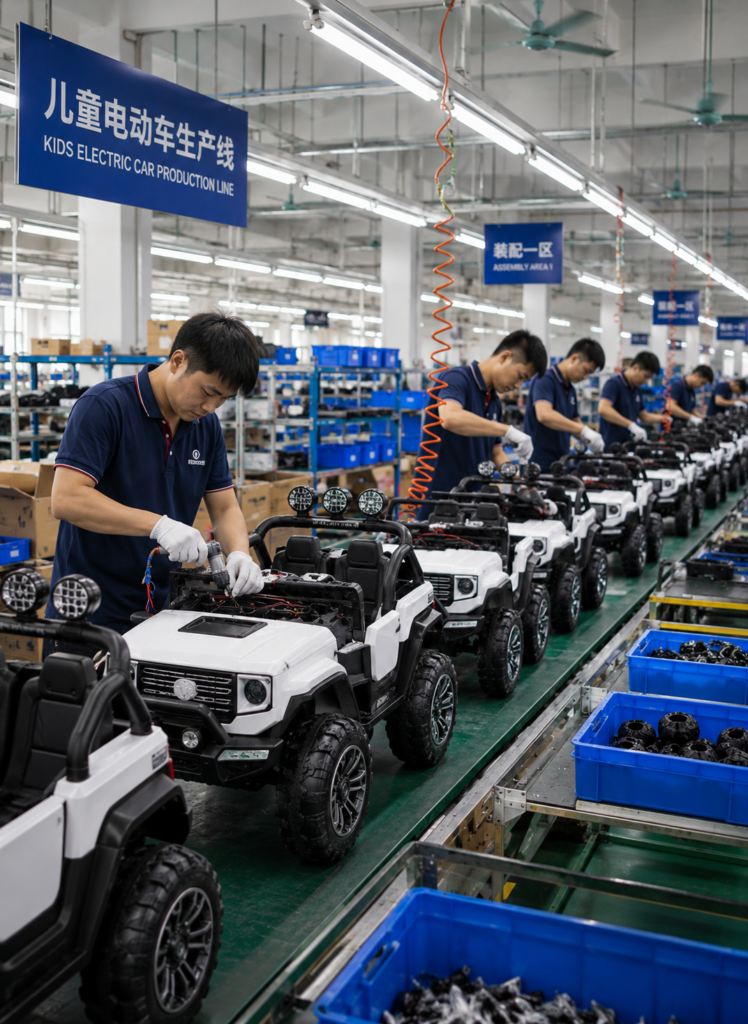
Introduction: Why European Distributors Are Sourcing Kids Electric Ride-On Cars from China
For European toy distributors, importers, wholesalers and private-label brands, kids electric ride-on cars represent an attractive product category because they combine strong visual appeal with multiple price points, battery configurations, body styles and opportunities for OEM customization.kids ride-on cars
A European distributor sourcing from China can choose from products such as electric sports cars, SUVs, off-road jeeps, pickup trucks, electric go-karts, tractors and themed ride-on vehicles. The same basic product category can therefore be developed into a much wider retail collection instead of being treated as a single SKU.
But importing a battery-powered children’s vehicle into Europe is very different from purchasing a simple plastic toy.
A kids electric ride-on car may involve mechanical safety, electrical safety, chemical restrictions, batteries, charging systems, product markings, instructions, traceability information and importer responsibilities. European buyers therefore need to evaluate much more than the FOB price.
As of 2026, toys placed on the EU market are still principally governed by the Toy Safety Directive 2009/48/EC. The newer Toy Safety Regulation (EU) 2025/2509 will replace that framework after its transition period; the existing Directive remains applicable until 31 July 2030.
For distributors, this means the correct sourcing strategy in 2026 is:
Product Selection → Supplier Verification → Compliance Review → Sample Testing → OEM Confirmation → Mass Production → Quality Control → Shipping → Customs Clearance → EU Market Distribution.
This guide explains each stage.
1. Start by Defining the Exact Ride-On Car You Want to Import
One of the biggest sourcing mistakes European buyers make is beginning with a request such as:
“Please send me your best kids electric cars.”
That request is too broad.
Before contacting a kids electric car manufacturer in China, define the commercial specification of your product.
A European distributor should first determine whether the target product is a 12V or 24V ride-on car, whether it is single-seat or two-seater, whether the intended retail positioning is entry-level or premium, whether parental remote control is required and whether features such as LED lights, music, USB, Bluetooth or EVA wheels are commercially necessary.
Product style is equally important.
A distributor serving traditional toy retailers may prefer mainstream SUVs and sports cars. An online brand may benefit from more differentiated designs such as electric go-karts, off-road vehicles, police cars or tractors.
The more precisely you define the target market, the easier it becomes to compare Chinese suppliers accurately.
For example, instead of asking:
“What is your ride-on car price?”
a professional sourcing request should look more like:
“We are looking for a 24V two-seater kids electric ride-on SUV for the German and French markets. Target order quantity is 500 units. Please quote the available motor configurations, carton dimensions, 40HQ loading quantity, OEM packaging options and available compliance documentation.”
That type of RFQ immediately separates casual sellers from experienced B2B suppliers.
2. Find the Right Kids Electric Ride-On Car Supplier in China
Price should never be the only criterion when selecting an electric ride-on car supplier China.
The supplier you choose affects not only the product but also your compliance risk, shipment schedule, replacement-part availability and long-term reputation in Europe.
A serious supplier should be able to explain the complete product specification rather than simply send pictures.
For each model, request the battery specification, motor power, number of motors, maximum load, recommended age, speed range, charging information, wheel material, product dimensions, carton size, net and gross weight, available OEM options and existing test documentation.
You should also understand exactly who controls production.
For a private-label project, the most important issue is not whether the company describes itself as a “factory” or “trading company.” What matters is whether your supplier can reliably control engineering, component purchasing, assembly, inspection, testing, packaging and production scheduling.
For European distributors, supply-chain control is more valuable than a supplier simply presenting a low quotation.
3. Order and Evaluate Samples Before Mass Production
Never evaluate a battery-powered ride-on car only from photos or videos.
Before placing a large order, order a representative sample with the configuration that you actually intend to sell.
A proper sample review should evaluate physical construction, steering, wheels, electrical functions, charger, battery installation, switches, wiring, seat, safety restraint where applicable, assembly process, labels, instructions, packaging and general workmanship.
The sample should also be used as the reference for compliance testing and later production approval.
This is particularly important when an OEM project includes modifications.
Changing a battery, motor, charger, wiring system, plastic component, wheel, electronics module or other safety-relevant component after testing may affect the validity of your existing compliance evidence. Under the EU toy framework, manufacturers must consider changes in toy design, characteristics and applicable standards when maintaining conformity.
For this reason, your approved sample and your mass-production specification should match.
4. Understand EU Toy Safety Requirements Before Placing the Order
This is one of the most important sections for any European distributor.
In the EU, toys must meet applicable safety requirements before they are placed on the market. Toys sold in the EU must carry CE marking, which indicates the manufacturer’s declaration that the product complies with applicable EU safety requirements.
The European Commission states that manufacturers are responsible for carrying out the conformity assessment, preparing the technical file, issuing the EU Declaration of Conformity and affixing the CE marking.
For an electric ride-on toy, the compliance review commonly involves both physical/mechanical toy safety and electrical toy safety.
The exact standards and versions applicable to your specific model must be verified at the time the product is placed on the market.
5. EN 71 Requirements for Kids Electric Ride-On Cars
European buyers frequently search for:
EN71 certified ride on cars
but the correct sourcing question is more detailed.
Do not simply ask:
“Do you have EN71?”
Instead ask:
“Which applicable EN 71 parts and versions were tested, for this exact model and configuration, and can you provide the full test report?”
The EU publishes references to harmonised toy standards that can give a presumption of conformity with the corresponding safety requirements. The harmonised standards list is updated over time, so buyers should verify the version cited in the Official Journal rather than relying on an old PDF sent by a supplier.
EN 71-1 concerns mechanical and physical properties, while other EN 71 parts may address additional hazards depending on materials and product characteristics.
A revised EN 71-1:2026 has also appeared in 2026, which is another reason importers should verify the currently applicable harmonised version rather than automatically assuming that a report issued several years earlier is sufficient.
6. EN IEC 62115 for Electric Toy Safety
Because an electric ride-on car depends on electrical components, electrical toy safety is a major compliance area.
EN IEC 62115:2020 is included in the European Commission’s harmonised standards framework supporting the Toy Safety Directive and covers electric toy safety.
This is particularly relevant to ride-on cars because they may contain:
battery systems, motors, wires, connectors, switches, charging circuits, lights, electronic control modules and remote-control components.
When reviewing a supplier, ask whether the test evidence relates to the exact:
battery + charger + motors + wiring + controller + finished vehicle configuration
you intend to purchase.
A report from a visually similar model should not automatically be treated as sufficient evidence for your model.
7. CE Marking Is More Than a Logo on the Product
One of the biggest misunderstandings among first-time importers is treating CE as a sticker.
CE marking is part of a conformity process.
The European Commission explains that the manufacturer must undertake the applicable conformity assessment, prepare technical documentation, issue the EU Declaration of Conformity and then affix the CE marking correctly.
Therefore, when sourcing CE ride-on cars from China, a European distributor should not be satisfied by seeing a CE symbol printed on the carton.
Request the underlying compliance documentation.
Your purchasing file should be able to connect:
Model Number → Product Specification → Test Evidence → Technical Documentation → Declaration of Conformity → Labels → Production Product
If those elements do not match, the risk increases dramatically.
8. Understand Your Responsibilities as the EU Importer
The European importer is not simply the company paying the invoice.
Under EU product rules, importers bringing products from non-EU countries have obligations to verify that the manufacturer has taken the necessary compliance steps, that required documentation such as the EU Declaration of Conformity is available, and that the manufacturer can be contacted.
This is one reason European distributors should avoid relying completely on statements such as:
“We export this product to Europe every month.”
That may be commercially useful information, but it does not replace your own due diligence.
You need documentation for your model, your configuration and your supply chain.
The General Product Safety Regulation, Regulation (EU) 2023/988, also establishes obligations for economic operators and complements sector-specific product safety law in relevant areas.
9. The EU Toy Safety Framework Is Changing
European distributors planning long-term product lines should also be aware that the regulatory environment is evolving.
The current Toy Safety Directive 2009/48/EC remains the principal framework during the transition period, while the newer Toy Safety Regulation (EU) 2025/2509 will ultimately replace it. The EU indicates that the new Regulation applies from 1 August 2030, with transitional arrangements for products already placed on the market under the Directive.
This matters commercially.
If you are building a ride-on car brand with a three-to-five-year product lifecycle, do not think only about getting the first shipment through customs.
Ask whether your supplier is capable of updating technical documentation, labels and product specifications when EU requirements evolve.
Long-term compliance capability should be part of supplier selection.
10. Check Battery-Related Requirements
A ride-on car without a reliable battery supply chain can become a warranty problem very quickly.
Battery type, capacity, supplier, charger compatibility, battery access and replacement availability should all be confirmed before mass production.
The EU Batteries Regulation, Regulation (EU) 2023/1542, entered into force in 2023 and progressively introduces requirements relating to batteries, sustainability, labelling, waste management and other lifecycle matters.
In 2026, the Commission has also highlighted future requirements concerning removability and replaceability of portable batteries incorporated into products.
For a European distributor, this means battery compliance should not be treated as an afterthought.
Before ordering, identify exactly which battery is incorporated in the ride-on car and determine the rules applicable to that battery/product combination.
11. Consider RoHS, WEEE and Other Electrical Product Obligations
Depending on the product’s scope and configuration, additional EU legislation may also need to be considered.
RoHS restricts certain hazardous substances in electrical and electronic equipment, and EU materials explicitly cover electrical/electronic product categories that can include toys.
Electrical and electronic toys may also fall within the WEEE framework, which concerns waste electrical and electronic equipment and producer responsibility. EU definitions of EEE cover equipment dependent on electric current or electromagnetic fields within specified voltage limits, and toys/leisure equipment are included in WEEE reporting categories.
The exact obligations depend on the product and the Member State where you place it on the market, so European distributors should verify producer-registration and extended producer responsibility requirements before sales begin.
If the ride-on vehicle includes radio functionality such as certain wireless modules, additional legislation such as the Radio Equipment Directive can also become relevant depending on the design. The RED establishes EU requirements for radio equipment.
12. Prepare Your OEM Ride-On Car Specification
Once the product and compliance route are clear, finalize the OEM specification before production.
This is where a private label kids electric car becomes your product rather than simply another catalog item.
Typical OEM projects may involve body colors, logos, stickers, seat material, wheel options, carton artwork, instruction manuals and other available product configurations.
More advanced projects may involve different battery and motor packages, but any change affecting the tested design needs to be reviewed carefully from a compliance perspective.
Your final specification should become the production standard.
A professional workflow is:
Approved Sample → Final Specification Sheet → Packaging Artwork → Label Approval → Production Approval → Mass Production.
This reduces arguments such as:
“That was not what we ordered.”
13. Quality Control During Mass Production
Do not wait until the final day of production to discover problems.
For electric ride-on cars, quality control should cover both cosmetic and functional issues.
Incoming components should be checked before assembly. During production, critical systems such as batteries, motors, steering mechanisms, switches, wiring and connectors should be inspected according to the agreed QC plan.
Finished products should then undergo functional checks based on the product specification.
For a large order, buyers may use supplier QC, third-party inspection or a combination of both.
Your inspection criteria should define what constitutes:
Critical Defect, Major Defect and Minor Defect.
The important point is consistency.
The product your European customer receives should match the approved sample.
14. Packaging Matters More Than Many Importers Expect
Ride-on cars are bulky products.
That means packaging directly affects:
- container loading quantity,
- international freight,
- warehouse efficiency,
- damaged-product rate,
- last-mile shipping cost.
A factory quotation of €5 less per unit may actually be more expensive if its carton is significantly larger.
For this reason, European distributors should always request:
Product dimensions, carton dimensions, gross weight and 20GP/40HQ loading quantity.
Then compare suppliers using landed cost rather than factory price.
15. Calculate the Real Landed Cost
The correct commercial question is not:
“What is your FOB price?”
It is:
“What is my landed cost per unit in Europe?”
A practical landed-cost model is:
Product Cost
OEM / Packaging Cost
Origin Charges
Ocean / Rail / Truck Freight
Cargo Insurance
Customs Duty
Customs Clearance
Port / Terminal Charges
Local Transportation
Compliance / Testing Allocation
=
Estimated Landed Cost
VAT should also be considered according to your business and destination country’s tax treatment.
This is why a professional ride on car wholesale China supplier should provide carton and container-loading data, not only FOB pricing.
16. Get an EORI Number Before Customs Clearance
Companies conducting customs operations in the EU generally need an EORI number.
The European Commission states that an EORI number is mandatory for customs clearance operations such as imports, exports and transit in the EU customs territory.
Do not wait until your container arrives to address this.
Before the shipment leaves China, confirm:
your importing entity, EORI, customs broker, tariff classification, customs value, commercial documents and destination port.
Goods entering the European single market need to be released through customs before entering free circulation.
17. Confirm Customs Classification Before Shipping
Do not automatically copy an HS code from a supplier quotation.
Classification affects:
- customs declarations,
- duty treatment,
- trade statistics,
- documentation.
Your European customs broker or customs adviser should confirm the correct classification for the exact product before shipment.
Product design matters.
A battery-powered children’s ride-on vehicle must be classified according to its actual characteristics, not simply because the Chinese supplier has historically used one generic code.
Resolve classification disagreements before the vessel sails, not after the container arrives.
18. Choose the Right Incoterm
Common sourcing quotations include EXW, FOB, CIF and other Incoterms.
For established European importers, FOB is often operationally attractive because the importer retains greater control of the main international freight and destination-side logistics.
However, there is no universally “best” Incoterm.
The right choice depends on your logistics experience, order size, negotiating position and freight arrangements.
More important than the Incoterm itself is knowing exactly who pays for and controls:
origin charges, export clearance, freight, insurance, destination charges and final delivery.
A surprisingly low CIF quotation should always be checked for destination-side charges.
19. Sea Freight: LCL or FCL?
For samples and very small commercial quantities, air or courier shipment may be used depending on the battery and transport requirements.
For commercial ride-on car orders, sea freight is normally more practical because of product volume.
An LCL shipment can make sense for a first market test.
As quantities grow, FCL often becomes commercially more attractive because container utilization becomes increasingly important.
For a distributor building regular business, do not calculate only:
“How much is one container?”
Calculate:
Freight Cost per Saleable Unit.
A supplier capable of improving packaging efficiency may create significant long-term savings.
20. Documents European Importers Should Prepare Before Shipment
Before approving shipment, your internal file should contain the commercial and product documents necessary for the transaction and compliance route.
The exact documentation depends on the product, shipping arrangement and Member State, but the commercial file typically needs to connect the supplier, model, specification, invoice, packing information and conformity evidence.
For product compliance, European Commission guidance places strong emphasis on the Declaration of Conformity and technical documentation.
Do not allow your documentation strategy to become:
“The forwarder will handle everything.”
A freight forwarder can manage logistics.
It does not replace your responsibility as an economic operator.
21. Ten Common Importing Mistakes European Buyers Should Avoid
The most expensive sourcing failures usually begin before production.
Common problems include selecting a supplier purely by price, ordering without an approved sample, assuming every “CE” logo represents valid conformity, using test reports from a different model, changing battery or motor configuration after testing, ignoring carton dimensions, relying blindly on a supplier’s HS classification, failing to prepare EORI/customs arrangements, failing to check Member State producer-responsibility obligations and shipping without a final pre-shipment inspection.
The underlying lesson is simple:
Compliance, product quality and logistics need to be planned as one project.
22. How to Evaluate a Ride-On Car Factory or Supplier
A capable kids electric car supplier China should be able to answer technical questions quickly.
Instead of asking:
“Are you professional?”
ask:
“What is the motor wattage?”
“Who manufactures the battery?”
“What charger is supplied?”
“What is the carton size?”
“What is the 40HQ loading quantity?”
“Can you provide the full test report for this exact model?”
“What changes were made after testing?”
“How do you inspect motors and batteries before shipment?”
“Can you supply spare gearboxes, chargers, controllers and wheels?”
These questions produce much more useful information than asking for the “best price.”
23. Spare Parts Are Critical for European Distributors
Ride-on cars contain more replaceable components than simple toys.
After-sales service may involve batteries, chargers, motors, gearboxes, switches, wheels, wiring, control boxes and other components.
Therefore, ask the supplier about spare-parts availability before ordering.
For a distributor selling hundreds or thousands of units annually, a spare-parts strategy can make the difference between:
a small service claim
and
a complete product return.
A strong OEM supplier should support the product after shipment, not disappear once the container is loaded.
24. Start with Market Testing, Then Scale
A distributor entering a new ride-on car category does not necessarily need to develop a completely new mould immediately.
A lower-risk strategy can be:
Phase 1 — Select proven ODM models
Test different body styles and price points.
Phase 2 — Analyze customer feedback
Identify complaints, desired features and winning specifications.
Phase 3 — Upgrade the successful SKU
Improve colors, packaging, wheels, seat material or functions.
Phase 4 — Develop a deeper OEM product
Once demand is validated, invest in stronger differentiation.
This approach can reduce development risk while allowing the brand to learn the market.
25. What Ride-On Car Models Should European Distributors Consider?
Instead of building a catalog with twenty nearly identical cars, build a portfolio around search and retail intent.
For example:
Entry-Level Electric Ride-On Car
for price-sensitive retail.
Kids Electric Sports Car
for visually driven e-commerce.
Kids Electric SUV
for mainstream premium retail.
4×4 Off-Road Ride-On Car
for adventure positioning.
Two-Seater Ride-On Car
for larger premium models.
Kids Electric Go-Kart
for differentiated racing products.
Kids Electric Tractor
for role-play and farm-themed ranges.
This product architecture also helps SEO because every category can target a different commercial keyword.
26. Why Private Label Matters
Many distributors begin by selling generic products.
The problem is that generic products are easy to compare by price.
OEM and private-label development can make comparison more difficult by creating unique combinations of:
design, color, packaging, logo, accessories and specification.
That gives the distributor more control over retail positioning.
A private-label strategy should therefore be viewed not simply as “printing a logo,” but as creating a more defensible product offer.
27. How Pingdi Supports European Ride-On Car Buyers
For European distributors searching for an OEM kids electric car supplier in China, the most valuable supplier is one that can coordinate sourcing rather than simply send a catalog.
Pingdi provides B2B sourcing and OEM/ODM support across multiple children’s ride-on vehicle categories, including sports cars, SUVs, off-road vehicles, jeeps, pickup-style models, go-karts, tractors and other children’s mobility products.
Depending on the selected model and project requirements, cooperation can include product selection, available configuration options, private-label branding, packaging customization, production coordination, inspection support and export documentation preparation.
For European buyers, the objective should be to build a repeatable supply chain:
Sample → Compliance Review → OEM Approval → Production → QC → Shipment → Repeat Order
rather than treating every purchase as a completely new transaction.
28. Final European Importer Checklist
Before paying the balance and releasing the shipment, confirm the product identity, approved specification, battery and motor configuration, labels, packaging, test evidence, Declaration of Conformity documentation, technical file availability, importer information, shipping documents, EORI/customs arrangements, carton dimensions, final quantities and pre-shipment QC results.
EU authorities require toys placed on the market to meet the applicable safety rules and carry the required CE marking, while importers themselves have responsibilities when introducing goods manufactured outside the EU.
A reliable supplier can support the process.
But the European distributor should always maintain its own compliance and import-control system.
Frequently Asked Questions
What documents do I need to import kids electric ride-on cars from China to Europe?
The exact file depends on the product and destination country, but importers should plan for commercial import documentation plus the applicable conformity documentation. For toys, EU guidance emphasizes technical documentation, conformity assessment, the Declaration of Conformity and CE marking.
Do kids electric ride-on cars need CE marking in Europe?
Yes, toys placed on the EU market must carry CE marking and satisfy the applicable EU toy-safety requirements.
What is EN IEC 62115?
EN IEC 62115 addresses electric toy safety and is part of the harmonised standards framework supporting the EU Toy Safety Directive. It is highly relevant to battery-powered electric toys.
Is an EN 71 test report enough?
Not necessarily. The applicable compliance package depends on the product. An electric ride-on toy can involve mechanical, chemical and electrical requirements, and the correct standard versions and scope should be confirmed for the exact product configuration.
Do I need an EORI number?
For EU customs operations, an EORI number is mandatory for relevant import, export and transit clearance activities.
Can I import OEM kids electric cars with my own brand?
Yes. Private-label projects can use customized branding, colors, packaging and available product configurations, provided the final product placed on the EU market is covered by the appropriate conformity assessment and documentation.
Should I choose 12V or 24V ride-on cars?
Choose based on your intended product positioning, actual motor system, product weight, target age, desired performance and retail price. Do not select a voltage purely for marketing—the complete product configuration matters.
Should I use LCL or FCL shipping?
LCL can be useful for smaller commercial tests, while higher-volume distributors should compare FCL based on freight cost per unit and container utilization, not simply total container freight.
How can I reduce ride-on car import costs?
Optimize the entire landed-cost structure rather than demanding the lowest factory price. Product configuration, packaging dimensions, container loading, freight, defects, warranty claims and spare-part availability can all affect the real margin.
What is the most important factor when choosing a Chinese ride-on car supplier?
For a European distributor, the strongest supplier is usually the one that can consistently combine product selection, specification control, compliance support, stable quality, OEM flexibility, packaging efficiency and after-sales spare-parts support.
Conclusion: Successful Ride-On Car Importing Starts Before the Order
Importing kids electric ride-on cars from China can be a profitable opportunity for European distributors, but the winning strategy is not simply finding the lowest-priced factory.
A professional importer needs to control the entire chain:
Product Strategy → Supplier Selection → Compliance → Sample → OEM Specification → Production → Quality Control → Shipping → Customs → Distribution
The EU requires toys placed on its market to satisfy applicable safety requirements and bear CE marking, while importers bringing products from outside the EU have their own verification responsibilities.
At the same time, the European regulatory environment continues to evolve through the new Toy Safety Regulation, Batteries Regulation, GPSR and related product legislation.
For this reason, European distributors should choose Chinese suppliers based not only on price, but on their ability to support long-term product development, documentation, quality management and supply-chain stability.
If you are looking for an OEM kids electric ride-on car supplier in China, send us your target country, required models, battery configuration, expected order quantity and target price.