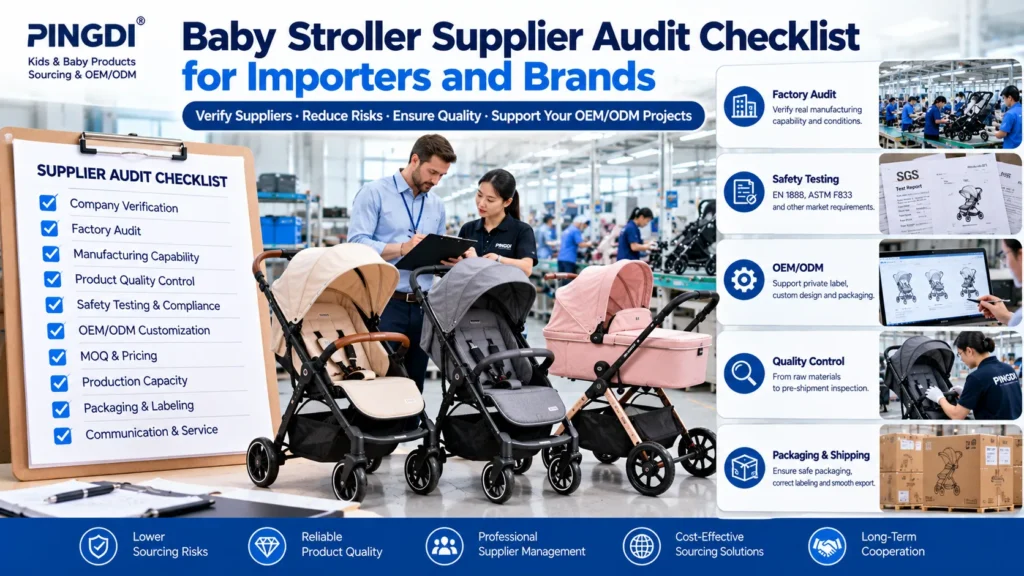
A practical guide to verifying Chinese baby stroller suppliers, manufacturing partners, product safety documentation and OEM production capabilities before placing bulk orders.
Choosing a baby stroller supplier in China involves much more than comparing product photographs and FOB quotations.
An importer may receive attractive pricing, professional catalogs and promises of fast delivery. However, those details do not establish whether the supplier has a reliable manufacturing network, adequate quality controls or the documentation required for the destination market.
For baby products, supplier verification is especially important because product defects can create serious safety and commercial consequences.
A folding mechanism that does not lock correctly, an unreliable parking brake or an incorrectly assembled restraint system can create risks that cannot be resolved through competitive pricing alone.
This baby stroller supplier audit checklist helps importers, distributors and private-label brands evaluate suppliers before committing to bulk production.
It covers company verification, factory auditing, OEM capabilities, product testing, quality management, order planning and shipment preparation.
1. Verify the Supplier’s Legal Business Identity
The first step is confirming that the company offering the quotation is a legitimate business.
Ask for its registered legal name, business license, registration details and official business address.
For Chinese companies, the Unified Social Credit Code is an important identifier.
Buyers can use China’s official enterprise credit information system to help verify registration information.
External resource: National Enterprise Credit Information Publicity System
Supplier verification checklist
| Information | Verification Question |
|---|---|
| Legal company name | Does it match the business license? |
| Registration number | Can it be verified independently? |
| Registered address | Is the address consistent? |
| Business status | Is the company currently registered? |
| Quotation issuer | Which legal entity is responsible? |
| Contract entity | Who will sign the sales agreement? |
| Payment beneficiary | Does the account belong to the agreed entity? |
Differences between the contracting company, manufacturing factory and export company are not automatically evidence of fraud.
However, their roles should be clearly documented.
Importers should resolve unexplained inconsistencies before transferring funds.
2. Manufacturer or Trading Company: Understand the Difference
One of the most important supplier audit questions is whether the company owns the manufacturing facility.
A direct manufacturer may operate its own production lines, machinery and factory workforce.
A trading company may source products through one or several manufacturing partners and coordinate commercial and production activities.
Neither business model automatically guarantees better quality.
A factory may offer direct production communication, while a specialized sourcing company may provide access to multiple suitable manufacturers and coordinate complex purchasing requirements.
Questions to ask
- Do you own the factory producing this stroller?
- If not, what is your relationship with the manufacturer?
- Can you disclose the actual manufacturing entity for verification?
- Who approves product specifications?
- Who manages quality inspections?
- Who is responsible for correcting production defects?
- Who is responsible for the commercial contract?
The key issue is transparency and accountability—not whether the supplier calls itself a factory.
For buyers working with a sourcing partner, the audit should evaluate both the trading company’s project management capability and the manufacturing partner’s production capability.
3. Verify the Actual Manufacturing Facility
A supplier’s website may display impressive production photographs, but buyers should establish whether those facilities are involved in the proposed order.
Request the manufacturing factory’s legal name and location, together with relevant production information.
Depending on the project’s value and risk, verification may include a video meeting, factory visit or independent third-party audit.
Factory audit checklist
| Area | What Buyers Should Verify |
|---|---|
| Factory identity | Legal entity and production address |
| Production lines | Relevant stroller assembly operations |
| Equipment | Appropriate manufacturing and testing equipment |
| Workforce | Relevant operational and technical personnel |
| Warehouse | Component and finished-product storage |
| Quality control | Incoming, in-process and final checks |
| Production records | Traceability and inspection documentation |
| Subcontracting | Which operations are performed externally? |
A factory tour should not be treated as proof that every displayed machine or production line belongs to the supplier.
The audit should connect the facility to the actual products being purchased.
4. Evaluate Baby Stroller Manufacturing Capabilities
Baby strollers involve multiple components and manufacturing processes.
These may include metal frames, plastic parts, textile components, wheels, brakes, folding mechanisms and restraint systems.
A capable manufacturing partner should be able to explain how relevant components are sourced, assembled and controlled.
Production questions
Can the manufacturer produce the selected stroller configuration?
Are critical components sourced from approved suppliers?
How are incoming materials inspected?
How are assembly errors identified?
What procedures apply when defective components are discovered?
How are product changes communicated and approved?
The answers should be supported by relevant procedures, records or demonstrations where appropriate.
For OEM projects, manufacturing capability must be evaluated against the proposed customization—not only the factory’s existing catalog.
5. Review Quality Management and Inspection Procedures
Quality management is one of the most important parts of a baby stroller factory audit.
Buyers should evaluate whether the manufacturing partner has documented inspection procedures and clear responsibility for resolving defects.
Recommended inspection stages
Incoming Quality Control (IQC)
Checks incoming components and materials against approved specifications.
In-Process Quality Control (IPQC)
Monitors relevant assembly operations and identifies defects during production.
Final Quality Control (FQC)
Checks finished products before packaging or release.
Pre-Shipment Inspection (PSI)
Verifies agreed product specifications, quantities, packaging and workmanship before shipment.
Stroller inspection checklist
| Inspection Area | Typical Verification |
|---|---|
| Frame | Construction and workmanship |
| Folding mechanism | Correct locking and operation |
| Parking brake | Operation against agreed criteria |
| Wheels | Assembly and retention |
| Restraint system | Correct components and operation |
| Seat and recline | Approved configuration |
| Fabric | Materials and workmanship |
| Fasteners | Correct installation |
| Labels | Required identification and warnings |
| Packaging | Approved materials and information |
Routine inspections do not replace required laboratory testing.
Both should form part of a risk-based quality management process.
For more detail, see PINGDI’s Baby Stroller Quality Control Checklist.
6. Verify Safety Testing and Compliance Documentation
Importers should request complete test reports and determine whether they cover the actual stroller being purchased.
A supplier’s claim that its products are “CE certified,” “ASTM approved” or “EN1888 compliant” should not be accepted without checking the applicable legal requirements and supporting evidence.
United States: ASTM F833 and 16 CFR Part 1227
For carriages and strollers covered by U.S. requirements, 16 CFR Part 1227 incorporates the applicable CPSC-accepted version of ASTM F833.
The U.S. Consumer Product Safety Commission identifies relevant safety considerations including brakes, stability, restraint systems, folding mechanisms, wheels and structural integrity.
Applicable children’s product testing, certification, labeling and product registration requirements must also be addressed.
Official resource: CPSC Carriages and Strollers Business Guidance
U.S. Consumer Product Safety Commission
Children’s Product Certificate
For applicable U.S. children’s products, the responsible manufacturer or importer must issue a Children’s Product Certificate based on the required compliance evidence.
Importers should also account for CPSC certificate eFiling requirements applicable from July 8, 2026, where relevant to their shipments.
Official resource: CPSC Children’s Product Certificate Guidance
U.S. Consumer Product Safety Commission
European market: EN 1888
For European stroller projects, buyers should determine which parts and editions of the EN 1888 standard apply to the specific product.
Additional product safety, chemical, traceability and labeling obligations may also be relevant.
EU importers have responsibilities for verifying product conformity and ensuring required documentation and information are available.
Official resource: European Commission — General Product Compliance
Your Europe
Test report review
Importers should check the laboratory, report number, product model, sample photographs, testing scope, dates and results.
A genuine report for a different model may not support the product being ordered.
7. Audit OEM and ODM Customization Capabilities
Private-label baby stroller projects often involve customized fabrics, colors, logos, accessories and packaging.
More advanced projects may require structural modifications or new product development.
Before selecting an OEM baby stroller supplier, buyers should confirm the manufacturing partner’s actual development capabilities.
OEM audit questions
Can the supplier provide suitable existing models?
What customization options are available?
Which changes require additional tooling?
Who owns newly developed tooling?
How are product specifications approved?
What is the sample development process?
How are modifications documented?
How is the effect of changes on safety compliance assessed?
Recommended approval process
Product requirements → Technical evaluation → Quotation → Prototype or sample → Compliance assessment → Approved production specification → Bulk production
A successful OEM project requires clear documentation and change control.
Buyers should not assume that changing a safety-related component is equivalent to changing a logo or retail box.
8. Evaluate MOQ and Wholesale Pricing Transparency
A low quoted price can be attractive, but buyers should understand what it includes.
Baby stroller wholesale quotations may differ because of frame materials, wheel specifications, fabrics, accessories, packaging and testing arrangements.
Pricing review checklist
| Cost Item | Audit Question |
|---|---|
| Unit price | What specifications are included? |
| MOQ | Does it apply per model or color? |
| Tooling | Are one-time charges separate? |
| Samples | What development costs apply? |
| Packaging | Is custom printing included? |
| Testing | Who pays for additional testing? |
| Inspection | Are third-party inspection costs included? |
| Freight | Which Incoterm applies? |
| Payment | What milestones are agreed? |
For customized products, buyers should request an itemized quotation.
A lower unit price may be offset by higher tooling expenses, packaging minimums or larger inventory commitments.
Related reading: Baby Stroller MOQ Explained.
9. Review Production Capacity and Lead-Time Reliability
A supplier may claim substantial monthly production capacity.
However, buyers should establish whether that capacity is available for the proposed order.
Ask for the estimated production schedule, relevant component lead times and expected delivery milestones.
Production planning questions
- What is the planned production start date?
- Which materials have the longest procurement lead time?
- Is the order dependent on new tooling?
- Are other customer orders using the same production line?
- When will the approved sample be finalized?
- When can inspection take place?
- What happens if a critical component is delayed?
Production capacity should be supported by reasonable planning information rather than an unsupported headline figure.
Importers should also agree on how schedule changes will be communicated.
10. Verify Component Suppliers and Traceability
Baby stroller quality depends partly on the consistency of its components.
Changes to wheels, brakes, buckles, fabrics or frame parts may affect product performance and compliance.
A supplier audit should therefore examine how relevant component suppliers are selected and controlled.
Important checks
Does the manufacturer maintain approved component specifications?
Are incoming components identified by supplier or batch where appropriate?
Can critical material changes be traced?
Are substitutions subject to approval?
Can the factory identify which production batches used specific components?
For OEM products, buyers should establish a process requiring approval before safety-relevant components are changed.
This is particularly important when existing test reports are being used to support a production program.
11. Check Packaging, Labeling and Export Readiness
Packaging affects product protection, shipping efficiency and market compliance.
Before approving production, request the proposed packaging specification.
It should identify carton dimensions, packing quantities, protective materials, product labels and shipping marks.
For destination markets with specific language, traceability or warning requirements, artwork should be reviewed before bulk printing.
Packaging audit checklist
| Item | Verification |
|---|---|
| Retail box | Approved artwork and construction |
| Master carton | Dimensions and packing quantity |
| Internal protection | Suitable for product configuration |
| Product labels | Correct identification |
| Instructions | Required language and content |
| Shipping marks | Match purchase order |
| Packing list | Accurate SKU and carton details |
Buyers should obtain final carton dimensions for freight planning rather than rely only on preliminary estimates.
12. Assess Communication and Project Management
Manufacturing capability is important, but communication can determine whether a purchasing project proceeds smoothly.
For international buyers, misunderstandings involving specifications, samples and production changes can create costly delays.
Evaluate how the supplier handles technical questions and project updates.
Communication checklist
Does the supplier provide written quotations?
Are product specifications documented?
Are changes confirmed before implementation?
Can the supplier explain quality issues clearly?
Are production milestones communicated?
Is there a responsible project contact?
Are inspection findings followed by corrective-action records?
For projects involving several factories or product categories, centralized coordination can help buyers maintain consistent purchasing information.
13. Conduct a Risk-Based Supplier Audit
Not every order requires the same audit depth.
A small trial order of an existing model may require a different commercial assessment from a new private-label stroller with customized structural components.
However, applicable product safety and legal requirements must be met regardless of order size.
Illustrative audit priorities
| Audit Area | Suggested Priority |
|---|---|
| Legal company verification | High |
| Actual manufacturing source | High |
| Product compliance evidence | Critical |
| Safety-related quality controls | Critical |
| OEM technical capability | High for customized projects |
| Production capacity | High |
| Packaging and logistics | Medium |
| Communication process | High |
| Commercial terms | High |
This is a purchasing management framework, not an official certification or regulatory scoring system.
Importers can use it to identify unresolved questions before approving suppliers.
14. Warning Signs When Auditing a Baby Stroller Supplier
Certain situations deserve additional investigation.
The supplier refuses to identify the actual manufacturer
There may be legitimate commercial confidentiality considerations, but buyers still need sufficient evidence to assess the manufacturing source and contractual responsibilities.
Test reports do not match the product
Request clarification and additional evidence before proceeding.
The supplier promises every certification without reviewing the destination market
Compliance requirements differ by market and product configuration.
The quotation contains unclear specifications
Request a complete product specification and itemized quotation.
The supplier cannot explain quality-control procedures
Ask for relevant inspection records or arrange an independent audit.
Payment details change unexpectedly
Verify changes independently through established communication channels.
Production changes occur without approval
Establish written change-control requirements and determine whether existing testing evidence remains applicable.
These warning signs do not automatically prove misconduct, but they should be resolved before significant financial commitments.
15. How PINGDI Supports Baby Stroller Supplier Audits
Guangzhou Pingdi Technology Co., Ltd. is a China-based B2B sourcing and OEM/ODM project management partner specializing in baby and children’s mobility products.
We work with suitable manufacturing partners to support international importers, distributors, wholesalers and private-label brands.
PINGDI operates as a sourcing and project coordination company rather than claiming ownership of every manufacturing facility involved in an order.
Our services can include:
Supplier screening and factory information coordination. We help buyers communicate verification requirements and collect available information from manufacturing partners.
Product sourcing and technical specification coordination. We help organize product requirements and evaluate suitable sourcing options.
OEM/ODM project coordination. We support communication involving customization, samples, approved specifications and production changes.
Documentation follow-up. We can coordinate requests for test reports and other available product information.
Quality inspection coordination. We help organize agreed inspection arrangements and follow up on identified issues.
Order and shipment coordination. We assist with production communication, packaging information and export preparation.
Our objective is to help importers establish a more transparent and organized sourcing process.
Independent factory audits, product testing and legal compliance assessments should be carried out by appropriately qualified providers where required.
16. Supplier Audit Checklist Before Paying a Deposit
Before making a significant payment, importers should confirm the following:
| Verification Item | Status |
|---|---|
| Legal company identity verified | Pending / Complete |
| Manufacturing entity identified | Pending / Complete |
| Factory capabilities assessed | Pending / Complete |
| Product specifications approved | Pending / Complete |
| Applicable regulations identified | Pending / Complete |
| Test reports reviewed | Pending / Complete |
| OEM requirements documented | Pending / Complete |
| MOQ and pricing confirmed | Pending / Complete |
| Sample approval completed | Pending / Complete |
| Quality inspection plan agreed | Pending / Complete |
| Production milestones agreed | Pending / Complete |
| Contract and payment details verified | Pending / Complete |
The checklist should be adapted to the product and purchasing project.
17. Frequently Asked Questions
How can I verify a baby stroller manufacturer in China?
Check the company’s registration, identify the actual manufacturing facility, review relevant capabilities and arrange independent verification where appropriate.
Is a trading company less reliable than a factory?
Not necessarily. Reliability depends on transparency, technical competence, supplier management, quality controls and commercial accountability.
What certificates should a baby stroller supplier provide?
The required evidence depends on the destination market and product configuration. Buyers should identify applicable regulations before requesting specific documents.
Can a supplier use one test report for several stroller models?
Only where the supporting evidence and applicable assessment justify coverage. Similar appearance alone is not sufficient.
Should I conduct a factory audit before an OEM order?
A factory audit is particularly valuable for higher-risk or customized projects, but the appropriate scope depends on the order and risk assessment.
Can PINGDI help coordinate factory verification?
PINGDI can assist with supplier information requests, manufacturing partner communication, documentation follow-up and agreed third-party audit arrangements.
Conclusion: Verify the Supplier Before Committing to Production
A professional baby stroller supplier audit should evaluate more than price, product photographs and factory claims.
Importers should verify the legal business, identify the manufacturing source, assess production capabilities, review product safety documentation and establish clear quality-control requirements.
For OEM and private-label brands, supplier audits should also address customization capability, component traceability, sample approval and change control.
The goal is not simply to find a supplier willing to accept an order. It is to establish a purchasing arrangement capable of supporting consistent product quality, regulatory compliance and reliable communication.
Need Help Evaluating Baby Stroller Suppliers in China?
PINGDI supports international B2B buyers with baby stroller sourcing, OEM/ODM project coordination, supplier documentation follow-up, inspection arrangements and shipment preparation.
Explore Our Baby Stroller Products
Contact PINGDI for a Wholesale Quotation
Share your destination market, stroller requirements, estimated quantities and customization plans so our team can discuss suitable sourcing and coordination options.