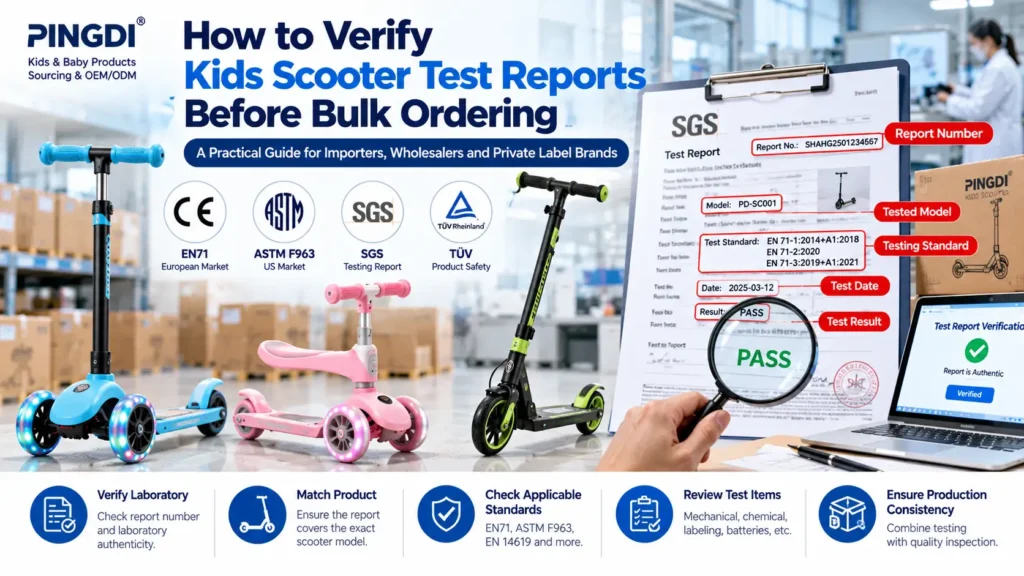
A practical compliance verification guide for importers, distributors, wholesalers and private-label kids scooter brands sourcing from China.
A kids scooter supplier sends you a quotation, product photographs and a PDF test report.
The report displays a recognized testing laboratory’s name, a report number and a PASS result.
Is that enough to approve a bulk order?
Not necessarily.
A test report may be genuine but relate to a different scooter model. It may cover only selected chemical tests, use a standard that does not apply to your destination market or describe a product configuration that has since been modified.
For importers purchasing wholesale kids scooters from China, verifying test reports is therefore more than checking whether a document looks professional.
Buyers need to establish three things:
- Authenticity: Was the report genuinely issued by the stated laboratory?
- Applicability: Does it cover the exact scooter model, materials and configuration being purchased?
- Compliance: Does the evidence address the requirements applicable to the intended market?
This guide explains how to verify kids scooter test reports before bulk ordering, identify common documentation problems and coordinate testing with manufacturing partners.
1. Why Kids Scooter Test Report Verification Matters
Children’s mobility products may involve mechanical, physical and chemical safety considerations.
Depending on the design, relevant concerns can include steering mechanisms, wheels, folding joints, sharp edges, accessible components, materials and labeling.
A supplier’s statement that a scooter is “EN71 certified” or “ASTM approved” does not establish that the product meets all applicable requirements.
Importers should request supporting documentation and evaluate what it actually demonstrates.
Common purchasing risks
Wrong-model documentation: A report covers a scooter with a different frame, steering mechanism or wheel configuration.
Incomplete testing: Only selected requirements were evaluated.
Outdated specifications: The product was modified after the sample was tested.
Unverified laboratory: The report’s origin or authenticity has not been confirmed.
Incorrect market classification: The supplier assumes that one standard applies to every children’s scooter.
Production inconsistency: Mass-produced goods differ from the approved and tested sample.
These problems can affect shipment approval, product compliance, customer confidence and after-sales performance.
A structured verification process helps buyers identify such issues before committing to large quantities.
2. Understand What a Test Report Actually Proves
A laboratory test report records testing performed on identified samples under specified conditions.
It typically includes information such as:
- Laboratory name and address
- Report number
- Applicant details
- Sample description
- Model identification
- Testing dates
- Referenced standards
- Test methods
- Results
- Conclusions
- Authorized report information
However, the meaning of a PASS result depends on the specific tests performed.
A report showing that a material passed selected chemical requirements does not necessarily demonstrate that the complete scooter passed all relevant mechanical and physical requirements.
Likewise, a report for one sample does not automatically establish that every future production unit is identical.
Importers should read the scope and results of the report, not just its conclusion page.
3. Step 1: Verify the Testing Laboratory
The first step is to establish whether the laboratory and report are authentic.
International buyers may encounter reports bearing names such as SGS, Intertek, TÜV Rheinland or Bureau Veritas.
These organizations operate testing and inspection services, but a familiar brand name alone is not sufficient evidence.
What buyers should check
Confirm the laboratory’s legal name, issuing location, report number and contact information.
Where the provider offers an official report verification service, use that service.
If necessary, contact the laboratory through contact details independently obtained from its official website.
Do not rely solely on telephone numbers, email addresses or QR codes printed on an unverified PDF.
Laboratory accreditation
Accreditation is another important consideration.
Buyers may need to verify whether the laboratory holds relevant ISO/IEC 17025 accreditation and whether the specific test methods fall within its accredited scope.
Accreditation should be checked through the relevant accreditation body or its official directory.
U.S. market considerations
For tests requiring a CPSC-accepted third-party laboratory, buyers should verify the laboratory’s acceptance for the relevant rule or test scope.
A laboratory may be accepted for some requirements but not others.
Key principle: Verify the laboratory’s authority for the required testing—not merely its commercial reputation.
4. Step 2: Match the Test Report to the Actual Scooter Model
One of the most important checks is whether the report covers the product being purchased.
For example, a supplier may provide a report for a standard three-wheel scooter while offering an OEM version with different wheels, handlebars or plastic components.
The two products may look similar, but that does not establish that the existing report covers the customized version.
Product matching checklist
| Item | What to Compare |
|---|---|
| Model number | Report vs quotation and product label |
| Product photographs | Report vs actual sample |
| Wheel configuration | Two-wheel or three-wheel design |
| Frame | Construction and relevant components |
| Steering system | Mechanism and configuration |
| Handlebar | Design and adjustment mechanism |
| Deck | Material and structure |
| Seat | Presence and attachment, if applicable |
| Materials | Relevant plastic, coating and other materials |
| Accessories | Included components |
| Intended age | Product documentation and classification |
Minor differences do not always require a completely new test program.
However, buyers should not independently assume that a change is irrelevant.
The appropriate testing laboratory or qualified compliance specialist should assess whether the existing evidence remains applicable.
5. Step 3: Check the Applicable Standard and Edition
Different markets may require different standards, regulations and conformity procedures.
Before reviewing the test results, determine which requirements apply to the actual product.
This is particularly important because not every scooter marketed for children is legally classified as a toy.
EN 71 and European toy scooters
EN 71 is a series of European toy safety standards.
Depending on the product’s classification, relevant parts may address mechanical and physical properties, flammability and certain chemical hazards.
However, buyers should not assume that EN 71 is the correct or complete framework for every scooter.
Some scooter designs may fall within a different product category and require a different standards assessment.
ASTM F963 and the U.S. market
For children’s toys within its scope, ASTM F963 is an important U.S. safety standard.
Importers should confirm the version incorporated into the applicable federal requirement for the product’s manufacturing date.
They should also determine which requirements apply to the scooter’s design.
EN 14619 and sports scooters
EN 14619 concerns kick scooters within its specified scope.
It should not automatically be substituted for toy safety requirements.
The product’s intended use, construction and classification must be evaluated before selecting a testing framework.
Comparison
| Standard | General Area | Important Limitation |
|---|---|---|
| EN 71 | Toy safety | Only relevant where applicable to the product |
| ASTM F963 | Toy safety | Scope and applicable edition must be confirmed |
| EN 14619 | Kick scooters within its scope | Not a universal replacement for toy requirements |
| Other market rules | Product-specific obligations | Depend on destination and classification |
A report using the wrong standard can be genuine yet insufficient for the intended import market.
6. Step 4: Review the Actual Test Items
A test report may contain many pages of results.
Importers should identify which requirements were evaluated and whether any relevant areas are missing.
Depending on the scooter design and applicable rules, testing considerations may include:
Mechanical and physical properties
These may involve relevant structural features, accessible edges, projections, mechanisms and components.
Wheels and steering
Testing or evaluation may address relevant wheel, axle and steering-related requirements.
Folding mechanisms
Foldable scooters may introduce additional mechanical considerations.
Material and chemical requirements
Applicable rules may address certain substances in accessible materials, coatings or components.
Labels and instructions
Warnings, identification information and instructions may be required depending on the product and market.
Battery-related features
Scooters with electronic lighting or batteries may require additional assessment.
The precise requirements depend on battery type, design and applicable legislation.
Recommended review table
| Test Area | Reported? | Applicable? | Action |
|---|---|---|---|
| Mechanical and physical properties | Check | Determine | Review results |
| Chemical requirements | Check | Determine | Review materials |
| Steering and wheels | Check | Determine | Review product scope |
| Folding mechanisms | Check | Determine | Review if applicable |
| Battery-related requirements | Check | Determine | Review if applicable |
| Labels and warnings | Check | Determine | Verify final artwork |
The purpose of this table is to organize the review, not to claim that every listed test is mandatory for every scooter.
7. Step 5: Check Test Dates and Product Changes
Importers sometimes ask whether a test report is still valid.
There is no universal expiration period that applies to every product test report.
A report’s continued usefulness depends on factors such as:
- Applicable regulatory requirements
- Standard edition
- Product design
- Materials
- Manufacturing arrangements
- Relevant product modifications
- Any specific certification or retailer requirements
A report issued several years ago is not automatically invalid solely because of its age.
However, it may no longer provide sufficient evidence if the product has changed or the applicable requirements have been updated.
Questions to ask the supplier
Has the frame design changed?
Have wheel materials or suppliers changed?
Has the steering mechanism been modified?
Are the plastics, coatings and other relevant materials unchanged?
Does the current production specification match the tested sample?
If important changes occurred, request a technical assessment of whether additional testing is needed.
8. Step 6: Distinguish Test Reports, Certificates and Declarations
These documents have different purposes.
Test report
Records the tests performed and their results.
Certificate
May be issued under a particular certification or regulatory scheme.
Its meaning depends on the issuing organization and the scheme involved.
Declaration of Conformity
A formal declaration by the responsible economic operator where required by applicable legislation.
Children’s Product Certificate
For applicable U.S. children’s products, a CPC is issued by the responsible manufacturer or importer based on supporting compliance evidence.
It is not simply another name for a laboratory report.
Why this matters
A supplier may provide a genuine test report but omit other documentation required for the destination market.
Importers should establish a complete documentation checklist rather than request a generic “safety certificate.”
9. Step 7: Verify OEM and Private-Label Modifications
OEM customization is common in wholesale kids scooter projects.
Buyers may request:
- Exclusive product colors
- Custom logos
- Different deck graphics
- Modified wheels
- New handlebar materials
- Retail packaging
- Additional accessories
- Alternative components
Not every change affects compliance in the same way.
For example, changing packaging graphics may raise different issues from changing a load-bearing component or accessible coating.
Recommended OEM verification process
Existing report review → Customization specification → Change assessment → Required additional testing → Approved production sample
The importer should retain a clear record of the approved configuration.
For private-label programs, the product identification, labels and supporting documents should consistently describe the final product.
This helps reduce the risk of using a report for a product that is materially different from the one being imported.
10. Step 8: Connect Test Reports with Pre-Shipment Inspection
A valid report does not replace production quality control.
The report relates to the tested sample and specified tests.
Pre-shipment inspection evaluates whether the manufactured goods meet the agreed product specifications and inspection criteria.
Both are useful, but they serve different purposes.
Practical inspection checkpoints
| Inspection Area | Verification |
|---|---|
| Model | Matches approved configuration |
| Materials | Match approved specifications |
| Wheels | Correct design and assembly |
| Steering | Correct operation |
| Deck | Correct construction |
| Folding system | Correct operation, if applicable |
| Fasteners | Correct installation |
| Labels | Correct product information |
| Packaging | Approved materials and artwork |
| Quantity | Correct SKU and color |
For larger orders, buyers may agree on third-party inspection arrangements.
If production changes are discovered, the importer should assess whether the existing test evidence remains applicable.
11. Common Warning Signs in Supplier Test Reports
Importers should investigate documentation that contains inconsistencies or missing information.
Examples include:
The supplier sends only the first page.
The full report is needed to review sample details, test methods and results.
The model number does not match the quotation.
Ask for a clear explanation and supporting evidence.
The product photograph is different.
Confirm whether the report covers the offered configuration.
The supplier cannot identify the issuing laboratory.
Verify the laboratory independently.
The report covers only one test category.
Determine whether other requirements apply.
The report is described as a universal certificate.
Clarify the actual test scope and applicable market.
The supplier refuses to discuss product changes.
Request a documented specification and change history.
Not every discrepancy proves that a report is fraudulent.
However, unresolved discrepancies should be addressed before order approval.
12. A Practical Test Report Verification Workflow
A structured process can make supplier evaluation more efficient.
Stage 1: Product identification
Confirm the exact scooter model, intended users, product configuration and destination market.
Stage 2: Document collection
Request complete test reports and relevant compliance documents.
Stage 3: Authenticity verification
Verify report details with the issuing laboratory where necessary.
Stage 4: Regulatory assessment
Determine the applicable rules, standards and required evidence.
Stage 5: Product matching
Compare the report against the actual sample and approved specification.
Stage 6: Gap resolution
Identify missing tests, inconsistent model information or changes requiring further assessment.
Stage 7: Production approval
Approve the final specification and establish change-control requirements.
Stage 8: Pre-shipment verification
Check that the finished goods match the approved configuration.
This workflow can be adapted to different product types and market requirements.
13. How PINGDI Supports Kids Scooter Compliance Coordination
Guangzhou Pingdi Technology Co., Ltd. is a China-based B2B sourcing and OEM/ODM project management partner specializing in children’s mobility products.
We work with suitable manufacturing partners to support importers, wholesalers, distributors and private-label brands.
PINGDI does not claim ownership of every factory involved in its sourcing projects.
Our role is to help buyers coordinate product requirements, supplier communication and agreed quality-control activities.
Product specification coordination
We help buyers document scooter models, materials, features and customization requirements.
Supplier documentation collection
We can coordinate requests for available test reports and product information from manufacturing partners.
Report discrepancy follow-up
When documentation does not match the proposed product, we can help communicate the questions requiring clarification.
Third-party testing coordination
Where additional testing is needed, we can help coordinate sample submission and communication with qualified testing providers.
OEM project management
We help manage communication regarding approved product changes, packaging and production specifications.
Quality inspection coordination
We can assist with agreed inspection arrangements before shipment.
Our objective is to help importers make better-informed purchasing decisions through organized sourcing and documentation management.
Final regulatory classification, certification responsibilities and market-entry obligations should be confirmed by the responsible economic operators and appropriately qualified specialists.
14. What Documents Should Importers Request Before Bulk Ordering?
A practical document checklist may include:
| Document | Purpose |
|---|---|
| Product specification sheet | Identify exact configuration |
| Product photographs | Support model matching |
| Complete test reports | Review tested scope and results |
| Laboratory information | Verify report origin and competence |
| Applicable compliance documents | Support market requirements |
| Label artwork | Verify required information |
| Instruction manual | Review use and warnings |
| Approved sample record | Establish production reference |
| Bill of materials or relevant component information | Support change assessment |
| Inspection requirements | Define production verification |
Not every document will be legally mandatory for every product.
The appropriate checklist should reflect the actual scooter and intended market.
15. Questions to Ask a Kids Scooter Supplier
Before placing a wholesale order, buyers can ask:
- Which exact scooter model was tested?
- Can you provide the complete report?
- Which laboratory issued it?
- Can the report number be independently verified?
- Which standards and editions were used?
- Which tests were performed?
- Does the report cover the offered product configuration?
- Have any materials or components changed since testing?
- Are additional tests required for our destination market?
- How will production consistency be controlled?
Clear answers can help buyers distinguish suppliers with organized documentation from those relying on generic compliance claims.
16. Frequently Asked Questions
How can I verify an SGS kids scooter test report?
Use the laboratory’s official verification process where available, or contact the issuing office using independently obtained official contact details.
Is an EN71 test report enough to import kids scooters into Europe?
Not necessarily. The product’s classification and all applicable EU requirements must be determined first.
Does ASTM F963 apply to every kids scooter?
No. Applicability depends on whether the product falls within the relevant toy safety requirements.
Can one test report cover several scooter colors?
Possibly, depending on the materials, test scope and documented assessment. Buyers should confirm coverage rather than assume it.
Does a PASS result mean the product is fully compliant?
Only with respect to the tests and criteria covered by that report. Other obligations may still apply.
Should importers retest after OEM customization?
That depends on the changes and applicable requirements. Relevant changes should be assessed by a qualified laboratory or compliance specialist.
Can PINGDI help coordinate third-party testing?
PINGDI can assist with communication and sample coordination with suitable testing providers according to the project requirements.
Conclusion: Verify the Product, Not Just the PDF
Before bulk ordering wholesale kids scooters, importers should verify more than the appearance of a laboratory report.
A reliable review should establish that the document is authentic, the tested sample matches the product being purchased and the testing evidence addresses the applicable market requirements.
For OEM and private-label projects, buyers should also consider how product changes affect the existing evidence and how production consistency will be checked.
Test report verification is an important part of professional sourcing—not a substitute for complete compliance assessment or production quality control.
Need Help Reviewing Kids Scooter Sourcing Documentation?
PINGDI supports international B2B buyers with kids scooter sourcing, OEM/ODM coordination, supplier documentation follow-up, third-party testing coordination and quality inspection arrangements.
Explore Wholesale Kids Scooters
Contact PINGDI for a Wholesale Quotation
Share your destination market, scooter model, estimated quantity and available product documentation so our team can discuss suitable sourcing and coordination options.