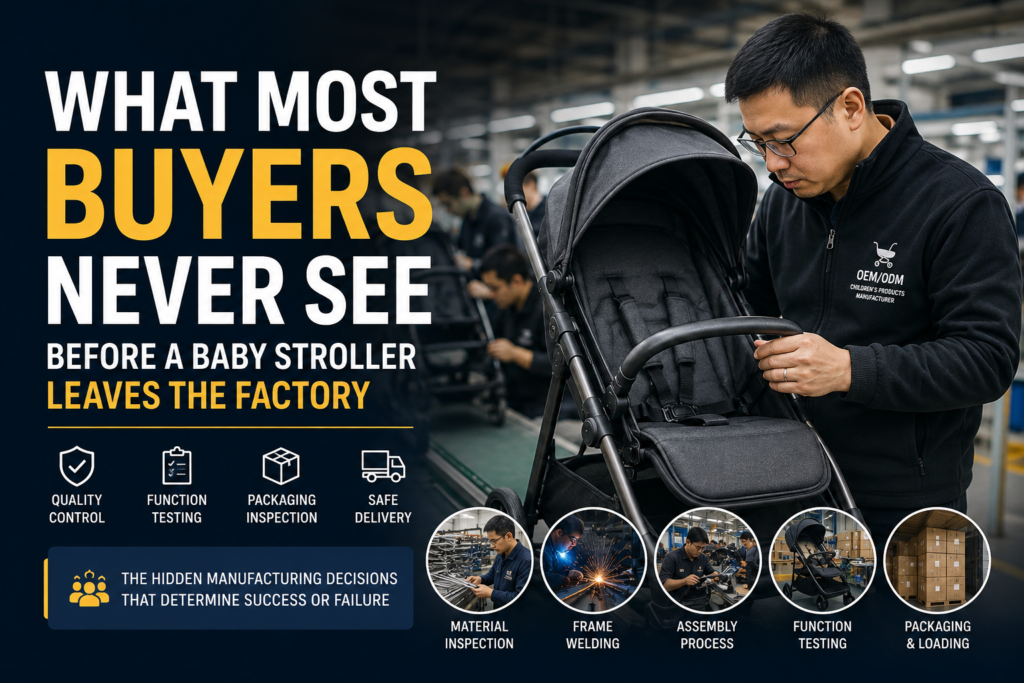
The hidden manufacturing decisions that determine whether your stroller project succeeds—or becomes an expensive lesson.
When international buyers visit our factory, they usually focus on the finished products.
They inspect the appearance.
They test the folding mechanism.
They check the wheels.
They compare fabrics.
Everything looks good.
But what most buyers never see is what happens during the weeks before a baby stroller is packed into a shipping container.
Ironically, this hidden part of the manufacturing process is where the success or failure of an order is decided.
In my experience working with overseas brands, importers, and distributors, quality problems rarely begin at final inspection.
They usually begin much earlier—during engineering, material selection, production planning, communication, or process control.
The good news is that most of these risks are preventable.
Here are the eight issues I believe every global buyer should understand before placing a baby stroller order.
1. The Product Looks Perfect—But the Process Is Not
One of the biggest misconceptions in sourcing is believing that a beautiful sample guarantees a successful production run.
It doesn’t.
Producing one showroom-quality sample is completely different from manufacturing 2,000 identical units.
Mass production depends on:
- Standard operating procedures
- Stable tooling
- Worker training
- Process consistency
- Quality checkpoints
A factory without a mature production system may produce an excellent sample while struggling to maintain the same quality during large-scale manufacturing.
Professional Recommendation
When evaluating a supplier, don’t only ask to see the sample.
Ask to see:
- The production line
- Assembly workflow
- Quality control process
- Standard operating procedures
A reliable process is more valuable than a perfect sample.
2. Quality Problems Usually Start With Raw Materials
Many buyers negotiate aggressively on price without asking how materials are selected.
This often becomes the first hidden risk.
For baby strollers, every component matters:
- Aluminum or steel frame
- Plastic connectors
- Wheel bearings
- Fabric density
- Foam materials
- Rivets
- Fasteners
Even when two strollers look identical, differences in raw materials can significantly affect durability, safety, and long-term customer satisfaction.
Professional Recommendation
Request a detailed material specification before production.
Ask suppliers how incoming materials are inspected and approved.
Strong quality starts long before assembly begins.
3. Communication Failures Create Expensive Mistakes
Surprisingly, many production issues are not technical—they are communication issues.
Common examples include:
- Incorrect logo placement
- Wrong fabric color
- Missing accessories
- Packaging artwork errors
- Barcode mistakes
- Shipping mark inconsistencies
These mistakes are rarely caused by a lack of manufacturing capability.
They happen because expectations were never documented clearly.
Professional Recommendation
For every project, establish a communication system that includes:
- Approved technical drawings
- Color references
- Packaging approvals
- Weekly production updates
- Written change confirmations
Good communication reduces risk more effectively than repeated corrections.
4. Quality Inspection Should Never Be Left Until the End
Many buyers hire a third-party inspector only after production has been completed.
By then, the factory has already invested materials, labor, and production time.
If defects are found, solutions become expensive.
Professional factories inspect products throughout production.
Our quality process typically includes:
Incoming Material Inspection
Checking every critical component before production.
In-Process Inspection
Monitoring assembly, wheel installation, brake function, and folding performance during manufacturing.
Final Inspection
Confirming appearance, function, packaging, labeling, and shipment readiness.
This layered approach prevents defects instead of simply discovering them.
5. Production Consistency Is More Important Than Production Speed
Fast production is attractive.
Consistent production is essential.
One issue buyers often overlook is process stability.
Questions worth asking include:
- Are work instructions standardized?
- Do operators receive regular training?
- How are production deviations recorded?
- How are recurring defects prevented?
Consistency is what allows every stroller in a shipment to meet the same standard—not just the first few units.
Professional Recommendation
Ask suppliers how they control process variation, not just production capacity.
A factory with stable systems is a safer long-term partner.
6. Packaging Is Part of Product Quality
Many buyers only evaluate the stroller itself.
However, damaged packaging creates a poor first impression before customers even open the carton.
Common export problems include:
- Weak cartons
- Incorrect pallet stacking
- Moisture exposure
- Compression damage
- Missing documentation
- Barcode errors
International transportation places significant stress on packaging.
Export packaging should be engineered—not improvised.
Professional Recommendation
Review packaging as carefully as you review the product.
Well-designed packaging reduces transportation damage and protects your brand image.
7. Compliance Should Begin During Product Development
Safety compliance is not something that can simply be added before shipment.
Baby strollers entering different markets must comply with different standards and labeling requirements.
Waiting until production is complete to address compliance often leads to:
- Retesting
- Redesign
- Delayed shipments
- Additional costs
Professional Recommendation
Discuss compliance requirements at the beginning of the project.
A professional manufacturer should integrate compliance considerations into product development—not treat them as a final step.
8. Great Suppliers Solve Problems Before Buyers Notice Them
Every factory encounters challenges.
The real difference lies in how they respond.
Professional manufacturers don’t wait for customers to discover defects.
They build systems that identify risks early, analyze root causes, implement corrective actions, and continuously improve future production.
This mindset transforms a supplier into a long-term manufacturing partner.
Professional Recommendation
During supplier evaluation, ask:
- How do you investigate quality issues?
- How do you prevent repeat problems?
- Can you provide examples of process improvements?
The answers often reveal far more than a price quotation.
What Successful Buyers Do Differently
Over the years, I’ve noticed that experienced buyers share several common habits.
They don’t simply compare prices.
They evaluate manufacturing capability.
They invest time in understanding production systems.
They ask detailed technical questions.
They value transparency.
Most importantly, they choose suppliers who are committed to continuous improvement rather than short-term transactions.
These buyers rarely experience major production failures—not because they are lucky, but because they make better sourcing decisions from the beginning.
Final Thoughts
When a baby stroller leaves the factory, buyers usually see only the finished product.
What they don’t see are the hundreds of decisions that shaped it:
- Material selection
- Engineering reviews
- Tool maintenance
- Operator training
- Process inspections
- Functional testing
- Packaging verification
- Final quality approval
Every one of these steps influences the quality, safety, and reliability of the product that eventually reaches parents and children.
In my view, successful manufacturing is not about producing more strollers.
It is about reducing uncertainty for every customer.
That means preventing problems before they happen, communicating transparently throughout the project, and continuously improving every stage of production.
Because at the end of the day, buyers don’t simply choose a factory.
They choose a partner they can trust to protect their brand.
Let’s Start a Conversation
If you import or source baby strollers internationally, I’d like to hear your perspective.
Which issue has caused the biggest challenge in your sourcing experience?
- Product consistency?
- Communication?
- Delivery delays?
- Compliance?
- Packaging?
- Something else?
Share your thoughts in the comments. Your experience may help another buyer avoid the same mistake.